From "Just One Rose" to "Yes, I'll Take the Whole Arrangement" — The Art of the Floral Upsell
Let's be honest: someone walks into your flower shop asking for a single stem, and somewhere deep in your floral-scented soul, you know that with just a little guidance, they'd happily walk out with a gorgeous curated arrangement, a vase, and maybe a box of chocolates to go with it. The gap between what a customer thinks they want and what they'd actually love is where your revenue lives — and most florists are leaving serious money on the table by not bridging it.
Upselling in a floral business isn't about being pushy. It's about being helpful. Customers often don't know what's possible, what's in season, or what combinations will make their recipient weep with joy (the good kind). Your job — and the job of everyone on your team — is to gently illuminate the possibilities. This guide will show you how to do exactly that, from the moment a customer steps through your door to the follow-up that keeps them coming back.
Understanding the Psychology Behind the Floral Purchase
Before you can upsell effectively, you need to understand why people buy flowers in the first place. Spoiler: it's almost never purely transactional. Flowers are emotional purchases — they communicate love, apology, celebration, sympathy, and everything in between. That emotional context is your greatest upselling asset.
Occasion-Driven Buying Behavior
According to the Society of American Florists, the top occasions driving floral purchases include Valentine's Day, Mother's Day, funerals, weddings, and "just because" gifting. Each occasion carries a different emotional weight, budget expectation, and openness to upselling. A customer buying anniversary flowers is in a very different headspace — and price bracket — than someone grabbing a get-well bouquet on the way to the hospital.
Train yourself and your staff to ask one simple question early in the conversation: "What's the occasion?" That one question unlocks everything. It tells you the budget ceiling, the emotional tone, and the upsell pathway. A wedding anniversary? Float the idea of adding a premium vase or a subscription arrangement. A sympathy purchase? Suggest a longer-lasting arrangement or a plant they can keep. A "just because" bouquet? That's prime territory for adding a small gift item or a handwritten card service.
The Perception of Value vs. Price
Here's something every florist should internalize: customers often want to spend more — they just need permission and a compelling reason. Research in consumer psychology consistently shows that when people are buying gifts, they tend to associate higher price with higher care and thoughtfulness. A $75 curated arrangement signals more love than a $20 bunch of carnations, even if the recipient would appreciate either.
The trick is framing. Instead of saying "Would you like to add more flowers?" try "Would you like me to build this into something really special?" The word "special" does a lot of heavy lifting. So does showing rather than telling — keep a few showcase arrangements at different price points visible near your counter so customers can see exactly what "upgraded" looks like.
Practical Upselling Strategies That Actually Work
Now for the part you came here for. These aren't theoretical concepts — these are real, tested approaches that florists use to increase average transaction value without making customers feel like they're being sold to.
The "Good, Better, Best" Presentation
One of the most effective upselling frameworks in retail is the three-tier offer. Present every customer with three options: a solid entry-level choice, a mid-range option with clear added value, and a premium option that genuinely wows. The magic here is that most people will land on the middle option — but a meaningful percentage will spring for the top tier when they see it laid out clearly.
For example: a single stem rose at $6, a hand-tied bouquet of a dozen mixed flowers at $45, and a fully curated seasonal arrangement in a keepsake vase at $85. When presented this way, the $45 option suddenly feels like the responsible, reasonable choice — and the $85 option becomes aspirational rather than extravagant. Price anchoring is a beautiful thing.
Add-Ons That Feel Natural, Not Forced
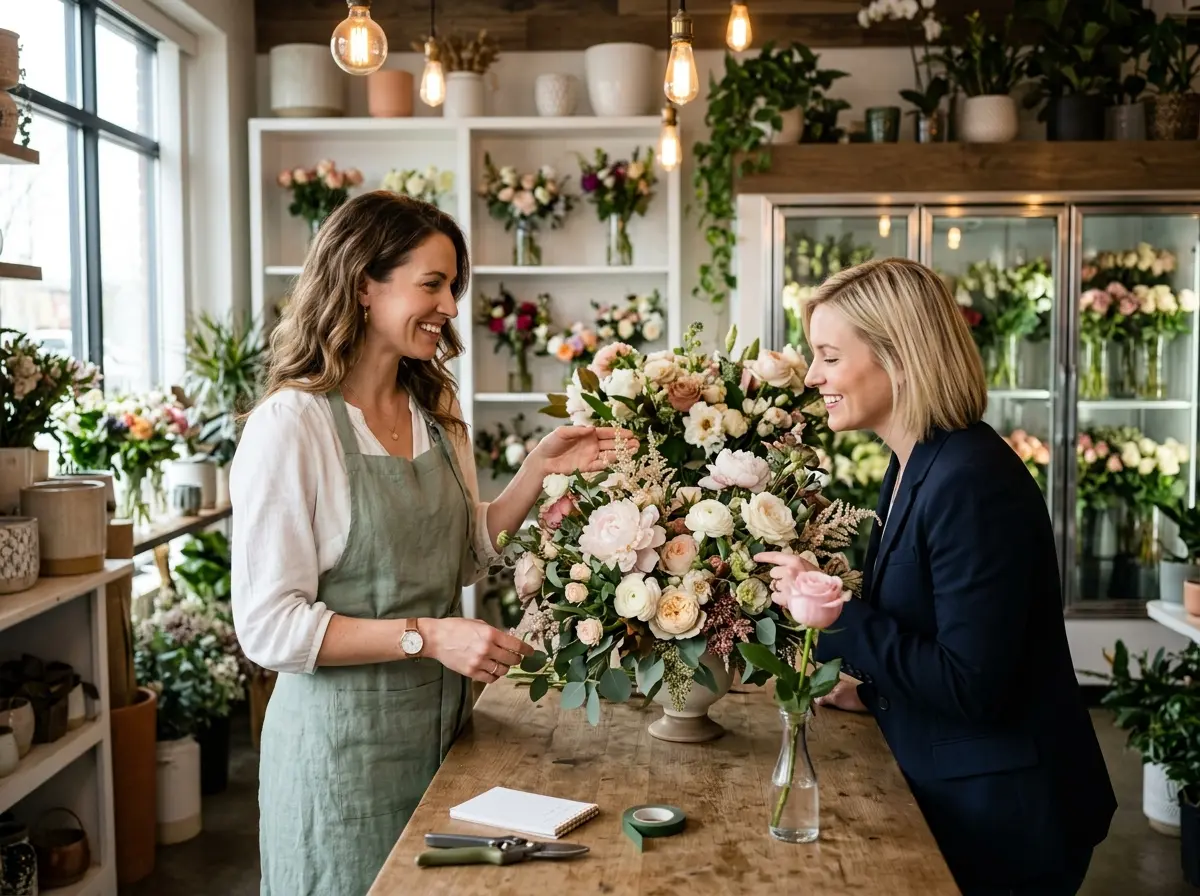
The best add-ons feel like they belong with the purchase. Think vases, care cards, ribbon upgrades, chocolates, candles, greeting cards, or even a small succulent. The key is to introduce them as complements, not extras. "I have a beautiful hand-blown glass vase that would be perfect for these peonies — would you like to see it?" feels like genuine service. "Do you want to add anything?" feels like a checkout prompt.
Consider creating pre-packaged "experience bundles" — an arrangement plus a candle plus a box of chocolates, priced slightly lower than buying each individually. Bundles reduce decision fatigue, increase perceived value, and almost always outperform individual add-on asks. Label them with evocative names like "The Romance Bundle" or "The Celebration Package" and watch them sell themselves.
Subscriptions and Recurring Arrangements
If you're not offering flower subscriptions, you're leaving recurring revenue on the floor. Weekly or monthly arrangement subscriptions are a win for customers (fresh flowers without the effort) and an absolute win for your cash flow. Introduce the idea at the end of a positive transaction: "We also offer a monthly subscription — fresh seasonal arrangements delivered or ready for pickup. A lot of our regulars love it for their offices or dining tables."
You don't need a sophisticated system to start. A simple sign-up sheet, a basic intake form, or even a QR code linking to your booking page is enough to get going. Once customers experience the convenience, the retention rate is remarkably high.
How Technology Can Handle the Upsell Conversation for You
Even the most charming florist can't be everywhere at once. You've got arrangements to build, deliveries to coordinate, and — let's face it — a constant stream of phone calls asking if you have red roses on Valentine's Day (you do, you always do). This is where smart tools make a real difference.
Letting AI Do the Legwork on Inquiries and Promotions
Stella, the AI robot employee and phone receptionist, is designed specifically for moments like these. In your shop, she stands as a friendly kiosk presence — greeting customers who walk in, answering questions about seasonal offerings, and proactively mentioning current promotions or featured arrangements before a human staff member is even available. She's essentially a knowledgeable team member who's always "on," never on break, and never forgets to mention the Valentine's bundle special.
On the phone side, Stella answers calls 24/7 with the same product knowledge she uses in person — so when someone calls at 9 PM wondering what anniversary arrangements you offer, she doesn't just read off a price list. She engages, recommends, and can even collect customer information for follow-up. For florists who lose sales simply because no one picked up the phone, this alone is a game-changer.
Training Your Team to Upsell With Confidence
Technology and strategy only go so far. At the end of the day, the human interactions in your shop are where upselling either thrives or fizzles. A well-trained team that genuinely believes in your products will upsell naturally — and a team that feels awkward about it will avoid the conversation entirely.
Scripts That Don't Sound Like Scripts
The fastest way to kill an upsell opportunity is to sound like you're reading from a laminated card. Instead, give your team frameworks — not word-for-word scripts, but conversational patterns that guide the interaction. Something like: acknowledge the occasion, make a personalized recommendation, present an upgrade option, and offer an add-on. That's four beats, not four sentences. How they fill those beats should sound like them, not a corporate training manual.
Role-play these conversations during slow periods. Have staff practice on each other until the recommendations feel natural. The goal is for every upsell to feel like genuine advice from a knowledgeable friend — because in your shop, it should be.
Incentivizing the Right Behaviors
If you want your team to upsell consistently, give them a reason to care beyond general professionalism. Consider a small commission structure on add-ons, a team bonus when weekly revenue hits a target, or even a friendly competition with a visible leaderboard. You don't need to break the bank — recognition and small rewards go a long way in retail environments where margins are already tight.
More importantly, track what's working. Which add-ons are being suggested and accepted most often? Which arrangements are generating the most upgrades? This data tells you where to focus your training, your merchandising, and your promotional energy. If lavender bundles are flying off the shelf when paired with candles, that's a bundle waiting to be officially created and promoted.
A Quick Word About Stella
Stella is an AI robot employee and phone receptionist that works in your shop as a kiosk and answers your phone calls around the clock — all for $99/month with no upfront hardware costs. She greets customers, promotes your specials, answers product questions, and keeps your staff free to do what they do best. Whether you're a solo florist or running a full shop, she's the team member who's always ready, always consistent, and never calls in sick on Mother's Day.
Start Upselling Like You Mean It
The path from a single stem to a curated arrangement isn't a hard sell — it's a conversation. It starts with understanding why your customer is there, moves through genuine recommendations that serve their needs, and ends with them walking out feeling like they made exactly the right choice (because they did). That's not manipulation; that's good floristry.
Here's what to do this week: review your current product lineup and identify your three-tier offering for your most common purchase occasions. Create one bundle package with a compelling name and price it to feel like a deal. Brief your team on the occasion-first conversation framework. And if your phone is going unanswered after hours — or your in-store greeting experience is inconsistent — it's worth exploring how a tool like Stella can quietly fill those gaps while you focus on the craft.
Your customers came in for flowers. With the right approach, they'll leave with an experience — and they'll be back next time without hesitation.