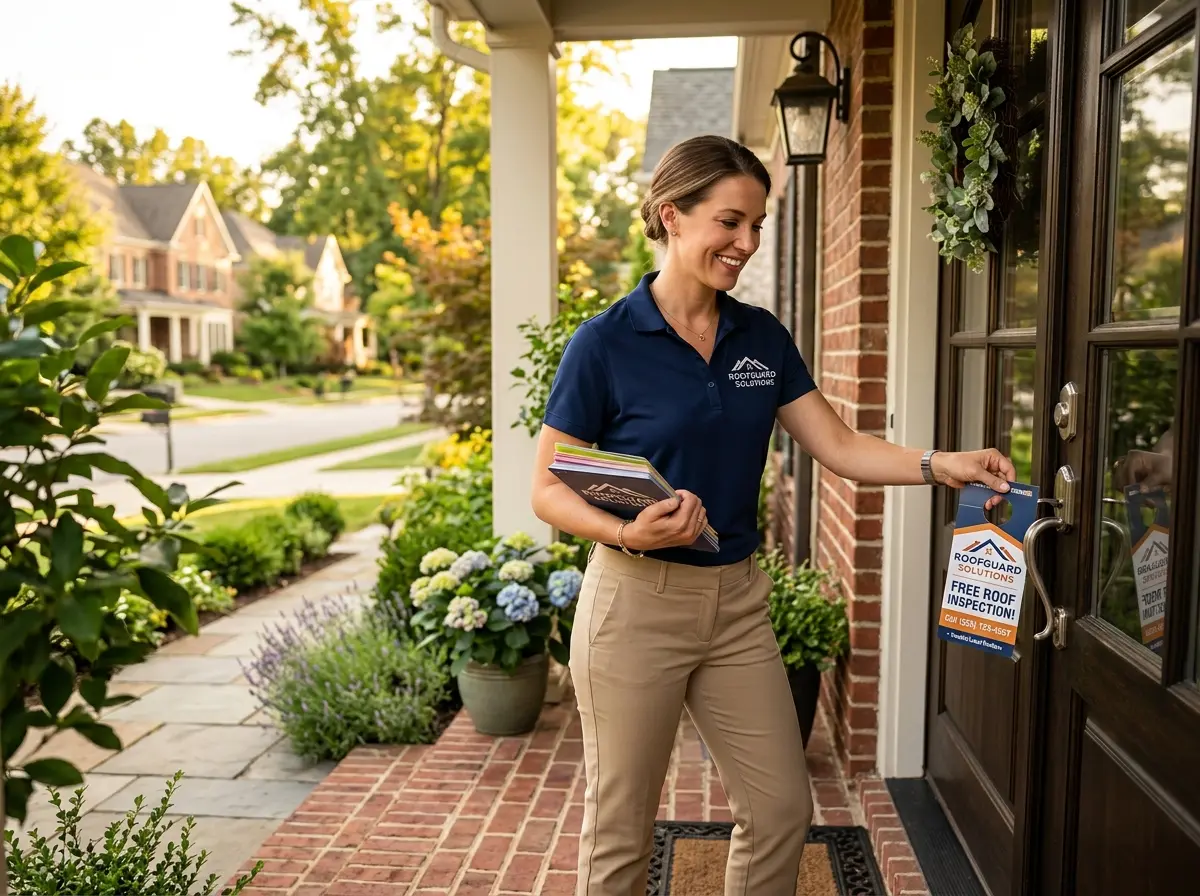
So You've Decided to Knock on Every Door in the Neighborhood
Good. Literally. Door-hanger campaigns are one of the most underrated, boots-on-the-ground marketing tools a roofing company can use — and yet most contractors either skip them entirely or execute them so poorly that they might as well be handing out blank paper. The good news? When done right, a well-planned door-hanger campaign can generate a surprisingly strong return on investment, fill your pipeline during slow seasons, and get your brand in front of homeowners who didn't even know they needed a new roof yet.
The bad news? There's a right way and a very, very wrong way to do this. Slapping your logo and phone number on a piece of cardstock and calling it a day is the marketing equivalent of showing up to a job interview in flip-flops. It technically counts, but don't expect a callback.
This guide breaks down exactly how to run a door-hanger campaign that generates real leads — not just a pile of door hangers in recycling bins across your target neighborhood.
Building a Campaign That Actually Works
Target the Right Neighborhoods (Not Just the Closest Ones)
The biggest mistake roofing companies make with door-hanger campaigns is treating every neighborhood like it's equally worth their time. Spoiler: it's not. Before you print a single door hanger, do your homework. Focus on neighborhoods where your services make sense right now — areas that recently experienced a hail storm or heavy winds are goldmines, since homeowners in those areas are already thinking about their roofs whether they know it or not.
Beyond storm data, look for neighborhoods with homes that are 15–25 years old. That's prime roofing age. Many insurance and remodeling industry reports suggest the average asphalt shingle roof lasts between 20 and 30 years, which means a neighborhood built in the early 2000s is full of homeowners who are sitting on a ticking clock. Use tools like your county's GIS mapping system or services like EagleView to identify target zones before you deploy your team.
Also, pro tip: if you just finished a roof in a neighborhood, that is your highest-value target zone. Studies in home services marketing consistently show that neighborhoods where recent work has been completed convert at significantly higher rates. You already have social proof baked right into the block — use it.
Design Door Hangers That Don't Look Like They Were Made in 2007
Your door hanger is a physical representative of your brand. If it looks cheap, rushed, or confusing, homeowners will assume your roofing work looks the same way. Invest in professional design — or at minimum, use a high-quality template from a platform like Canva or Vistaprint's design tools — and stick to a few core principles.
Keep the message focused. You have about three seconds of a homeowner's attention before they decide to read or toss it. Lead with a strong, benefit-driven headline like "Your Neighbors Just Got a Free Roof Inspection — You Should Too" or "Storm Damage in [Neighborhood Name]? We're Already in the Area." Personalization and urgency work. Generic slogans do not.
Include a clear call to action (one, not five), your license number for credibility, a QR code that links to a dedicated landing page, and a limited-time offer if you have one. Keep the visual hierarchy clean: headline, offer, proof, call to action. That's it. Resist the urge to cram your entire service menu onto a 4x9 piece of paper.
Train Your Distribution Team Like You Mean It
The people hanging your door hangers are representing your company whether they realize it or not. A crew member who looks disheveled, leaves hangers on the ground, or ignores a homeowner who comes to the door can do more damage than good. Brief your team before deployment. Dress them in branded shirts. Give them a simple two-sentence pitch in case a homeowner engages them directly.
Track which streets were covered and when, and never — never — double-hang the same address within a short window. Nothing annoys a homeowner more than finding two of your hangers on the same door in the same week. It doesn't signal enthusiasm; it signals disorganization.
Converting Leads Before They Go Cold
Speed Is Everything When Leads Call In
Here's a hard truth: the average homeowner who calls a roofing company after receiving a door hanger will try two or three competitors if they don't get a response quickly. According to a widely cited lead response study by Harvard Business Review, companies that respond to inbound leads within an hour are nearly seven times more likely to qualify that lead than those who wait even a few hours. In roofing, where decisions can be emotionally driven by storm anxiety or urgency, that window is even tighter.
This is where a lot of roofing companies quietly hemorrhage the leads they worked hard to generate. The door hangers go out, the phone rings, and nobody picks up — or worse, the call goes to a voicemail that nobody checks until Tuesday. Your marketing budget just funded your competitor's next job.
How Stella Can Help You Capture Every Lead
Stella is an AI robot employee and phone receptionist that answers every call, 24/7, with the same knowledge and professionalism you'd expect from your best front-desk staff — without the sick days or the "I didn't hear my phone" moments. When a homeowner calls after finding your door hanger at 9 PM on a Sunday, Stella picks up, answers their questions about your services, collects their contact information through a conversational intake form, and logs everything into her built-in CRM so your team can follow up first thing Monday morning — with full context already in hand.
For roofing companies running active door-hanger campaigns, this kind of always-on lead capture isn't a luxury — it's a competitive advantage. You put in the legwork to get that homeowner to call. Stella makes sure that call doesn't disappear into the void.
Measuring Results and Scaling What Works
Set Up Tracking Before You Distribute a Single Hanger
If you can't measure it, you can't improve it — and "we got some calls" is not a measurement strategy. Before your campaign launches, set up dedicated tracking so you know exactly which efforts are driving results. Use a unique phone number (call tracking services like CallRail make this easy and affordable) on your door hangers that's different from your main business line. Create a dedicated landing page for your QR code so you can track digital engagement separately from phone calls.
Tag your leads in your CRM by campaign source — neighborhood, date, and offer. Over time, this data tells you which neighborhoods convert best, which offers resonate, and what your true cost-per-lead is. That last number is critical. If you distributed 2,000 hangers at $0.35 each and generated 18 qualified leads, your cost-per-lead is about $39. Compare that to your digital advertising costs, and you might be pleasantly surprised.
Optimize Your Offer Based on Real Data
Not all offers perform equally, and the only way to find out what works for your market is to test. Run two variations of your door hanger in adjacent neighborhoods — same design, different headline or offer — and track which one generates more inbound contacts. This kind of simple A/B testing is almost never done in local service marketing, which means the roofing companies that do it quietly pull ahead of their competitors without anyone noticing why.
Common high-performing offers in roofing door-hanger campaigns include free inspections (especially post-storm), referral incentives tied to recent local jobs, financing promotions, and limited-time discounts framed around a specific event or season. Avoid vague offers like "great prices" or "quality you can trust." Every contractor says that. Homeowners have become impressively good at ignoring it.
Build a Follow-Up Sequence That Doesn't Creep People Out
A homeowner who calls for a free inspection but doesn't immediately book isn't a dead lead — they're a warm one. Build a simple follow-up sequence: a text or email within 24 hours of their inquiry, a follow-up call three days later, and one final touch a week out. Keep it helpful, not pushy. Reference what they asked about. If they called because of storm damage concerns, your follow-up should speak directly to that — not blast them with a generic promotional email about gutters.
The roofing companies that win long-term don't just chase the immediate close. They build a reputation for being responsive, organized, and genuinely helpful. That reputation is what fills your pipeline with referrals — which are, not coincidentally, the cheapest leads you'll ever generate.
A Quick Reminder About Stella
Stella is an AI robot employee and phone receptionist built for businesses that can't afford to miss a lead — which, frankly, is every business. She answers calls around the clock, collects lead information through natural conversation, manages contacts through a built-in CRM, and keeps your team informed without adding to their workload. For roofing companies running active outreach campaigns like this one, Stella runs at just $99/month with no upfront hardware costs — and she never calls in sick right before your busiest season.
Your Next Steps Start Before the Hangers Even Go Out
A great door-hanger campaign isn't about printing something and hoping for the best. It's a system — one that starts with smart targeting, uses compelling creative, deploys a professional and prepared team, and then has the infrastructure ready to capture and convert every lead that comes in as a result.
To put it simply: identify your target neighborhoods based on home age and recent storm activity. Design door hangers with a clear, single call to action and a trackable response method. Train and equip your distribution team to represent your brand well. Set up tracking before a single hanger goes up. And make sure someone — or something — is ready to answer the phone when those homeowners call.
The roofing market is competitive. The companies that grow consistently aren't necessarily the ones with the biggest budgets or the flashiest trucks. They're the ones that execute the fundamentals better than everyone else and treat every lead like it cost them something — because it did. Now go hang some doors.