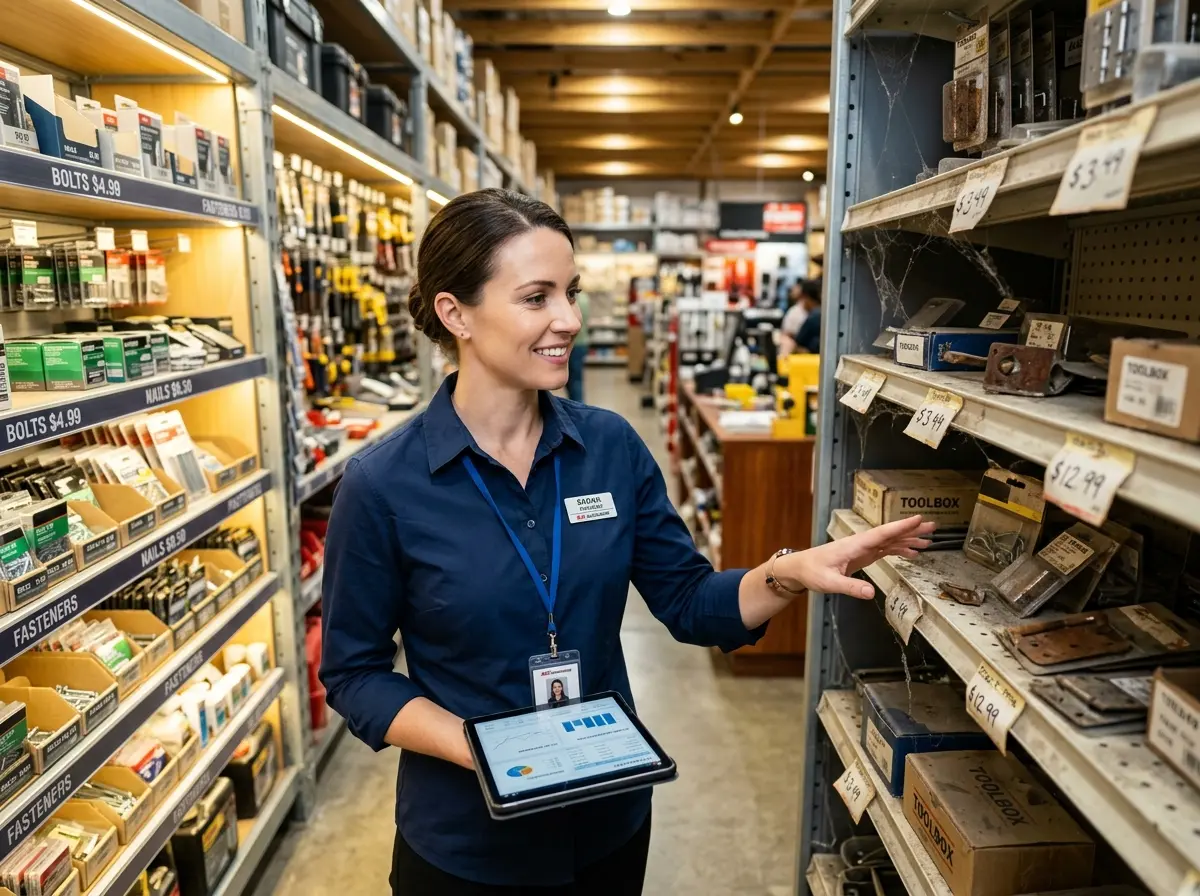
Introduction: The Slow Death of Inventory You Forgot You Had
Take a walk through your hardware store. Really walk it — past the busy lumber section, past the paint department, past the seasonal aisle. Now look at that shelf in the back corner. You know the one. The shelf where products go to collect dust, lose relevance, and silently drain your profits while you're busy running everything else. That's dead stock, and if you haven't dealt with it yet, congratulations — you're not alone, and also, it's costing you money every single day.
Dead stock isn't just an eyesore. It's cash you already spent, sitting on a shelf, doing absolutely nothing for you. According to industry estimates, excess and obsolete inventory can account for 20–30% of a retailer's total inventory value, which means that dusty corner of your store might be quietly eating into margins you've worked hard to build. For hardware stores especially — where product lines are vast, seasonal items are everywhere, and trends shift with every new home improvement craze — dead stock is practically a rite of passage. But it doesn't have to be your permanent reality.
This guide is here to help you identify what's killing your shelf space, move product that's been sitting long enough to have its own postal address, and put smarter systems in place so history doesn't keep repeating itself. Let's get into it.
Understanding Dead Stock: How It Happens and Why It Hurts
The Usual Suspects Behind Dead Inventory
Dead stock doesn't appear overnight. It accumulates gradually, the result of small decisions made under pressure, incomplete data, or — let's be honest — a touch of optimism that didn't quite pan out. You bought 200 units of a specialty fastener because the distributor offered a great deal. You stocked up on a particular brand of power tool before learning the manufacturer was discontinuing the line. You over-ordered seasonal items because last year was a record year for decks. Sound familiar?
Common culprits in hardware retail include over-purchasing to hit bulk discount thresholds, buying based on gut instinct rather than sales data, failing to track slow-moving SKUs consistently, and not responding quickly enough when a product starts losing momentum. Supplier minimum order requirements don't help either — sometimes you're forced to buy more than your market actually needs just to get the item on your shelf at all.
What Dead Stock Actually Costs You
Beyond the obvious — capital tied up in product that isn't moving — dead stock carries a surprising number of hidden costs that many hardware store owners underestimate. There's the physical space cost: every square foot of shelving occupied by a non-moving product is space that could be stocked with something customers actually want. There's the labor cost of counting, managing, and reorganizing inventory that never sells. There are potential markdowns and write-offs if items deteriorate or become obsolete. And there's the opportunity cost of not having the right product mix to drive repeat visits and strong word-of-mouth.
If your hardware store generates $500,000 in annual revenue and 25% of your inventory is dead stock, you could easily be looking at tens of thousands of dollars in frozen capital — money that could be reinvested in faster-moving products, store improvements, or marketing.
Identifying Dead Stock Before It Becomes a Crisis
Most hardware store owners know what's not selling — they just don't always look at the data formally. Set a threshold: any SKU that hasn't sold a single unit in 90 days deserves a review. Any SKU with no movement in 180 days is dead stock by most definitions. Your POS system should be generating this report for you monthly, and if it isn't, that's your first action item. Regularly auditing slow-moving inventory gives you the chance to take action while you still have options — discounting, bundling, returning to supplier, or donating — before the product becomes worthless.
Smart Tools That Help Hardware Stores Stay Ahead
How Stella Can Help You Move Inventory and Engage Customers
Here's where technology can genuinely earn its keep. Stella is an AI robot employee and phone receptionist that works both as an in-store kiosk and a 24/7 phone answering solution — and for hardware stores dealing with slow-moving inventory, she can be a surprisingly practical asset. Standing right inside your store, Stella proactively greets customers and can actively promote specific products, bundles, or clearance deals that you're trying to move. Instead of hoping a customer wanders past your overstock corner, she can bring it to their attention in a natural, conversational way — recommending complementary items, highlighting current promotions, and cross-selling in the moments that matter most.
Stella also answers phone calls around the clock with the same product and promotional knowledge she uses in person, so if a customer calls to ask what's on sale or whether you carry a specific item, she handles it without pulling a staff member away from the floor. She collects insights about what customers are asking about and how promotions are landing — data that can help you make smarter buying decisions going forward. At $99/month with no upfront hardware costs, it's one of the more straightforward ways to add a consistent, revenue-supporting presence to your store without adding headcount.
Strategies to Actually Move Dead Stock Out the Door
Discounting and Bundling: The Classics, Done Right
The most immediate way to move dead stock is to make it irresistible to buy. Strategic discounting — not panicked slashing — is the key word here. Start with a modest markdown, 15–20%, and give it a few weeks. If the product still isn't moving, escalate. Create urgency with time-limited promotions or "while supplies last" messaging. For hardware stores, bundling is particularly effective: pair a slow-moving specialty caulking gun with a popular brand of caulk and sell them together at a slight discount. Customers love the perceived value, and you move two products instead of one. Think creatively about what items naturally belong together and build those pairings around your stuck inventory.
Creative Merchandising and Placement Changes
Sometimes dead stock is dead simply because nobody sees it. Moving a product from a back corner to an end cap near the register, or placing it next to a fast-moving complementary item, can meaningfully increase visibility and sales without a single dollar of discounting. Signage matters too — a well-placed "Did you know we carry this?" sign near a related product category can drive discovery. Consider creating a dedicated clearance section that customers actively seek out, especially bargain-minded DIYers who come in specifically looking for deals. Merchandising isn't magic, but it's often the lowest-cost lever you haven't pulled yet.
Returns, Donations, and the Write-Off Option
Not everything will sell, and that's worth accepting. Before writing a product off entirely, check your supplier agreements — many distributors allow returns within certain windows, sometimes with a restocking fee that's well worth paying to free up capital. Local contractor programs, trade schools, and community organizations sometimes accept hardware donations and may provide a tax receipt that partially offsets your loss. As a last resort, liquidation through discount retailers or online marketplaces like eBay or Facebook Marketplace can recover at least some value. The goal is to get the inventory off your books and out of your space — sitting on it longer is rarely the better financial outcome.
Preventing Dead Stock From Coming Back
Buying Smarter with Better Data
The best dead stock strategy is the one that stops it from accumulating in the first place. That starts with disciplined, data-driven purchasing. Review your sales velocity reports before every reorder. Understand which categories are genuinely seasonal versus perennially slow. Work with suppliers to negotiate smaller minimum order quantities where possible — the bulk discount rarely makes sense if you end up holding half the units for two years. Many hardware store owners have found success with a "test and reorder" approach: bring in a smaller quantity of a new product, see how it performs over 60–90 days, and scale up only if the data supports it. This alone can dramatically reduce the volume of new dead stock entering your store.
Building a Culture of Inventory Accountability
Dead stock is often a people and process problem as much as a purchasing problem. Make inventory performance a regular agenda item in your operations — review slow-moving SKUs monthly, assign ownership of clearance initiatives, and make sure your team understands which products need attention. Empowering floor staff to flag items that customers consistently overlook or ask negative questions about gives you early warning signals long before the 90-day threshold kicks in. Small habits — consistent cycle counts, timely data entry, proactive reorder point reviews — compound into meaningfully healthier inventory over time.
A Quick Reminder About Stella
Stella is an AI robot employee and phone receptionist built for businesses like yours — standing in-store to greet and engage customers, and answering phone calls 24/7 with full knowledge of your products, promotions, and policies. She helps hardware stores promote clearance deals, cross-sell related items, and handle customer questions without pulling staff away from more important work. At $99/month with no hardware costs and an easy setup, she's ready to work the moment you need her.
Conclusion: Stop Letting Dust Collect on Your Profits
Dead stock is one of those problems that feels manageable right up until it isn't — and by the time it becomes a crisis, you've already lost significant money. The good news is that the path forward is straightforward, even if it's not always easy: identify what's not moving, take deliberate action to clear it out, and put smarter systems in place to prevent the cycle from repeating.
Here's your actionable starting point. This week, pull a 90-day no-sale report from your POS system and identify your top 10 dead stock SKUs. For each one, decide on a specific action: discount, bundle, move to a new location, return to supplier, or write off. Set a 30-day deadline for each decision and hold yourself to it. Then look at your purchasing process and identify one change — a tighter reorder point, a reduced minimum, a smarter review cadence — that you can implement before your next buying cycle.
Your shelves should be working for you. Every inch of space, every dollar of inventory, every product you carry is either contributing to your revenue or quietly costing you. Clear the dust, reclaim the capital, and reinvest in what actually sells. Your future self — the one with healthier margins and a much tidier back corner — will thank you.