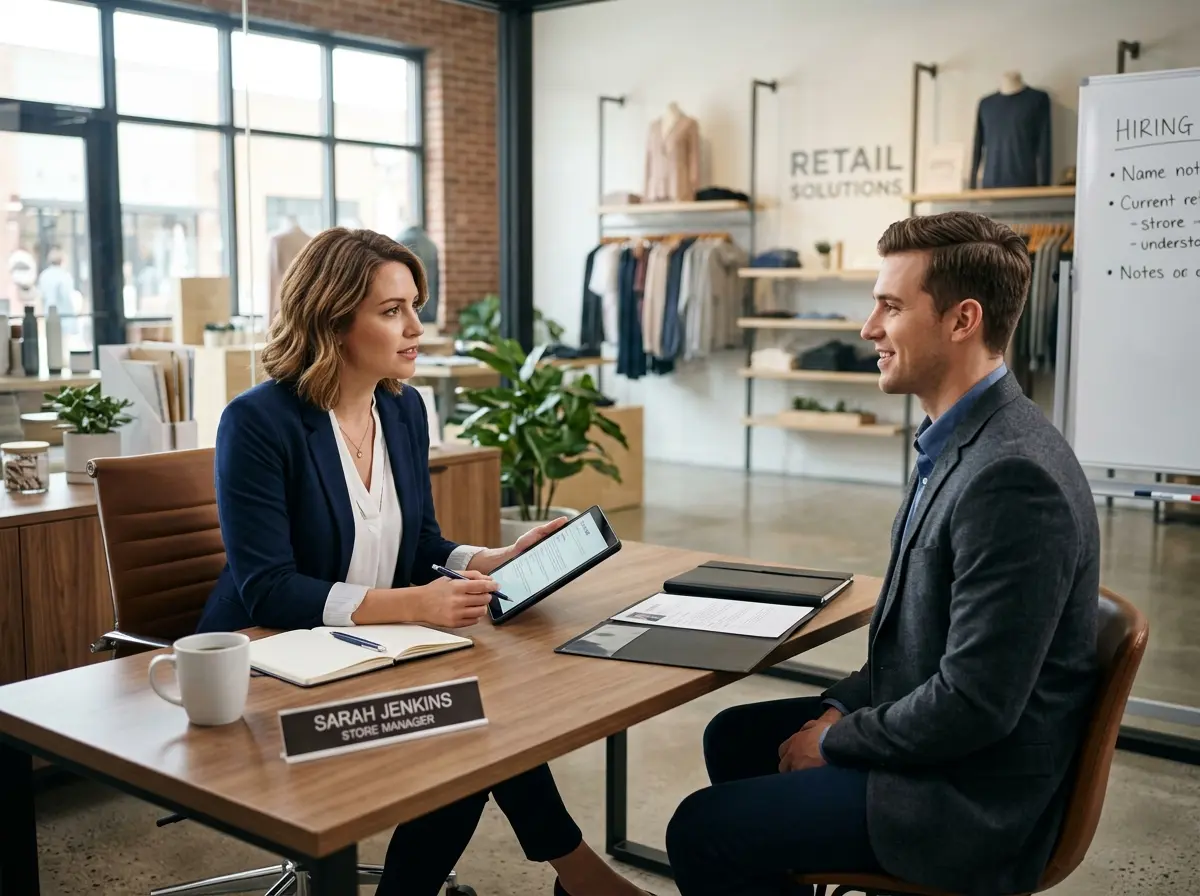
So, You Need to Hire a Retail Employee (Again)
Welcome back to the hiring rodeo — where the stakes are high, the applicant pool is unpredictable, and your best candidate from last Tuesday just texted to say they "found something else." If you're a retail manager or business owner who's been through a few hiring cycles, you already know the uncomfortable truth: a bad hire costs you more than a vacant position ever will. According to the U.S. Department of Labor, a bad hire can cost up to 30% of that employee's first-year earnings. For a $35,000-a-year employee, that's over $10,000 down the drain — not counting the stress, the retraining, and the three other team members who quietly updated their resumes in protest.
The good news? Most bad hires aren't accidents. They're the result of interviews that felt more like casual chats than structured evaluations. The fix isn't hiring harder — it's hiring smarter. And that starts with asking the right questions before you hand anyone a name tag.
Why Most Retail Interviews Fall Flat
The "Tell Me About Yourself" Trap
Let's be honest — asking someone to "tell you about themselves" at the start of an interview is the conversational equivalent of a vending machine. You put something in, you get something rehearsed out. Candidates have been coached on this question since high school. It doesn't reveal how they handle an angry customer, how they perform under the pressure of a holiday rush, or whether they'll actually show up on time. Generic questions produce generic answers, and generic answers lead to generic hires who may or may not ghost you before their first shift.
Focusing on Experience Over Behavior
Experience matters, of course — but it's a résumé item, not a performance predictor. A candidate who worked at a big-box retailer for three years might have spent most of that time hiding in the stockroom. What you actually need to uncover is behavioral evidence: how did they respond when things went sideways? Behavioral interview questions — the kind that ask for specific past examples — are far more predictive of future performance than hypotheticals or experience overviews. The classic format is the STAR method: Situation, Task, Action, Result. When a candidate can walk you through a real scenario with real outcomes, you learn something. When they say "I'm a people person," you learn nothing.
Skipping the Culture and Availability Reality Check
Retail scheduling is its own special kind of chess. You need weekend coverage, holiday availability, and the occasional "can you come in today?" flexibility. Skipping these conversations in the interview — because it feels awkward or you're just excited to have an applicant — is how you end up with a full-time employee who can't work Saturdays. Clarifying expectations around schedule, peak seasons, and team dynamics early in the process isn't pushy; it's professional. It saves everyone time and prevents the disappointment of a great interview followed by a scheduling dealbreaker on day one.
How Smart Tools Can Free You Up to Hire Better
Taking Routine Off Your Plate So You Can Focus on People
Here's a thought: if you're spending your peak store hours answering the same five customer questions on repeat — "What are your hours?" "Do you carry this in blue?" "Is this on sale?" — you're not just losing time. You're losing the mental bandwidth you need to make good hiring decisions, train new staff, and actually run your business. Stella, the AI robot employee and phone receptionist, is designed specifically to absorb that operational noise. Her in-store kiosk presence greets customers, answers product and policy questions, promotes current deals, and handles the front-of-house engagement that typically eats up your team's time. Meanwhile, she answers every phone call 24/7 so that no lead goes to voicemail limbo.
For retail managers in the middle of a hiring push, this matters more than it might seem. Stella keeps the floor running smoothly so your human staff aren't stretched thin covering gaps — and so you have the headspace to interview thoughtfully rather than desperately. She runs on a $99/month subscription with no upfront hardware costs, making her a practical solution whether your store is booming or you're in that awkward in-between staffing phase.
The Interview Questions That Actually Tell You Something
Behavioral Questions That Reveal Real Character
These are the questions that separate the rehearsed candidates from the genuine ones. The goal is to get specific, real-world examples — not theoretical best-case scenarios. Here are some questions worth adding to your rotation:
- "Tell me about a time a customer was upset and how you handled it." You're looking for ownership, empathy, and a calm resolution — not blame-shifting or vague platitudes about "staying positive."
- "Describe a situation where you had to juggle multiple tasks at once during a busy shift. What did you prioritize and why?" Retail is organized chaos. You need to know they can triage.
- "Give me an example of a time you made a mistake at work. What happened and what did you do about it?" This one is gold. Candidates who can't answer it haven't grown. Candidates who answer it well are keepers.
- "Tell me about a time you went out of your way to help a customer or coworker." Genuine service orientation shows up in the specifics. "I always try to help" isn't an answer.
Situational and Role-Specific Questions
Beyond behavior, you want to see how candidates think in the moment. Pose scenarios that are realistic to your specific store environment. For example: "It's a Saturday afternoon, the store is packed, the register line is six people deep, and a customer approaches you asking for help finding a product that you're not sure you carry. Walk me through what you do." There's no perfect answer — but how they navigate the competing priorities tells you whether they'll freeze, improvise thoughtfully, or escalate appropriately.
You can also ask role-specific questions about upselling, product knowledge, and customer engagement. Retail employees who understand that a positive customer interaction has real business value — not just in tips, but in loyalty and return visits — will approach their work differently than those who see the job as "scan items, take money, repeat."
Questions About Longevity and Fit
Retail has notoriously high turnover — the national average hovers around 60% annually in the industry. You're not going to solve that with interview questions alone, but you can screen for candidates who are more likely to stick around. Ask things like: "What would make you stay with a company long-term?" or "What did you like most about a previous job, and what would you change?" You're listening for alignment with what your store actually offers. If they say they thrive with structure and your operation is anything but structured, that's a conversation worth having before the first day — not after.
Also worth asking: "Where do you see yourself in a year?" This isn't about demanding loyalty oaths — it's about understanding their mindset. Candidates who are growth-oriented but realistic tend to be more engaged employees, even in the short term.
Quick Reminder About Stella
Stella is an AI robot employee and phone receptionist built for businesses like yours — standing in-store to engage customers and answer questions, while simultaneously handling phone calls around the clock. She keeps your operation running professionally with zero turnover, zero sick days, and zero complaints about the break room. At $99/month with no hardware costs, she's the one hire that actually stays.
Start Interviewing Like You Mean It
Hiring well in retail isn't about finding the perfect candidate — it's about using your limited interview time to gather real, meaningful information instead of comfortable small talk. That means replacing filler questions with behavioral ones, clarifying expectations early, and actually listening for specifics rather than nodding along to polished non-answers.
Here's how to put this into practice immediately:
- Audit your current interview questions. If more than half of them could be answered with "I'm a hard worker and a team player," rewrite them.
- Prepare a short list of 5–7 behavioral and situational questions tailored to your store's actual challenges — not generic retail templates.
- Set clear expectations on schedule, pace, and culture before the second interview, not after the offer.
- Score candidates consistently using a simple rubric so you're comparing answers, not gut feelings.
- Reduce the hiring pressure by making sure your operation doesn't fall apart every time you have a staffing gap — which is where tools like Stella can genuinely help.
The best retail managers aren't the ones who hire the fastest — they're the ones who hire well and then have the systems in place to make those good hires successful. Ask better questions. Listen for real answers. And give your team the support they need to thrive once they're on board.