Why Your Morning Huddle Is Either Your Secret Weapon or Your Biggest Missed Opportunity
Let's be honest — most restaurant mornings look something like this: servers arrive in a flurry, someone can't find the specials board, the manager is buried in a delivery discrepancy, and somehow the whole team is supposed to hit the floor ready to impress paying customers in about eleven minutes. Sound familiar? You're not alone, and you're not doomed — but you do need a system.
A morning briefing habit isn't a corporate buzzword exercise. For restaurant management teams, it's the difference between a shift that flows and a shift that limps. Research from the hospitality industry consistently shows that teams who receive pre-shift communication outperform those who don't — in guest satisfaction scores, upsell revenue, and even staff retention. One study by Cornell's Center for Hospitality Research found that structured pre-shift meetings directly correlate with higher service quality scores. That's not a coincidence. That's preparation paying off.
The good news is that building this habit doesn't require a time machine, a motivational speaker, or a clipboard the size of a door. It just requires intention, consistency, and a format that your team will actually respect. Let's walk through how to make it happen.
Building the Foundation of an Effective Morning Briefing
Keep It Short, Structured, and Non-Negotiable
The fastest way to kill a morning briefing habit is to let it become a meandering conversation that runs 25 minutes and covers everything from last Tuesday's complaint to the walk-in temperature. Nobody has time for that, and frankly, nobody wants it. The sweet spot for a pre-shift briefing is 10 to 15 minutes — long enough to be substantive, short enough to respect your team's time before the doors open.
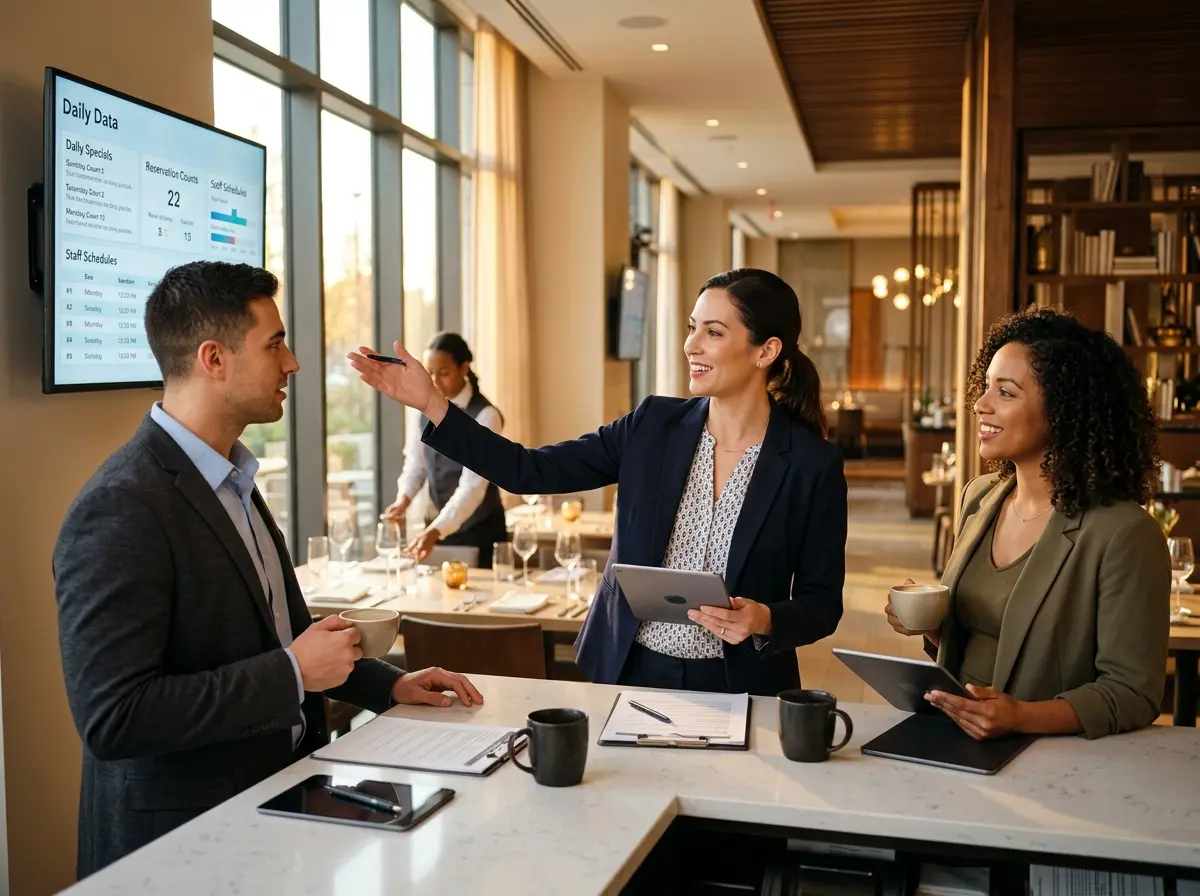
Structure is everything. Consider a simple three-part format: what's on today (specials, events, reservations, staffing notes), what we're pushing (promotional items, upsell opportunities, slow-moving inventory you need to move), and what we're fixing (one specific area of focus based on recent feedback or operational hiccups). That's it. Rinse and repeat daily. When your team knows exactly what to expect from the meeting format, they engage faster and retain more.
Make it non-negotiable, too. If the briefing happens "when we have time," it will never happen. Block it into the opening checklist. Fifteen minutes before doors open — same time, same place, every single day.
Assign Ownership and Rotate Presenters
One of the smartest things a manager can do is stop being the only person who talks in the morning briefing. When you rotate who leads each section — maybe a server presents the specials rotation, a bartender covers the cocktail feature, and a senior team member covers the service focus — you accomplish two things simultaneously. First, your team pays more attention because their peers are presenting. Second, you're building leadership skills in your staff without enrolling anyone in a management training program.
This also takes pressure off the opening manager, who is usually juggling about fourteen other things at that exact moment. Distributed ownership means the briefing still happens even when the GM is handling a vendor issue at the back door. Structure survives chaos. That's the whole point.
Document It So Nothing Gets Lost
A morning briefing is only as good as the information feeding into it. Build a simple running document — a shared Google Sheet, a notes app, a whiteboard protocol, whatever works for your operation — where managers log important updates as they come in. New 86'd items, a VIP reservation, a health inspector visit last week, a social media mention that set expectations — all of it should be captured before the meeting starts, not improvised during it.
This documentation habit also protects you on days off. When the opening manager is out sick and the assistant manager is running the briefing for the first time, having a clear, current document to pull from is the difference between a confident ten-minute huddle and an awkward shrug in front of the whole team.
Letting Technology Do the Heavy Lifting
Automate the Information Gathering So You Can Focus on Delivery
The most time-consuming part of preparing a morning briefing isn't delivering it — it's gathering the information. Managers who spend 45 minutes every morning cobbling together notes from phone messages, customer feedback, voicemails, and verbal handoffs from the closing team are working harder than they need to. This is exactly where smart technology earns its keep.
Stella, the AI robot employee and phone receptionist, can quietly support your morning prep without anyone even thinking about it. Her 24/7 phone answering capability means overnight voicemails arrive with AI-generated summaries and push notifications straight to your managers — so instead of playing back seven messages before the briefing, the opening manager already knows what came in and can drop the relevant details directly into the prep doc. For restaurants with a physical location, Stella's in-store kiosk presence also captures customer interaction insights and promotional response data that can actually inform what you emphasize in your morning huddle. Did last night's dessert feature get a lot of attention? That's briefing-worthy information, and Stella can help surface it.
Running a Briefing That Actually Sticks
Start with Energy, Not Announcements
Nobody wants to be talked at first thing in the morning. The managers who run the best pre-shift briefings understand that tone sets everything. Start with something that creates momentum — a quick win from yesterday's shift, a positive guest review, a shoutout to a team member who handled something well. Thirty seconds of genuine recognition before you get into logistics does more for engagement than a motivational poster ever will.
This doesn't mean you need to do jazz hands or bring donuts (though donuts are rarely a bad idea). It just means you're acknowledging that these are human beings showing up to do a demanding job, and a brief moment of positivity before diving into the specials board costs you nothing and pays dividends in team morale and attentiveness.
Make the Upsell Conversation Specific and Practiced
Telling your team to "upsell tonight" is about as useful as telling them to "do a good job." If you want upsell behavior, you have to make it concrete and give them the language. During the briefing, walk through the one or two items you're focusing on that shift. Explain why a guest would genuinely love them — the flavor profile, the value, the limited availability. Then, and this is the part most managers skip, say the actual words out loud. Model the upsell phrasing so your team hears it and can echo it back.
This kind of rehearsal takes maybe two minutes in a briefing, but it meaningfully increases the likelihood that your servers will actually attempt the upsell and do it naturally rather than awkwardly. Over a week, that behavioral change adds up on your revenue line.
Close with a Rallying Focus, Not a List of Warnings
How you end the briefing is just as important as how you start it. Too many pre-shift meetings close with a flurry of reminders about things not to do — don't forget to check IDs, don't let tables sit too long, don't forget to input the allergy notes. This sends your team onto the floor already thinking about failure modes instead of opportunity.
Instead, close with one clear, positive focal point for the shift. "Tonight we're focused on table turn efficiency during the 7 o'clock rush" or "Today's goal is every table hears about the weekend brunch announcement." One thing. Specific. Positive. Your team will walk out of that huddle knowing exactly what success looks like for the next few hours, and that clarity is genuinely powerful.
Quick Reminder About Stella
Stella is an AI robot employee and phone receptionist that greets customers in your physical location, answers calls around the clock, and provides AI-generated voicemail summaries so your team is never flying blind. At just $99/month with no upfront hardware costs, she's the kind of always-on support that quietly makes everything — including your morning briefings — run more smoothly.
Start Tomorrow Morning, Not "Soon"
Here's the thing about building habits: the best time to start is almost always immediately. You don't need a perfect template, a new management philosophy, or a staff training day to launch a morning briefing practice. You need a consistent time, a simple structure, and the discipline to protect that fifteen minutes every single day.
Start this week with the basics: what's happening today, what you're promoting, and one service focus. Run it for two weeks exactly the same way. Then layer in rotating presenters. Then refine the documentation system. Habits are built through repetition, not perfection, and your team will adapt faster than you expect once they see that this is how things work now.
The restaurants that run great operations aren't doing dramatically different things — they're doing consistent, intentional things daily. A morning briefing habit is one of the highest-return investments of fifteen minutes you can make as a management team. The floor is yours. Use it well.