When Your Front Desk Is the Bottleneck, Something Has to Give
Let's paint a familiar picture: It's a Tuesday afternoon at your med spa. The phone is ringing, a client just walked in for a consultation, another is asking about your laser package pricing, and your front desk coordinator is somehow expected to handle all of it simultaneously — while also managing appointment reminders, intake forms, and a stack of voicemails from the weekend. Sound familiar? If you're nodding along, you're not alone, and you're definitely not running a broken business. You're running a human business — and that's exactly the problem.
Administrative overhead is the silent killer of med spa profitability. According to industry research, front desk staff at medical aesthetics practices spend up to 40% of their time on repetitive tasks like answering the same questions, collecting patient intake information, and routing phone calls. That's nearly half a workday — every day — spent on tasks that, frankly, don't require a human touch. What if you could reclaim that time? One med spa did exactly that, cutting administrative work by 60% through strategic AI automation. Here's how they did it — and how you can too.
The Administrative Burden Med Spas Know Too Well
The Never-Ending Intake Form Problem
Anyone who has worked in or owned a med spa knows that intake forms are both essential and exhausting. Clients need to fill them out before treatments, staff need to review them, information needs to be entered into the system, and — inevitably — someone shows up having filled out nothing and your entire schedule starts to shift like a Jenga tower on a windy day. Manual intake processes create bottlenecks that ripple throughout the entire day.
The med spa in our case study was collecting intake information almost entirely on paper, then manually digitizing it. Two staff members were spending a combined three hours per day on this process alone. The fix? Conversational digital intake forms that clients could complete before their appointment — triggered automatically via a phone call or web interaction — with information flowing directly into a centralized contact management system. No clipboards. No data entry. No three hours.
Phone Calls: The Productivity Vampire
Phone calls are a necessary part of running a med spa. Clients have questions — about pricing, availability, treatment options, aftercare, you name it. But when your front desk is fielding 40 to 60 calls per day (a conservative number for a mid-sized practice), and a significant portion of those are answering the same five questions on repeat, you have to ask yourself: is this really the best use of your most important human resources?
The answer, perhaps unsurprisingly, is no. The med spa identified that roughly 65% of incoming calls could be fully resolved without human intervention — questions about hours, service menus, pricing tiers, pre-treatment instructions, and cancellation policies. Automating these interactions didn't just save time; it freed up staff to have meaningful conversations with clients who genuinely needed personalized attention. Quality over quantity — a concept every med spa owner claims to believe in but rarely applies to their own operations.
Voicemail Chaos and the Follow-Up Black Hole
If you've ever listened to 12 voicemails first thing in the morning and immediately felt your will to live diminish slightly, this section is for you. Voicemail management is low-glamour, high-consequence work. Miss a callback, and you've potentially lost a client who was ready to book a $800 treatment package. The med spa was losing an estimated 10 to 15 potential bookings per month simply due to delayed or missed follow-ups on voicemails — messages that sat unheard over weekends or got buried during busy afternoons.
The solution was an automated voicemail system that not only captured messages but generated AI-powered summaries and sent instant push notifications to the appropriate manager. No more morning inbox archaeology. Just a clean, prioritized list of who called, why they called, and what they need — ready to act on immediately.
How AI Tools Like Stella Stepped In
A 24/7 Presence That Never Calls in Sick
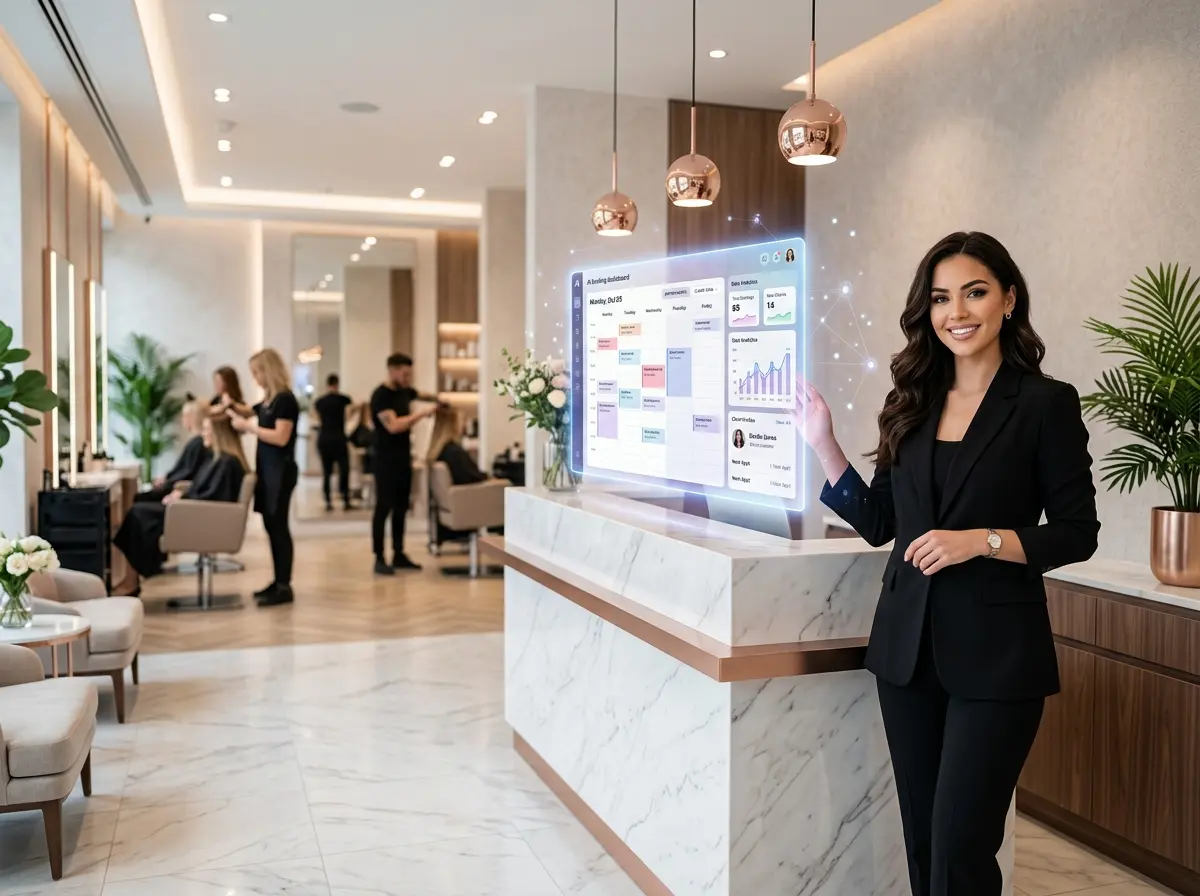
Part of the transformation at this med spa involved deploying Stella, an AI robot employee and phone receptionist designed for exactly this kind of environment. In the reception area, Stella operates as a human-sized AI kiosk that greets walk-in clients, answers questions about services and promotions, and proactively engages anyone who walks by — without needing a coffee break, a lunch hour, or a mental health day (though we fully support those for your human staff).
On the phones, Stella handles incoming calls 24/7 with the same depth of business knowledge she uses in person. She can answer service questions, collect intake information through natural conversation, forward calls to human staff when needed, and take voicemails with AI-generated summaries. Her built-in CRM stores client profiles with custom fields, tags, and notes — meaning intake data collected over the phone doesn't disappear into a void. It lives in a system your team can actually use. For a med spa managing hundreds of active clients, that kind of organized, accessible information is genuinely transformative.
Building a Leaner Administrative Workflow
Audit Before You Automate
The worst thing you can do is automate a broken process. Before this med spa deployed any technology, they spent two weeks documenting exactly where their staff time was going. They tracked every phone call, every form, every interruption. What they found wasn't surprising — but seeing it in black and white made the decision to act much easier. If you want to reduce administrative work, start by understanding what that work actually is. Map your workflows, identify the repetitive tasks, and prioritize the highest-volume, lowest-complexity items for automation first.
You'll likely find, as this spa did, that a small number of task categories account for the majority of your administrative burden. Phone call routing, intake collection, appointment reminders, and FAQ responses are almost always at the top of that list. These are your low-hanging fruit — and they're often lower-hanging than you think.
Integrate Systems So Data Flows Automatically
One of the biggest time sinks in any service business is re-entering the same information across multiple platforms. A client books an appointment on your website, their information goes into your booking software, then someone copies it into your CRM, then it gets printed for a paper intake form. Every manual transfer is a chance for error — and a theft of time your staff will never get back.
The med spa prioritized integration: their AI receptionist, CRM, and booking platform were connected so that information entered once flowed everywhere it needed to go. The result was a dramatic reduction in duplicate data entry and a notable improvement in data accuracy. Clients stopped being asked for the same information twice, which — as a bonus — also improved the client experience significantly. Turns out people don't love filling out the same form three times.
Empower Staff to Focus on High-Value Work
Here's the part that often gets overlooked in conversations about automation: it's not about replacing your staff, it's about redeploying them. When the med spa reduced administrative load by 60%, those hours didn't disappear. They were reinvested. Staff who had been chained to the front desk were able to spend more time on client care, upselling during consultations, following up with lapsed clients, and building the kinds of relationships that actually drive retention. One coordinator took on a part-time client success role that didn't exist before — because there simply hadn't been bandwidth to create it.
Automation creates capacity. What your team does with that capacity is up to you — but the options are almost always more valuable than answering the same question about your Hydrafacial pricing for the forty-seventh time this week.
A Quick Reminder About Stella
Stella is an AI robot employee and phone receptionist built for businesses like yours — serving as both an in-store kiosk presence that greets and engages walk-in clients and a 24/7 phone receptionist that handles calls, collects information, and manages voicemails with AI-generated summaries. She runs on a straightforward $99/month subscription with no upfront hardware costs and no complicated setup. For a med spa looking to reduce administrative overhead without sacrificing the client experience, she's worth a very serious look.
Your Next Steps Start Today
The med spa in this story didn't overhaul everything overnight. They started with a two-week audit, identified their biggest time drains, and implemented solutions in phases — beginning with phone automation and intake forms, then expanding into CRM organization and proactive client engagement. Within three months, they had reclaimed hundreds of staff hours per month, reduced missed follow-ups to near zero, and — perhaps most meaningfully — had a team that actually enjoyed coming to work again.
If you're ready to do the same, here's where to start:
- Audit your administrative tasks for two weeks and document where time is actually going.
- Identify your top three repetitive tasks — these are your first automation targets.
- Evaluate tools that integrate rather than adding another silo to your tech stack.
- Consider an AI receptionist for phone coverage and in-person client engagement, especially during off-hours and high-volume periods.
- Redefine your staff roles based on what they're uniquely able to do — not what a well-designed system could handle for them.
Administrative work will never be fully eliminated — nor should it be. But when it's consuming the majority of your team's energy, it's consuming the majority of your business's potential. The good news is that the tools to change that are more accessible, more affordable, and more capable than they've ever been. The only thing left to do is decide that your front desk deserves better — and so do you.