When the Phone Rings and Nobody's There to Answer It
Picture this: It's 7:45 PM on a Tuesday. A potential patient just got home from work, finally has a moment to breathe, and decides tonight's the night — they're going to call and book that physical therapy appointment their doctor recommended three weeks ago. They dial. It rings. And rings. And then... voicemail. They hang up without leaving a message because, honestly, who leaves voicemails anymore?
Meanwhile, you're at home having dinner, completely unaware that a new patient — and the revenue that comes with them — just evaporated into thin air.
For physical therapy practices, this scenario plays out dozens of times a week. Most patients work traditional business hours, which means they're trying to call you after your front desk closes. The result? Missed calls, missed appointments, and missed revenue. According to research from Invoca, 80% of callers who reach a voicemail won't leave a message — they'll simply move on to the next provider on Google's list. In a competitive healthcare market, that's not a minor inconvenience. That's a serious operational problem.
The good news is that physical therapy practices are now solving this problem in a surprisingly elegant way: AI-powered phone receptionists that never clock out.
The After-Hours Problem Is Bigger Than You Think
Why Patients Call When You're Closed
Physical therapy patients are not calling you at 2 PM on a Wednesday because they have the luxury of a flexible schedule. Most of them are working professionals, parents managing school pickups, or elderly patients who rely on family members to help coordinate their care. The window of time they have to make healthcare calls is narrow — and it almost never aligns with a typical 9-to-5 front desk schedule.
Studies suggest that a significant portion of patient calls to outpatient clinics occur outside of core business hours, including early mornings, evenings, and weekends. When those calls go unanswered, the practice doesn't just lose a scheduling opportunity — it loses trust. Patients interpret an unanswered phone as a signal that the practice might be difficult to work with, even before the first appointment is ever booked.
The Hidden Cost of Missed Calls
Let's do some quick math, because physical therapy practice owners tend to appreciate measurable outcomes (occupational hazard). If your average patient is worth $1,200 in revenue over the course of their treatment plan, and you're missing even five new patient calls per week due to after-hours gaps, that's potentially $6,000 in lost weekly revenue — or over $300,000 annually. That number has a way of making people sit up a little straighter.
Beyond the raw revenue loss, there's also the staff burden to consider. When after-hours calls do leave voicemails, someone has to listen to them, interpret them, and return those calls the next morning — all before the day has even officially started. Front desk staff are already stretched thin managing check-ins, insurance verifications, scheduling changes, and the general beautiful chaos of a busy clinic. Piling on a stack of unreturned voicemails every morning is a morale issue as much as it is an operational one.
Why Traditional Solutions Fall Short
Practices that recognize this problem usually try one of a few familiar workarounds: hiring additional front desk coverage for extended hours, using a generic answering service, or encouraging patients to book online. Each of these has its own set of problems. Extended staffing increases payroll costs significantly. Generic answering services sound generic — because they are — and they can't actually answer specific questions about your services, your providers, or your scheduling availability. And online booking, while useful, doesn't capture the patients who prefer to talk to someone, which in healthcare is still a substantial portion of your audience.
What practices actually need is something that combines the availability of an automated system with the knowledge and conversational ability of a well-trained staff member. That combination didn't really exist in an affordable, scalable form — until recently.
How AI Is Changing the Front Desk Game for PT Practices
A Smarter Way to Handle After-Hours Calls
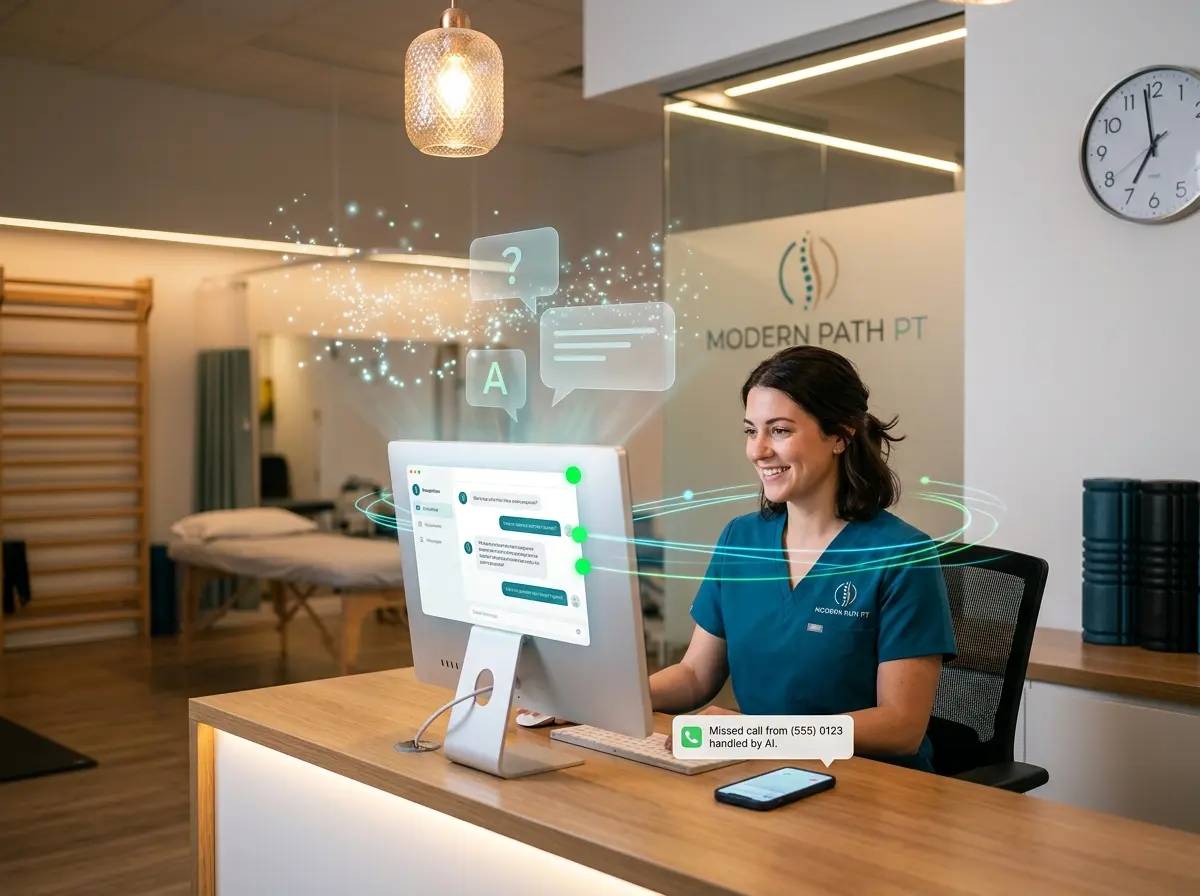
Stella, an AI robot employee and phone receptionist, is one of the tools that physical therapy practices are increasingly turning to for exactly this reason. Unlike a standard voicemail system or a scripted phone tree that sends patients spiraling into a maze of button-pressing frustration, Stella answers calls with actual conversational intelligence. She can discuss your services, explain what conditions your clinic treats, answer questions about insurance, describe what a new patient intake looks like, and — critically — collect the patient's information right there on the call so your front desk can follow up with a fully contextualized profile waiting for them the next morning.
For practices with a physical location, Stella also operates as an in-person kiosk presence, greeting walk-ins and proactively engaging visitors in the waiting area. Her built-in CRM and conversational intake forms mean that whether a patient reaches out by phone, web, or in person, their information is captured cleanly and consistently — no sticky notes, no misheard last names, no follow-up guesswork.
What This Looks Like in Practice
A Real-World Scenario at a PT Clinic
Consider a mid-sized physical therapy practice with two locations and a front desk team that closes at 6 PM. Before implementing an AI phone receptionist, their after-hours calls went to a voicemail box that was checked — optimistically — once per morning. New patient conversion from those voicemails was poor, largely because returning a call 12 to 14 hours later often meant the patient had already booked elsewhere.
After deploying an AI phone receptionist, calls made after hours were answered immediately, every time. The AI handled questions about services, walked callers through a brief intake conversation, and created a summary that was pushed to the practice manager via notification. By the time the front desk arrived the next morning, they had a clean list of interested patients — with names, contact details, reasons for calling, and notes — ready for outbound calls. The practice reported a measurable increase in new patient conversions within the first 60 days, with zero additional staffing cost.
Beyond After-Hours: Reducing Daytime Interruptions Too
Here's a bonus benefit that practices often don't anticipate: an AI phone receptionist doesn't just help after hours. During business hours, it acts as a first line of contact, handling routine calls so that front desk staff can focus on the patients who are physically in front of them. Questions about parking, directions, cancellation policies, and accepted insurance plans don't need a human to answer — they just need a knowledgeable, friendly voice. Redirecting those calls through an AI first filter can meaningfully reduce interruptions and improve the in-clinic experience for patients who are already there.
Actionable Steps to Get Started
If you're a physical therapy practice owner ready to stop hemorrhaging after-hours leads, here's a practical path forward:
- Audit your missed calls. Pull your phone records for the last 30 days and identify how many calls came in after hours. If your phone system doesn't show this, your carrier likely can. The number will probably surprise you.
- Define what information you need from new patients. Before deploying any AI tool, know what your intake process requires — name, contact info, referral source, primary complaint, insurance — so that the AI can collect it correctly from the start.
- Choose a solution built for conversational intake, not just message-taking. There's a meaningful difference between an AI that takes a message and one that actually conducts an intake conversation. Make sure you're evaluating the right category of tool.
- Integrate with your existing workflows. The best AI phone receptionist in the world doesn't help if the information it collects lives in a silo. Look for solutions that connect to your CRM or can push summaries directly to the people who need them.
- Monitor and refine. Review the call summaries and patient profiles your AI generates regularly in the first few weeks. Adjust the intake questions, the conversational tone, and the conditions under which calls get forwarded to a human as you learn what works for your practice.
Quick Reminder About Stella
Stella is an AI robot employee and phone receptionist designed to help businesses — including healthcare practices — never miss a customer interaction again. She answers calls 24/7, engages walk-in visitors at her in-store kiosk, collects intake information conversationally, and keeps everything organized in a built-in CRM. At $99/month with no upfront hardware costs, she's the front desk team member who never calls in sick, never puts anyone on hold indefinitely, and never has a bad Monday.
Stop Leaving New Patients on the Table
The after-hours missed call problem is solvable. It's not a staffing problem that requires hiring more people, and it's not a technology problem that requires a six-figure software investment. It's a coverage problem — and AI phone receptionists are purpose-built to fill exactly that gap.
Physical therapy practices that address this now are building a meaningful competitive advantage in their local markets. While other clinics are letting evening callers drift away to competitors, forward-thinking practices are capturing those patients, collecting their information, and starting the relationship before the competition even knows the phone rang.
The next step is simple: look at your missed call data, take the problem seriously, and explore the tools that can close the gap. Your patients are trying to reach you. Make sure you're there when they do — even when you're not.