The Little Restaurant That Could (If It Had a Strong Brand)
Let's be honest: competing against chain restaurants sometimes feels like showing up to a knife fight armed with a really well-seasoned cast iron skillet. The chains have massive marketing budgets, national advertising campaigns, loyalty apps developed by entire engineering teams, and the kind of brand recognition that gets burned into your brain after the 400th roadside billboard. And there you are — a passionate, hardworking independent restaurant owner — trying to get people to notice your amazing food and warm atmosphere in a world full of golden arches and familiar logos.
Here's the good news: you have something the chains can never truly replicate, no matter how much money they throw at it. You have authenticity. You have a story, a soul, and the ability to make decisions in real time without consulting seventeen layers of corporate management. Chains are built on consistency and scale. You're built on character. The key is learning how to turn that character into a brand identity so compelling that your regulars become your evangelists — and first-timers become regulars.
This guide is going to walk you through exactly how to do that, practically and without the fluff.
The Foundation: Know Who You Are Before You Tell Anyone Else
Brand identity isn't a logo. It's not a color palette. It's not even your Instagram aesthetic, as tempting as it is to start there. Brand identity is the sum total of every impression your restaurant makes — from the font on your menu to how your staff greets someone at the door to what your voicemail message sounds like at 9 PM on a Tuesday. Before you can communicate your identity to the world, you need to get brutally clear on what that identity actually is.
Define Your Core Story and Values
Every great independent restaurant has a story worth telling. Maybe you learned to cook from your grandmother in a tiny kitchen in Naples. Maybe your restaurant was born out of a food truck that became a neighborhood institution. Maybe you're a first-generation immigrant bringing flavors that your city has never experienced. Whatever it is — that's your competitive advantage over a chain that was designed by a committee in a conference room in Ohio.
Start by writing down the answers to these questions: Why does this restaurant exist? What would be lost if it closed tomorrow? Who do you serve, and why do they keep coming back? Your answers will form the emotional core of your brand — the "why" that Simon Sinek keeps yelling at everyone about. Customers connect with purpose. Give them one.
Get Specific About Your Target Customer
One of the most common mistakes independent restaurant owners make is trying to appeal to everyone. The chains can afford to do that because they have 4,000 locations and a research department. You need to be someone's favorite — not everyone's acceptable option. A strong brand identity is specific, and specificity requires knowing exactly who you're talking to.
Are you the cozy neighborhood brunch spot where young families come every Sunday? The upscale-casual date night destination for professionals in their 30s? The no-frills, old-school diner where construction workers and lawyers eat side by side? Each of these identities requires a completely different brand voice, visual style, and customer experience. Pick your lane, own it completely, and build everything else around it.
Building Your Visual and Verbal Brand Identity
Create a Visual Identity That Tells Your Story at a Glance
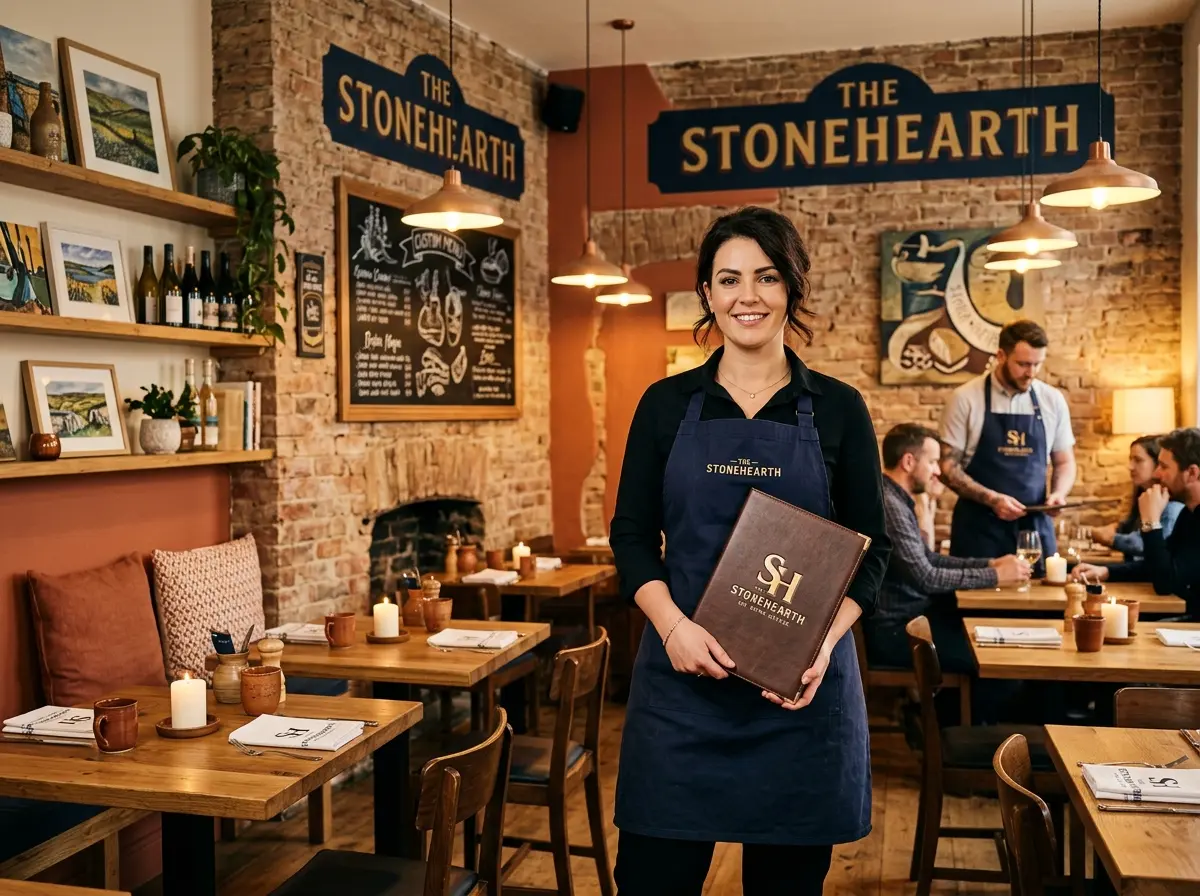
Now you can talk about the logo. Once you know your story and your audience, your visual identity — colors, typography, logo, signage, menu design, packaging — should flow naturally from that foundation rather than being chosen because "teal is trendy right now."
Consider how your visual elements reflect your personality. A rustic farm-to-table restaurant and a sleek modern sushi bar should look absolutely nothing alike, and that's the point. Invest in professional design if you can — even a one-time investment in a good local graphic designer can give you years of cohesive, polished materials. And please, for the love of good food, maintain consistency. Your Instagram, your menu, your website, your to-go bags, and your signage should all feel like they belong to the same family. Inconsistency quietly undermines trust without customers even realizing why they feel slightly off about your brand.
Develop a Brand Voice That Sounds Like a Real Human Being
Your brand voice is how your restaurant "talks" — on social media, in email newsletters, on your website, and even in how your staff communicates with guests. It should feel consistent, recognizable, and genuinely reflective of your restaurant's personality. A warm, family-style Italian trattoria should write its Instagram captions very differently than a trendy, irreverent taco spot — and both should sound nothing like a corporate chain that hired a social media intern to simulate having a personality.
Document your voice in a simple brand guide: a few adjectives that describe your tone, examples of how you would and wouldn't phrase things, and a clear sense of what topics you talk about and what you avoid. This ensures that when you hand off social media or email duties to a team member, the voice stays consistent instead of suddenly sounding like a different restaurant entirely.
How the Right Tools Can Reinforce Your Brand at Every Touchpoint
Brand identity isn't just built in marketing meetings — it's built in every single customer interaction, including the ones that happen when you're elbow-deep in a Friday night dinner rush and can't get to the phone. This is where smart tools can either protect your brand image or quietly damage it.
Stella, an AI robot employee and phone receptionist, is one of those tools worth knowing about. For independent restaurants, she can stand as a friendly in-store presence — greeting walk-in customers, answering questions about the menu, promoting daily specials, and even upselling in a way that feels conversational rather than pushy. She also answers your phone calls 24/7, meaning that when someone calls at 10:15 PM to ask about your hours or whether you accommodate gluten-free diets, they get a real, helpful, on-brand response instead of a voicemail box that communicates "we might get back to you eventually." Every touchpoint is a brand moment. Stella helps make sure those moments are consistently good ones, at a flat rate of $99/month with no upfront hardware costs.
Turning Your Brand Identity Into a Loyalty-Building Customer Experience
A brand identity that only lives on your website and social media is decoration. The real test of your brand is whether customers feel it when they walk through your door, when they call you, when they open your takeout bag, and when they think about where to eat on Saturday night. Independent restaurants win on experience — and experience is something chains have to spend billions trying to simulate.
Train Your Team to Be Brand Ambassadors
Your staff is your brand in motion. The most beautiful logo in the world won't save you if the person at the host stand is visibly annoyed to see customers. Every team member — from the chef to the busser to the person answering phones — needs to understand your brand values and what they look like in practice. This doesn't mean scripting every interaction into robotic uniformity (that's what chains do). It means ensuring your team understands the spirit of the experience you're creating and has the judgment and freedom to deliver it authentically.
Hold brief monthly conversations with your team about what the brand means, share customer feedback — both positive and negative — and celebrate moments when a staff member goes above and beyond to create the kind of experience you're known for. Culture is built in small, repeated moments, not in a single all-hands meeting.
Create Signature Experiences and Rituals
Chains are predictable by design. You can be memorable by design. Think about what makes dining at your restaurant feel special and distinct — then intentionally build more of those moments. Maybe it's a complimentary amuse-bouche, a handwritten note on the check, a chef who comes out to chat with regulars, or a signature cocktail that's become legendary in your neighborhood. These details become the stories your customers tell their friends. Word-of-mouth is still the most powerful marketing tool available to independent restaurants, and it's fueled by moments worth talking about.
Build a Community Around Your Brand
The most resilient independent restaurants don't just have customers — they have communities. Hosting local events, partnering with nearby businesses, supporting neighborhood causes, and engaging authentically on social media transforms your restaurant from a place people go into a place people belong to. According to a study by Toast, 62% of diners say they specifically seek out independent restaurants because they want to support their local community. That's not just a warm feeling — it's a genuine competitive advantage. Lean into it deliberately and consistently.
Quick Reminder About Stella
Stella is an AI robot employee and phone receptionist that greets customers in-store, promotes your specials and offerings, and answers phone calls around the clock — all for $99/month with no hardware costs to get started. She's easy to set up and designed to give your business a reliable, professional presence that never calls in sick, never has an off day, and never lets a customer interaction fall through the cracks.
Your Brand Won't Build Itself — But Here's Where to Start
Building a strong brand identity for your independent restaurant is not a weekend project, but it's also not as complicated as the marketing world sometimes makes it sound. It starts with clarity — knowing who you are, who you serve, and what makes you genuinely different. It grows through consistency — making sure every visual, every word, and every customer interaction reflects that identity. And it becomes self-sustaining when you build the kind of experiences and community that turn customers into loyal advocates who do some of your marketing for you.
Here are your actionable next steps to get started this week:
- Write your brand story in 200 words or less — the "why" behind your restaurant, in plain, honest language.
- Audit your current touchpoints — your signage, menu, website, social media, and phone experience — and identify where the brand feels inconsistent or weak.
- Define your target customer with enough specificity that you could describe them as a real person, not a demographic category.
- Have one honest conversation with your team about what your brand means and what it looks like in daily interactions.
- Identify one signature experience you can intentionally create or amplify to make your restaurant more memorable.
The chains will always have bigger budgets. But they will never have your story, your flexibility, or the kind of genuine human connection that makes an independent restaurant irreplaceable to the people who love it. Build your brand around what you actually are — and then show up consistently, across every touchpoint, every single day. That's the formula. It's not glamorous, but it works.