Your Phone Is Ringing — Please Don't Wing It
Let's be honest: most physical therapy practices have a clinical director who spent years mastering manual therapy, dry needling, and functional movement screening — and approximately zero time scripting what the front desk should say when a potential new patient calls. And yet, that phone call is often the very first impression your practice makes. No pressure.
Here's the uncomfortable truth: a poorly handled new patient call is one of the most common and most preventable sources of lost revenue in outpatient PT. Studies suggest that healthcare practices lose anywhere from 20% to 40% of inbound inquiries simply due to poor phone handling — missed calls, unprepared staff, or conversations that fail to inspire confidence. That's not a marketing problem. That's a front desk problem.
The good news? A well-crafted phone script — one that balances warmth, professionalism, and just enough structure to keep things on track — can dramatically improve your conversion rate from "caller" to "scheduled patient." This guide walks you through how to build one from scratch, what to include, and how to train your team (or your technology) to deliver it consistently.
The Anatomy of a Great New Patient Call
Step One: The Greeting Sets the Tone Immediately
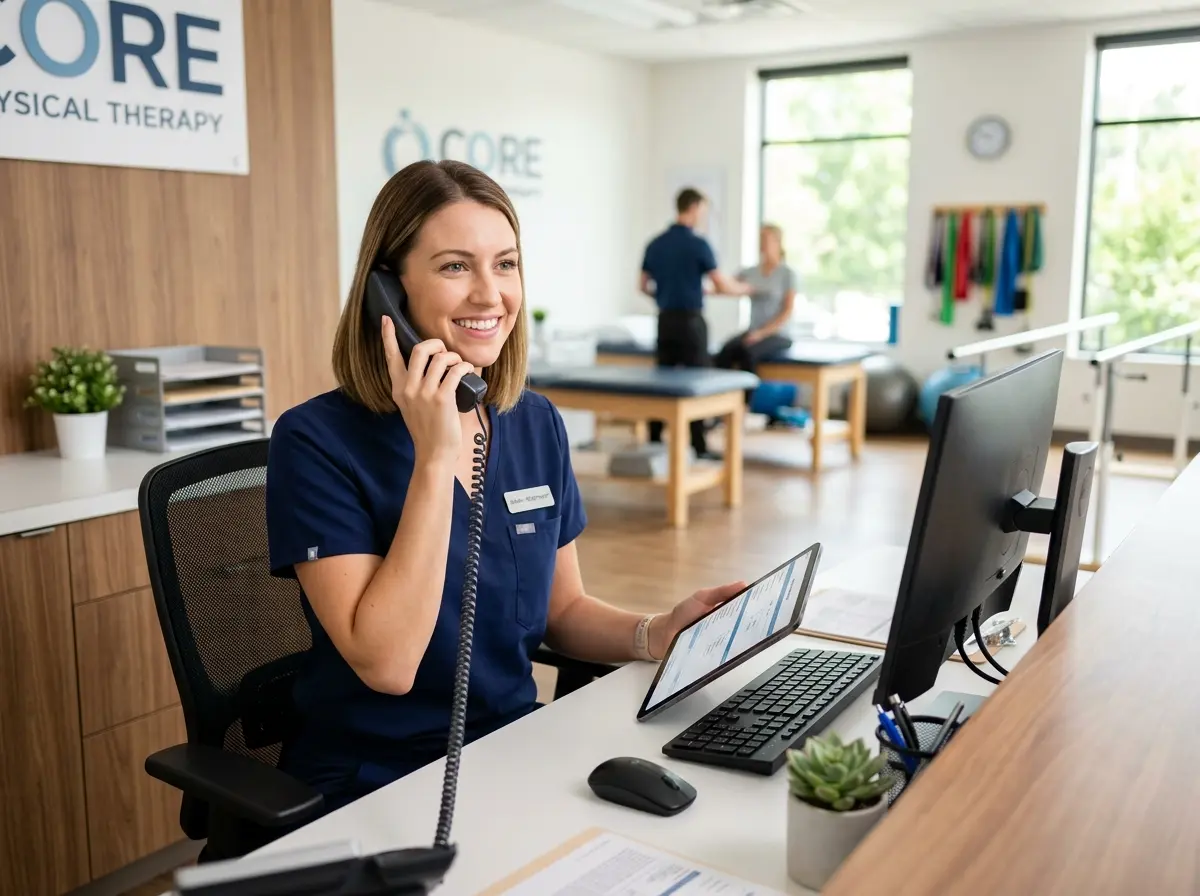
You have about four seconds to signal to a potential patient that they've called the right place. A flat, distracted, or robotic greeting does the opposite of that. Your opening line should include the name of your practice, a brief welcome, and ideally the name of the person answering. Something like:
"Thank you for calling [Practice Name], this is Sarah — how can I help you today?"
Simple. Warm. Human. Notice it doesn't include a recitation of your entire service menu or a corporate disclaimer. The goal is to make the caller feel like they've reached a place that actually wants to hear from them. If your current greeting sounds like it was written by a law firm in 1987, it's time for a rewrite.
One important nuance: train your staff to smile while they talk. It sounds absurd, but it genuinely changes the vocal tone. Callers can hear it, even if they can't see it.
Step Two: Listen Before You Pitch
The biggest mistake untrained staff make is immediately jumping into a list of services, insurance questions, or scheduling availability before the caller has finished explaining why they called. This is the phone equivalent of interrupting someone mid-sentence — and it signals that you're more interested in filling a slot than solving a problem.
After your greeting, give the caller space to explain their situation. Then, before you go anywhere else, acknowledge what they said. Something as simple as "I'm sorry to hear you've been dealing with that — you're definitely in the right place" goes a long way toward building rapport and trust. People don't just want a PT appointment. They want to feel heard by someone who gets it.
Step Three: Gather the Right Information — Without Turning It Into an Interrogation
Once you've established rapport, you'll need to collect the basics: the caller's name, contact information, reason for visiting, insurance provider, and preferred availability. The key here is to frame each question conversationally rather than firing them off like a checklist.
Instead of: "Name, date of birth, insurance?"
Try: "To get you set up, can I grab your full name and the best number to reach you? And do you happen to know which insurance you'd be using?"
The pacing matters. Moving through intake questions too quickly can make patients feel like a transaction rather than a person. Too slowly and you risk losing a caller who's already opened three other browser tabs. Aim for natural conversation flow — efficient, but not clinical.
Leveraging Technology to Handle Calls You Can't
The Real Cost of a Missed Call
Here's a scenario that plays out in PT clinics everywhere: it's 6:30 PM, the front desk has gone home, and a potential new patient who just got out of work finally has a moment to call about that nagging shoulder pain they've been ignoring for three months. They call. It rings. Voicemail. They hang up without leaving a message and Google the next clinic on the list.
That's not a hypothetical. That's Tuesday. And Wednesday. And Saturday morning. The harsh reality is that roughly 62% of callers won't leave a voicemail — they'll simply move on. If your practice isn't reachable outside of a narrow window of business hours, you're handing patients to your competitors on a silver platter.
How Stella Can Help Fill the Gap
Stella is an AI robot receptionist that answers phone calls 24/7 with the same knowledge and professionalism your best human staff member would bring — except she never calls in sick, never puts someone on hold to go find an answer, and doesn't get flustered during a busy Monday morning rush. For physical therapy practices, she can handle new patient inquiries, collect intake information through conversational AI-powered forms, and even flag urgent calls for immediate human follow-up based on configurable rules.
Stella also comes with a built-in CRM that stores patient contact details, generates AI-powered profiles, and keeps notes organized — so when your human staff does follow up, they're walking into the conversation informed. For practices with a physical location, she can also serve as an in-office kiosk presence, greeting patients who walk in and answering common questions about services and scheduling. It's a particularly effective combination: consistent coverage on the phones, and a polished presence in your lobby.
Training Your Team to Deliver the Script Consistently
Role-Playing Is Not Optional (Sorry)
You can write the most elegant phone script in the history of outpatient physical therapy, print it on laminated cardstock, and tape it directly to the front desk monitor — and your staff will still default to their own habits under pressure if they haven't practiced it out loud. Role-playing feels awkward. That's the point. The awkwardness in training is what prevents the awkwardness on actual calls.
Schedule monthly role-play sessions where staff rotate between playing the caller and the receptionist. Use realistic scenarios: the frustrated worker's comp patient, the elderly caller who doesn't know what insurance they have, the parent calling about their kid's sports injury who is in a hurry. Variety builds adaptability, and adaptability is what makes a script feel natural rather than robotic.
Review, Refine, and Track Your Metrics
A phone script is not a set-it-and-forget-it document. It should evolve based on real feedback and measurable outcomes. Start tracking the following:
- Call-to-appointment conversion rate: Of the new patient inquiries you receive by phone, what percentage actually schedule?
- Missed call rate: How many inbound calls go unanswered, and at what times of day?
- Cancellation rate post-first-call: If patients are canceling before their first visit, the phone experience may be overpromising or underdelivering on expectations.
Review recorded calls periodically (with appropriate consent disclosures, of course) and use them as coaching tools. When a call goes particularly well, break down exactly why and replicate it. When one goes sideways, treat it as a learning opportunity rather than a disciplinary one. The goal is a culture of continuous improvement, not a culture of fear.
Handle Objections With Confidence, Not Desperation
Every front desk team member will eventually encounter the caller who says "I'm just shopping around" or "I'm not sure if I need PT or just a massage." These moments are not dead ends — they're opportunities. Train your staff to respond with curiosity rather than defensiveness. Ask what they're hoping to improve, share a brief and relevant success story, and offer something low-commitment like a free phone consultation with a therapist.
The goal is never to pressure someone into an appointment they're not ready for. The goal is to give them enough confidence in your practice that when they are ready, you're the first call they make — or the call they're glad they didn't hang up on.
A Quick Reminder About Stella
Stella is an AI robot employee and phone receptionist that works around the clock for just $99/month — no upfront hardware costs, no training curve, no sick days. She answers calls, collects patient information, manages contacts through a built-in CRM, and can escalate to human staff whenever needed. Whether you run a solo PT practice or a multi-location clinic, she's worth knowing about.
Your Next Steps Start With a Single Script
Building a great new patient phone experience doesn't require a massive overhaul of your practice. It requires intentionality, a little structure, and the willingness to treat that inbound call as the valuable business moment it truly is. Start by drafting a greeting and a basic question flow this week. Role-play it once. Measure your conversion rate for a month. Then refine.
The practices that win on the phone aren't necessarily the ones with the best clinical outcomes or the fanciest equipment — they're the ones that make a caller feel like they've already found their answer before they've even walked through the door. Build that experience deliberately, support it with the right tools, and train your team to deliver it every single time.
Your patients are out there, phone in hand, deciding who to trust with their recovery. Make sure when they call you, the answer is obvious.