When Your Phone Is the Enemy of Your Healing Space
Picture this: You're a solo therapist, deep in a session with a client who's finally — finally — opening up about something they've been sitting with for months. The room is quiet. The trust is fragile. And then your phone rings. Again. Because someone wants to know if you take their insurance. Again.
Welcome to the glamorous world of running a solo therapy practice, where you're simultaneously the clinician, the scheduler, the billing department, and the very reluctant receptionist. If you've ever had to choose between answering a new client inquiry and being fully present for the person sitting across from you, you already know this tension isn't sustainable.
Solo therapists face a uniquely cruel paradox: the better you are at your job, the busier you get — and the busier you get, the harder it becomes to give each client the attention they deserve. According to the American Psychological Association, demand for mental health services has increased dramatically in recent years, leaving many solo practitioners overwhelmed and understaffed. The bottleneck, more often than not, is communication. Specifically, the phone.
The good news? There's a smarter way to handle it — and it doesn't require hiring a part-time receptionist you'll need to train, manage, and eventually replace.
The Real Cost of Missed Calls in a Therapy Practice
Every Missed Call Is a Missed Connection
For most businesses, a missed call is an inconvenience. For a solo therapist, it can mean a potential client in crisis never calls back, or worse, gives up on seeking help altogether. Studies suggest that nearly 80% of callers who reach voicemail don't leave a message — they simply move on to the next provider. In a field where the therapeutic relationship begins the moment someone decides to reach out, that first unanswered call carries more weight than in almost any other profession.
And it's not just new clients. Existing clients call to reschedule, cancel, ask about billing, or check your availability. Each of those calls, when handled poorly or not at all, chips away at the professional trust you've worked hard to build.
The Hidden Time Tax on Solo Practitioners
Here's a number worth sitting with: solo business owners spend an average of 23% of their workday on administrative tasks. For a therapist billing by the hour, that's not just frustrating — it's genuinely costly. Every 15 minutes spent playing phone tag is a quarter-hour you're not earning, not resting, and not doing the work you actually went to school for.
The administrative burden of managing a practice solo is often what drives therapists to either burn out or reluctantly join a group practice — not because they want to, but because they can't figure out how to keep the lights on without drowning in logistics. The scheduling piece alone can feel like a part-time job: confirmations, cancellations, rescheduling, reminders, intake paperwork. It adds up fast.
Professionalism Without the Payroll
There's also the image problem. A solo practitioner who answers their own phone between sessions — sounding rushed, distracted, or occasionally breathless — doesn't exactly project the calm, organized presence that instills confidence in prospective clients. Clients are choosing someone to trust with their mental health. First impressions, including that very first phone call, matter enormously. The challenge is projecting the professionalism of a full-service practice without the overhead to match.
A Smarter Front Desk: How AI Can Fill the Gap
One Therapist's Turning Point
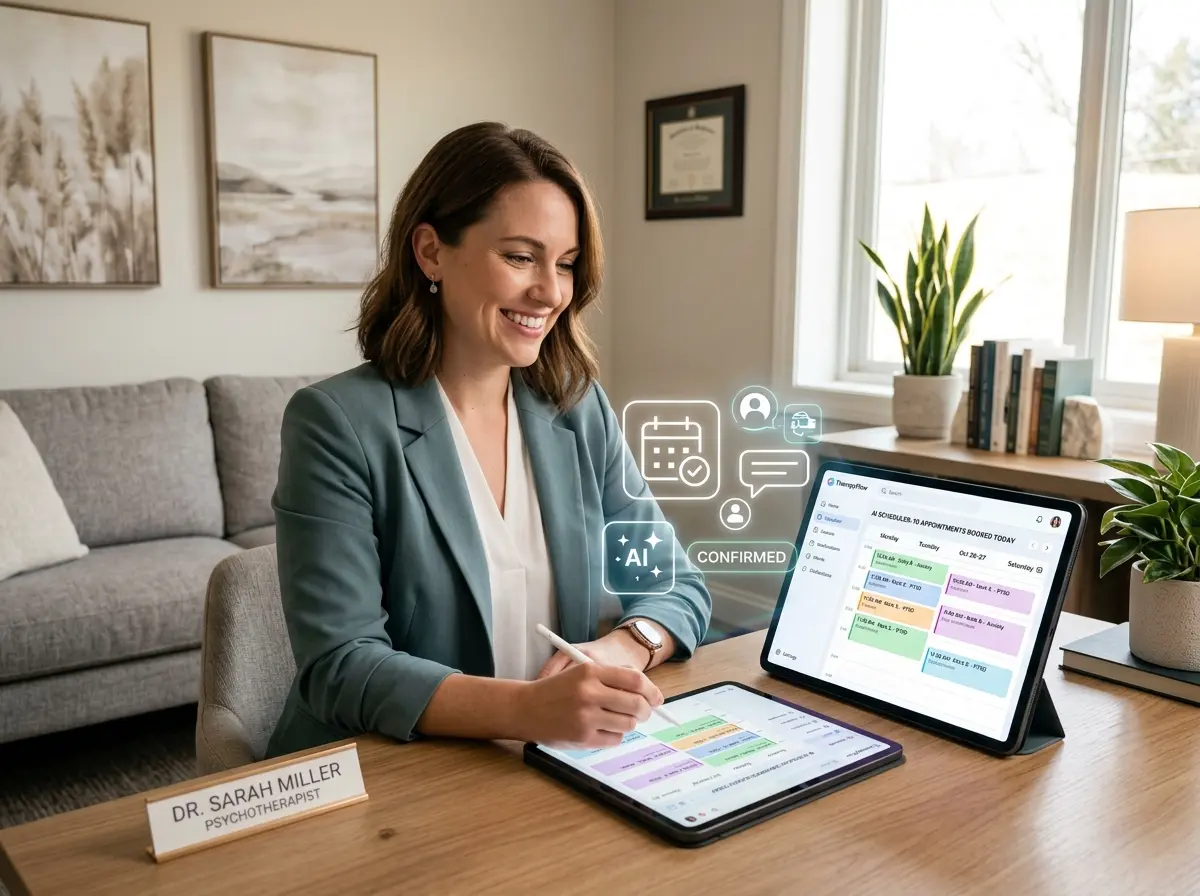
Meet Dr. Margaux — a fictional but painfully relatable solo therapist we'll use to illustrate a very real scenario. Dr. Margaux had a full caseload, a waitlist, and a phone that she was increasingly ignoring out of sheer self-preservation. She'd return calls at 8 PM, play voicemail tag for days, and occasionally lose a prospective client because she simply couldn't respond fast enough. She wasn't bad at running her practice — she was just one person doing the work of three.
After implementing an AI phone receptionist, everything changed. New client inquiries were answered immediately, any time of day. Callers received warm, professional responses to common questions — insurance, session length, her therapeutic approach, availability. Intake information was collected conversationally during the call and delivered to Dr. Margaux as a clean summary, ready to review before the first session. She didn't miss a single inquiry during a session, yet never once had to interrupt one to answer the phone.
Where Stella Comes In
This is exactly the kind of transformation that Stella was built for. As an AI phone receptionist, Stella answers every call with the same professional warmth and detailed knowledge of your practice — your services, your policies, your availability, your FAQ. She can collect client intake information through natural, conversational phone interactions and push that data directly into a built-in CRM, complete with AI-generated profiles, custom fields, and tags you define. For therapists managing a waitlist or tracking referral sources, that kind of organized, automatic data collection is genuinely game-changing.
Stella also handles voicemails with AI-generated summaries and sends push notifications to you as the manager, so you always know what came in and how urgent it is — without listening to a single voicemail. And if a call genuinely needs your personal attention, she can be configured to forward it to you based on conditions you set. You stay in control without being on call 24/7.
Practical Steps to Streamline Client Communication as a Solo Therapist
Audit What's Actually Coming Through Your Phone
Before you can fix a communication problem, you need to understand it. Spend two weeks tracking every call you receive: Who called? What did they want? How long did it take you to respond? How many required follow-up? You'll likely discover that the vast majority of your incoming calls fall into a handful of predictable categories — new client inquiries, scheduling changes, insurance questions, and general practice information. That's actually great news, because predictable questions have answerable answers, and answerable questions are exactly what AI handles best.
Once you've mapped your call patterns, you can start thinking strategically about which interactions genuinely require your voice and which ones would be handled just as well — or better — by a well-informed AI receptionist who picks up every time, never sounds flustered, and never puts someone on hold to finish session notes.
Build Your Communication Infrastructure Before You Need It
One of the most common mistakes solo practitioners make is waiting until they're overwhelmed to address communication gaps. By then, you've already lost clients, frustrated existing ones, and built a habit of reactive scrambling that's hard to unlearn. The smart move is to set up your systems early — even when your caseload feels manageable — so that growth doesn't break you.
At minimum, every solo therapist should have a clear, professional phone greeting, a defined intake process, and some mechanism for capturing new client information outside of business hours. Ideally, that mechanism is automatic, organized, and doesn't depend on you remembering to check a second inbox. Think through your client journey from the first call to the first session and identify every point where a drop-off could happen. Then close those gaps before they cost you.
Set Boundaries That Technology Can Actually Enforce
Boundaries are a recurring theme in therapy for good reason — and therapists are notoriously bad at applying them to their own practices. Telling yourself you won't answer calls during sessions is easy. Actually not answering calls during sessions, when you can see someone calling and wonder if it's urgent, is much harder. The most effective boundary isn't willpower — it's a system that physically handles the call so you don't have to decide whether to pick up.
When your phone is covered, you're free to be present. And for a therapist, presence isn't a soft skill — it's the entire service. Clients pay for your full attention. Anything that protects that attention directly improves the quality of care you provide. Good communication infrastructure isn't just an operational upgrade; for a solo therapist, it's an ethical one.
Quick Reminder About Stella
Stella is an AI robot employee and phone receptionist built for businesses of all sizes — including solo practitioners who need professional support without the overhead of a full-time hire. She answers calls 24/7, collects intake information, manages contacts through a built-in CRM, and keeps you informed without keeping you tethered to your phone. At $99/month with no upfront hardware costs, she's one of the more practical investments a solo therapist can make in the sustainability of their practice.
Your Next Steps Toward a Calmer, Better-Run Practice
The solo therapist's communication problem is real, it's common, and — perhaps most importantly — it's solvable. You don't need to hire a receptionist, share an office suite, or join a group practice just to have a functional front desk. What you need is a system that answers the phone when you can't, collects the right information when clients call, and keeps everything organized so you can focus on the work that actually requires your expertise.
Here's where to start:
- Track your calls for two weeks to identify what's coming in and what categories emerge.
- Document your most frequently asked questions — insurance, availability, session format, fees — so any system you implement can answer them accurately.
- Define your intake process and identify what information you need before a first session.
- Implement an AI phone solution that can handle new inquiries, collect intake data, and free you up to be present with current clients.
- Revisit your communication setup every quarter as your practice evolves.
You became a therapist to help people, not to manage a phone queue. The tools exist to handle the latter — so you can get back to the former. Your clients deserve your full attention. So, frankly, do you.