Introduction: The Endless Game of "I'll Call You Back"
You've perfected your signature truffle risotto. Your braised short rib could bring a grown adult to tears. Your private dinner service is, frankly, a work of art. And yet, somehow, the most chaotic part of your personal chef business isn't the cooking — it's the endless back-and-forth just to book a client.
Sound familiar? You're elbow-deep in a mise en place when your phone rings. You miss it. They leave a voicemail. You call back. They don't answer. They text you. You're driving. They email. You respond three hours later. They've already hired someone else. Congratulations — you just lost a $2,000 dinner party to phone tag.
The truth is, personal chefs are solopreneurs running a highly personal, high-touch service business. Your time is genuinely precious, and every minute spent chasing down a potential client is a minute you're not cooking, planning menus, or, you know, sleeping. The good news? Booking clients without the chaos isn't just possible — it's a system you can build intentionally. Let's walk through it.
Building a Booking System That Actually Works
Start With a Clear, Frictionless Inquiry Process
The first step to eliminating phone tag is making it easy for clients to tell you what they need — before you ever speak to them. A well-designed intake process does the heavy lifting upfront. Think about it: if a prospect can tell you their event date, number of guests, dietary restrictions, and budget through a simple form or guided conversation, you're already 80% of the way to a qualified booking by the time you have your first real conversation.
Your intake process should capture the essentials without overwhelming people. Ask for the event date, type of occasion, number of guests, any dietary needs, rough budget range, and preferred contact method. Keep it conversational, not clinical. Nobody fills out a form that looks like a tax return. Once you have this information in hand, your follow-up call becomes a short, purposeful conversation rather than a fact-finding expedition.
Set Defined Communication Windows — and Stick to Them
Here's a radical concept: you don't have to be available 24/7 to seem professional. In fact, defining your availability increases perceived professionalism. Set specific times when you handle client communications — say, weekday mornings from 9 to 11 a.m. — and communicate those hours clearly on your website, in your email signature, and in any automated responses.
When clients know what to expect, they stop sending frantic follow-up messages and start respecting your process. This also trains your clientele over time. High-value clients who are serious about booking will work within your schedule. Those who expect you to drop everything and call them back at 10 p.m. on a Saturday? Consider that an early warning sign.
Use Scheduling Tools to Eliminate the Back-and-Forth
If you're still booking consultations through a series of "Does Thursday work?" texts, please stop immediately. Scheduling tools like Calendly, Acuity Scheduling, or similar platforms let prospects book a time directly into your calendar without a single phone exchange. You set your available windows, they pick a slot, and everyone shows up prepared. It's not impersonal — it's efficient, and clients actually appreciate not having to coordinate across six messages just to talk to you.
Pair your scheduling link with a brief pre-consultation questionnaire (the intake form mentioned above), and you've created a seamless onboarding pipeline that filters serious inquiries and keeps your calendar organized without any manual effort on your part.
How the Right Tools Can Handle the First Touch For You
Let Technology Answer When You Can't
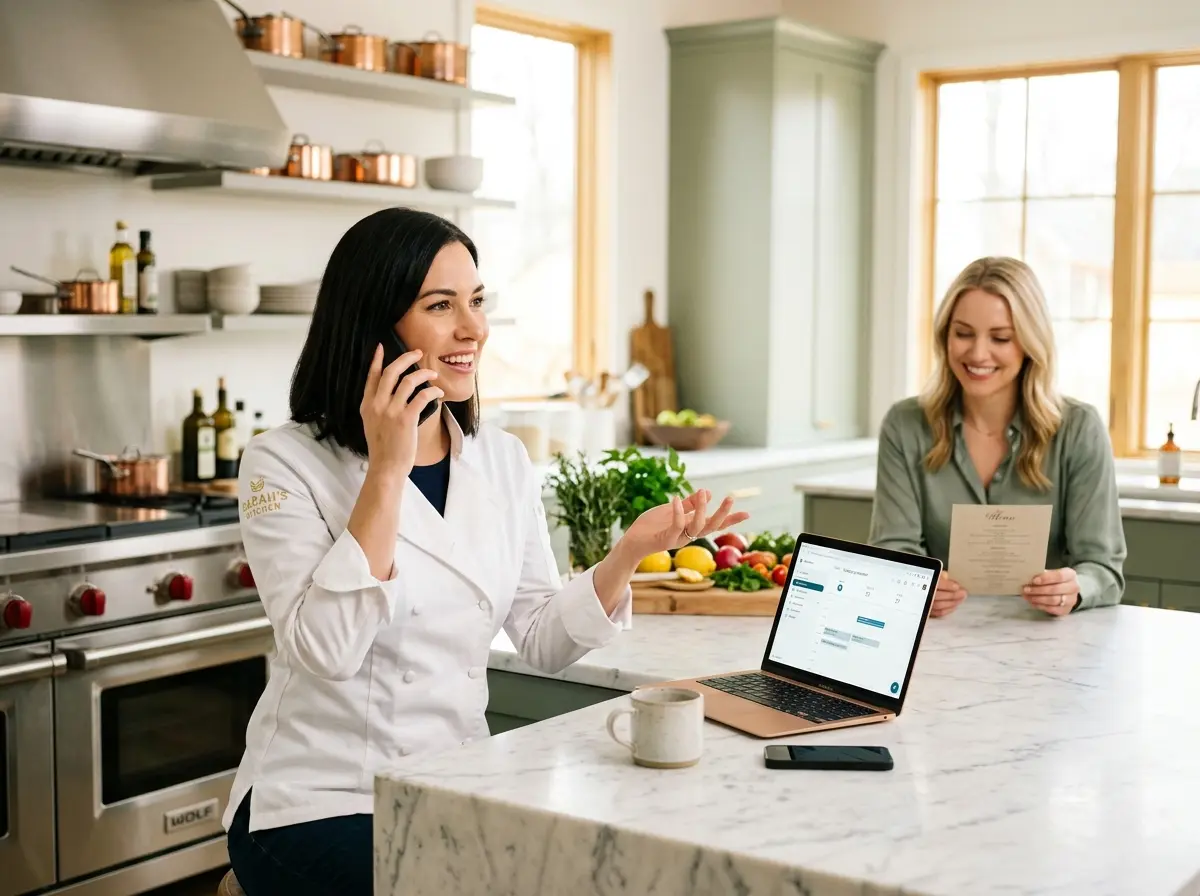
One of the biggest booking killers for solo personal chefs is the missed call. You're at a client's home preparing a five-course tasting menu. Your phone rings. You obviously can't answer. A potential client hangs up and moves on. This is where Stella — an AI robot employee and phone receptionist — genuinely changes the game for solopreneurs and small service businesses.
Stella answers your phone calls 24/7, speaks naturally with callers about your services, availability, and pricing, and can collect client intake information through a conversational form right there on the call — no hold music, no voicemail black hole. She logs everything into a built-in CRM with AI-generated profiles and summaries, so when you finish up at your client's kitchen and check your phone, you don't have a cryptic missed call. You have a qualified lead, their details, and a summary of what they're looking for. At just $99/month, it's the kind of front-desk coverage that used to require hiring an actual person.
Qualifying Clients Before You Commit Your Time
Ask the Right Questions Early
Not every inquiry is worth a 45-minute discovery call. Part of a healthy booking system is learning to qualify prospects efficiently — which means gathering enough information upfront to assess fit before you invest significant time. Your intake form is your first filter. Your response template is your second.
When you receive an inquiry, your initial reply shouldn't be a phone call. It should be a short, warm message that acknowledges their interest, confirms your availability for their general timeframe, and directs them to either complete your intake form or book a consultation slot. This simple step eliminates tire-kickers and ensures that when you do get on a call, you're talking to someone who's genuinely ready to move forward.
Know Your Minimum Viable Client
Every personal chef should have a clear picture of their ideal booking — minimum guest count, geographic service area, event types you specialize in, and a starting price point. When you know this, you can pre-qualify inquiries quickly and decline gracefully when something isn't a fit. Saying "I specialize in intimate dinner experiences for 6 to 14 guests, with a starting investment of $X" in your intake confirmation email is not aggressive — it's respectful of everyone's time.
This also helps you avoid the exhausting experience of spending an hour on the phone with someone who gasps at your rates. Set expectations early, and the clients who proceed are already pre-qualified on budget. That alone will save you hours every month.
Create a Simple Follow-Up Sequence
Once a prospect enters your pipeline, don't rely on memory to follow up. A simple three-step follow-up sequence — an initial response within a few hours, a check-in after 48 hours if there's no reply, and a final follow-up at the one-week mark — ensures that no warm lead goes cold simply because life got busy. Keep each message brief, personal in tone, and low-pressure. Something as simple as "Just wanted to make sure my message didn't get buried — happy to answer any questions!" goes a long way without feeling pushy.
Document your sequences somewhere, whether that's a CRM, a simple spreadsheet, or a project management tool. The goal is a reliable system, not heroic memory.
Quick Reminder About Stella
Stella is an AI robot employee and phone receptionist that answers calls around the clock, collects client intake information conversationally, and manages it all inside a built-in CRM — so you never lose a lead to a missed call again. At $99/month with no upfront hardware costs, she's designed for exactly the kind of busy, on-the-go professional who can't afford to be glued to their phone. Setup is straightforward, and she's ready to work the moment you are.
Conclusion: Build the System Once, Book Clients Continuously
Here's the honest truth about booking clients as a personal chef: the cooking is the easy part. The business infrastructure — the intake, the qualification, the follow-up, the scheduling — is where most talented chefs lose clients they never should have lost. But it doesn't have to be that way.
Start with these concrete next steps:
- Create or refine your intake form to capture event details, guest count, dietary needs, and budget before any phone conversation takes place.
- Set up a scheduling link and include it in every inquiry response, so prospects can book consultations without the back-and-forth.
- Define your communication hours and make them visible on your website and in your email signature.
- Build a simple three-touch follow-up sequence so no warm lead quietly disappears into the void.
- Consider letting an AI receptionist like Stella handle your calls when you're in the kitchen, in the car, or simply off the clock — because missed calls are missed revenue.
Your personal chef business deserves a booking process as polished as the meals you serve. Stop playing phone tag, build a system that works while you cook, and start spending your energy where it belongs — creating extraordinary experiences for the clients you've already won.