When Your Shampoo Bottles Start Selling Themselves
Here's a fun little riddle: What do a hair salon, a 40% sales increase, and a robot have in common? If you said "absolutely nothing," you'd be wrong — and also leaving serious money on the table. If you said "sounds like my next business move," then congratulations, you're already thinking like a 21st-century salon owner.
Retail sales at hair salons have always been a bit of an awkward dance. Stylists are busy, clients are mid-conversation about their vacation to Cancún, and nobody wants to feel like they're being pitched a $45 hair mask while foils are literally baking their highlights. And yet — retail product sales can account for up to 30% of a salon's total revenue when done right. The keyword there being when done right.
The problem isn't the products. The products are great. The problem is the system — or more accurately, the lack of one. Most salons rely entirely on stylists to remember to recommend products, feel comfortable doing so, and find the right moment in a 45-minute appointment to make it happen naturally. That's a lot of ifs. This post is about replacing those ifs with a repeatable, scalable product recommendation system — and yes, there's a robot involved.
Why Salon Retail Sales Underperform (And It's Not Your Stylists' Fault)
The Inconsistency Problem
Your best stylist recommends three products per client, every single time, because she genuinely loves what she uses and can't stop talking about it. Your newest hire is still nervous about suggesting a $30 conditioner because she doesn't want to seem pushy. And your third stylist is technically great at recommendations — but only when he remembers, which is roughly 60% of the time on a good day.
This inconsistency is the silent killer of salon retail revenue. It means your sales numbers are essentially a reflection of individual personality traits rather than a business strategy. Clients with certain stylists buy products consistently; others walk out the door empty-handed every single visit. Sound familiar? The fix isn't to pressure your team more — it's to build a system that doesn't depend on anyone having a perfect day.
The Timing Problem
Even the most enthusiastic product recommender runs into the timing issue. A stylist's hands are full — sometimes literally — and the natural windows for a product pitch are narrow. Too early in the appointment and it feels random. Too late and the client is already mentally on their way to their next errand. Product recommendations need to happen at the right moment, with the right context, and with enough information about the client's actual hair concerns to feel genuinely helpful rather than scripted.
The solution? Capture client hair concerns before the appointment even begins, and use that information to surface relevant recommendations automatically. When a client mentions she's been dealing with frizz since her last color treatment, a recommendation for a smoothing serum isn't a sales pitch — it's a service.
The Follow-Up Problem
A client leaves your salon looking incredible. She bought nothing. Three days later, her hair is doing the thing she hates, and she's at the drugstore buying whatever's on sale. This is not a hypothetical. This is happening at your salon right now, probably multiple times a week. The window for a retail sale doesn't close when a client walks out — but you need a system to stay in that window. Automated follow-ups, personalized based on what was discussed during the appointment, can recover a significant portion of those missed sales. It's not aggressive; it's attentive.
How Smart Tools (Including a Robot) Can Close the Gap
Meet the Tool That Works While You're Deep-Conditioning
This is where things get genuinely interesting. Stella is an AI robot employee and phone receptionist designed for businesses exactly like yours. For salons with a physical location, she stands inside the salon as a human-sized kiosk and engages clients naturally — talking about products, current promotions, and services while they wait. She doesn't get distracted, doesn't forget to mention the new keratin treatment special, and absolutely does not feel awkward recommending a $55 hair oil. She's consistent, friendly, and always on message.
Beyond the in-store experience, Stella also answers your phone calls 24/7 — collecting client intake information, answering questions about services, and capturing the kind of hair concern data that makes personalized product recommendations possible. Her built-in CRM stores client profiles, tags, and notes so that every interaction builds a richer picture of what your clients actually need. That's the foundation of a real recommendation system: knowing your customer before they sit down in the chair.
Building a Product Recommendation System That Actually Works
Step 1 — Collect the Right Information Upfront
A product recommendation is only as good as the information behind it. Before a client ever walks through your door, you should know what their primary hair concerns are, what products they're currently using, and what results they're hoping for. This sounds like a lot of data to collect, but it doesn't have to be complicated. A short intake form — delivered via phone conversation, a web link, or a kiosk interaction — can capture exactly what you need in under two minutes.
The goal is to make recommendations feel inevitable rather than opportunistic. When a client has already told you she's struggling with dryness and breakage, handing her a product specifically designed for that isn't upselling. It's listening. And clients notice the difference.
Step 2 — Build a Recommendation Logic That Your Team Can Actually Use
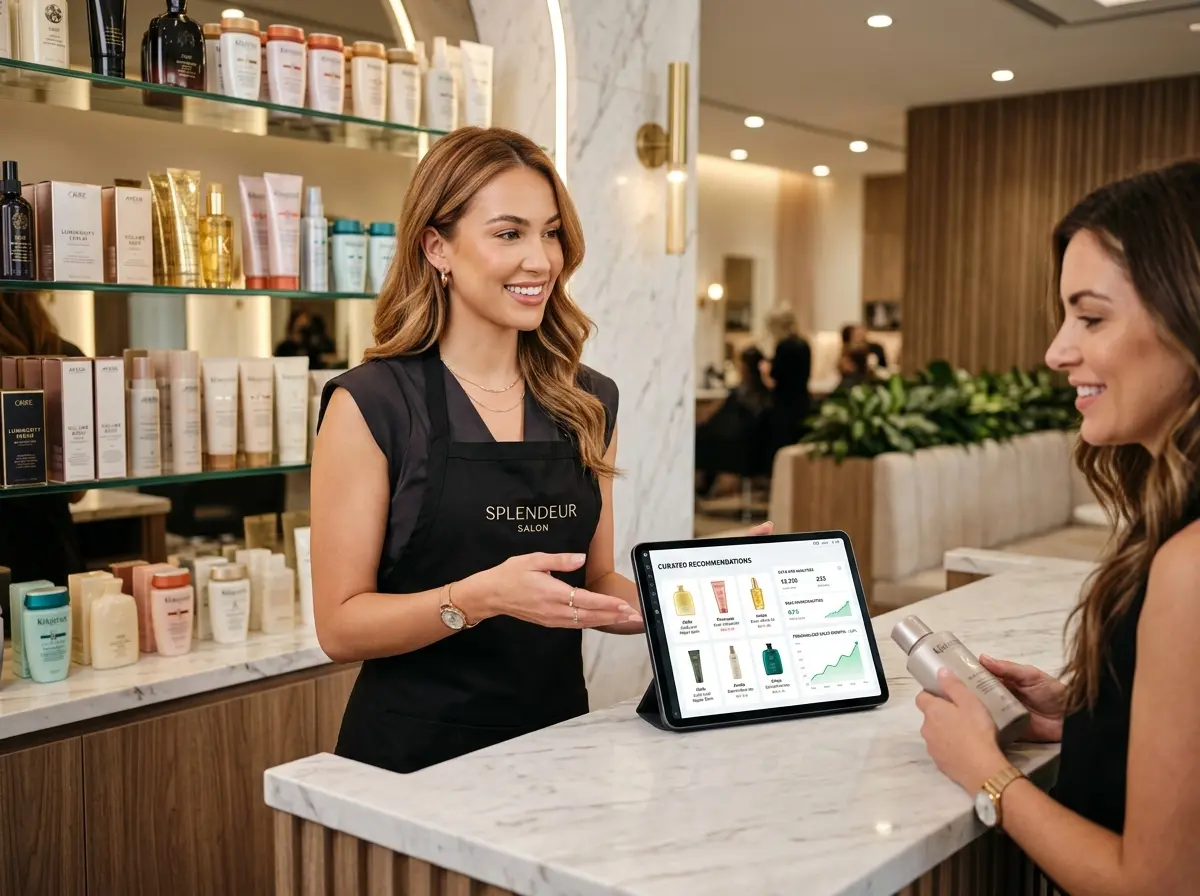
Map your product inventory to common client concerns. This doesn't need to be a PhD dissertation — a simple matrix works beautifully. Frizz and humidity issues? Here are your top three recommended products. Color-treated and over-processed? These two. Fine hair that goes flat by noon? Pull from this category. When your team (and your technology) has a clear, simple framework to work from, recommendations become part of the service rather than an afterthought.
Train your stylists to reference the client's intake information at the beginning of the appointment. When a client sees that you've already read her notes and thought about her hair before she sat down, the entire dynamic shifts. You're not selling; you're solving.
Step 3 — Reinforce at Every Touchpoint
The recommendation shouldn't happen only once. Introduce the product during the appointment, explain why it's relevant to this specific client's concerns, and then reinforce it before checkout. A brief, personalized follow-up message a few days later — referencing what was discussed — can significantly increase the likelihood of a purchase on the next visit or through your online store.
Track which recommendations are converting and which aren't. Over time, this data becomes incredibly valuable for refining your system, identifying your best-performing products, and even informing your inventory decisions. A recommendation system isn't just a sales tool — it's a feedback loop that makes your entire retail operation smarter.
Quick Reminder About Stella
Stella is an AI robot employee and phone receptionist available for just $99/month with no upfront hardware costs — she greets clients in-store, answers your phones around the clock, and collects the kind of intake information that powers a real product recommendation strategy. She's the consistent, always-on presence your front desk deserves, without the turnover.
Your Next Steps Start Before Your Next Client Walks In
A 40% increase in retail sales doesn't happen because someone got lucky. It happens because a system replaced guesswork. The salons that consistently outperform their retail benchmarks aren't necessarily the ones with the best products or the most experienced stylists — they're the ones that have figured out how to make every client interaction an informed, personalized, and well-timed conversation about what those clients actually need.
Here's what you can do this week. First, audit your current retail recommendation process — or honestly acknowledge that you don't really have one. Second, map your top-selling products to the three or four most common client concerns you hear in your salon. Third, identify where client information is currently getting lost, whether that's at the phone booking stage, during check-in, or somewhere between the shampoo bowl and the styling chair. Then start plugging those gaps, one touchpoint at a time.
You don't have to overhaul everything overnight. Start with intake. Add consistency. Follow up. Measure what's working. The revenue is already there — it's just waiting for a system smart enough to capture it. And if a friendly robot standing near your reception desk is what it takes to make that happen, well, stranger things have worked.