The Half of Your Market You're Probably Ignoring
Let's talk about something most auto repair shop owners haven't thought about — or worse, have thought about and dismissed with a wave of a greasy hand. Women represent nearly 65% of all automotive service decisions in the United States. That means the majority of the people deciding where to take their car are women, and yet most auto shops are still marketing like it's 1987 and their only customer is a guy named Gary who subscribes to Car and Driver.
To be fair, the auto industry has historically been male-dominated, and old habits die hard. But here's the thing: while you're busy marketing exclusively to Gary, your competitor down the street is winning over his wife, his daughter, his sister, and frankly, probably Gary's business too — because she told him where to go. Word of mouth among women is powerful, loyalty runs deep, and the shops that earn that trust tend to keep it for years.
So, whether your current marketing strategy is "we post on Facebook sometimes" or you have a full digital presence, this post will walk you through why a female-forward marketing strategy isn't just a nice idea — it's good business.
Understanding What Female Customers Actually Want
Before you can market effectively to women, you need to understand what they're looking for — and it's probably not what you think. It's not pink waiting rooms and scented candles (please don't). It's about trust, transparency, and feeling respected. Those aren't uniquely female desires, of course, but research consistently shows that women place a higher weight on these factors when choosing a service provider, and they're more likely to walk away permanently when these expectations aren't met.
Transparency Is Non-Negotiable
A 2023 consumer trust survey found that 76% of women felt they had been talked down to or overcharged at an auto repair shop at least once. That's not a small problem — that's a widespread reputation issue for the entire industry. Women are not less knowledgeable about cars than men on average; they're just more likely to be treated as if they are. The shops that break this pattern win enormous loyalty.
Practical transparency looks like itemized estimates before work begins, clear explanations of what a service actually does and why it matters, and honest timelines. It means not adding three surprise line items to an invoice and hoping the customer just goes along with it. Show your work. Explain the "why." Customers who understand what they're paying for are far more likely to authorize the work — and come back next time.
The Experience Inside Your Shop Matters More Than You Think
Marketing brings people in the door. The in-shop experience determines whether they ever come back. Women, statistically, are more likely to leave online reviews and more likely to refer friends and family to businesses they trust. That means every single visit is a potential multiplier — or a warning to the entire neighborhood's group chat.
Think about your waiting area. Is it clean, comfortable, and welcoming? Is there clear signage explaining your process? Do customers feel acknowledged when they walk in, or do they stand awkwardly at the counter while technicians pointedly avoid eye contact? Small improvements in the customer experience — a greeter, a clean lounge, proactive communication about wait times — can make a measurable difference in how your shop is perceived and reviewed.
Online Reputation Is Your New Storefront
Women are twice as likely as men to research a service provider online before their first visit. Your Google reviews, your website, and your social media presence are doing a job 24 hours a day — either selling your shop or quietly undermining it. A pattern of reviews mentioning dismissive staff or unexplained charges is a massive red flag for a female customer who's already a little wary of the industry. Conversely, reviews that specifically mention being treated with respect and having repairs explained clearly? Those are golden.
Responding to reviews — especially negative ones — professionally and promptly also signals that you care. It's not just about damage control; it's about demonstrating the kind of accountability that builds trust before a customer even walks through the door.
Modernizing Your First Impression
Here's where technology can give you a real edge. Women are more likely to make decisions based on first impressions — and in 2024, your first impression is often a phone call or a walk through your front door, not a conversation with a human employee. If that first impression is a phone that rings indefinitely, a rushed "can you hold?" or an awkward silence when someone walks in, you've already lost points.
Where Stella Fits In
Stella, the AI robot employee and phone receptionist, is particularly well-suited to help auto shops nail that critical first impression. As an in-store kiosk, she greets every customer who walks in — proactively and warmly — so no one ever stands around wondering if anyone noticed them. She can answer questions about services, pricing, current promotions, and wait times without pulling a technician away from a lift. On the phone side, Stella answers calls 24/7 with the same knowledge and professionalism she brings to the floor, so a woman calling at 7pm to ask about a brake inspection gets a real, helpful answer — not voicemail. For shops looking to capture customer information more efficiently, her built-in CRM and conversational intake forms make it easy to collect contact details and service history without awkward clipboard moments at the counter.
Building a Female-Forward Marketing Strategy That Actually Works
Now let's get practical. A female-forward marketing strategy isn't about excluding men or overhauling your entire brand identity. It's about making intentional choices that signal respect, competence, and trustworthiness — values that attract everyone, but that women are specifically evaluating for.
Represent Your Actual Customer Base in Your Marketing
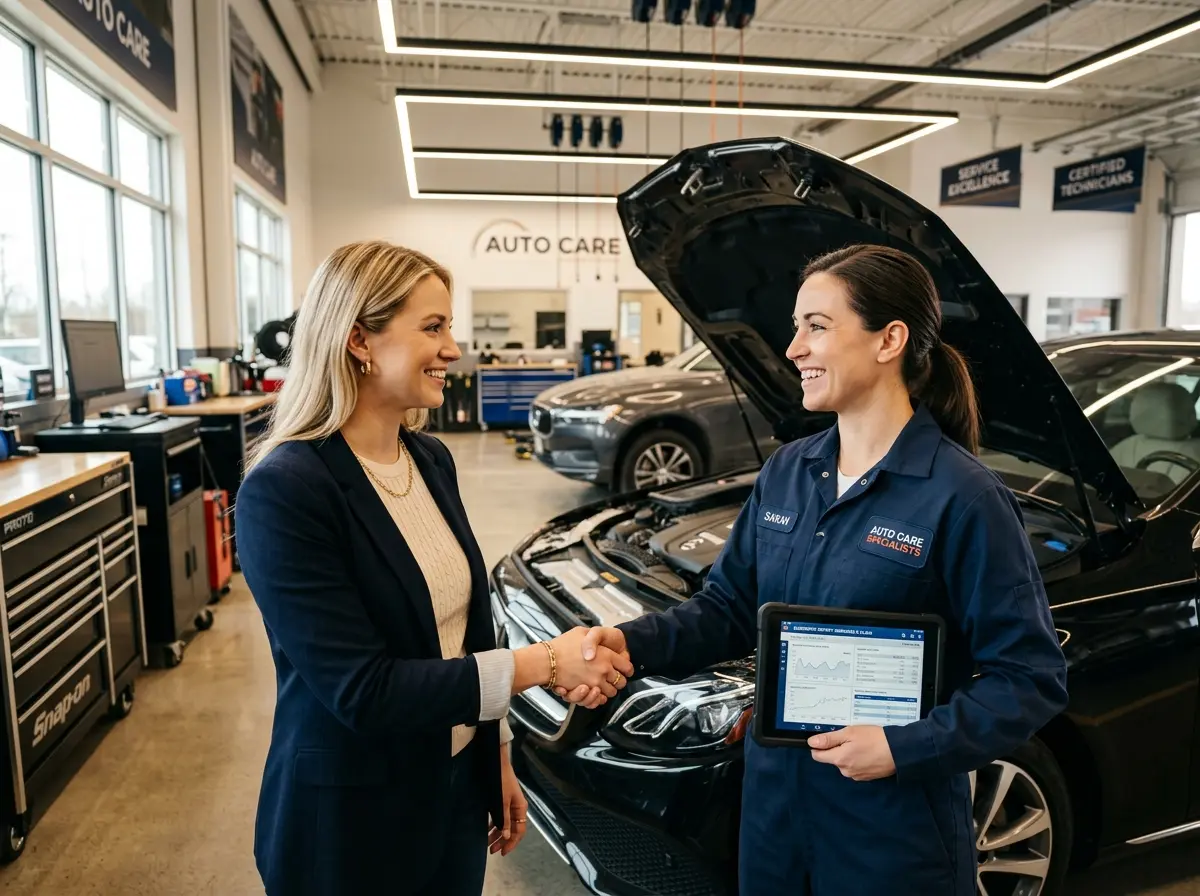
Look at your current marketing materials. Website photos, social media posts, mailers. How many feature women — not as props, but as actual customers making decisions? Representation matters because it signals who your shop considers a "normal" customer. If every photo is a man talking to a mechanic, you're subtly telling half your potential market that this place isn't really for them.
This doesn't require a full rebrand. Update your website hero image. Feature a testimonial from a female customer. Post social content that speaks to the questions women are actually Googling — "how do I know if my brakes need replacing?" or "what does a check engine light actually mean?" Becoming a trusted educational resource is one of the most effective ways to build credibility with an audience that's been historically underserved by the industry.
Create Content That Educates Without Condescending
There's a fine line between helpful and patronizing, and it's worth finding it carefully. Educational content — blog posts, short videos, social media tips — should explain car maintenance in plain language without assuming the reader knows nothing or treating the topic like it's too complex for a non-mechanic to grasp. Think of it as the difference between a doctor who explains a diagnosis clearly and one who just says "trust me, you need this."
Topics like seasonal maintenance checklists, how to read a tire tread, or what to expect during a multi-point inspection perform well with female audiences and build genuine authority for your shop. Bonus: this content also boosts your SEO, so you're not just earning trust — you're earning traffic.
Loyalty Programs and Follow-Up Communication
Women are more likely to remain loyal to a business that makes them feel valued after the transaction, not just during it. A simple follow-up text or email after a service visit — "thanks for coming in, here's a reminder for your next oil change" — goes a long way. A loyalty program with meaningful rewards (not just a punch card that lives in a junk drawer) gives customers a reason to choose you over a competitor when the options seem equal.
The key is consistency. Sporadic communication feels random and impersonal. A predictable, professional follow-up cadence feels like a business that has its act together — and that alone is a differentiator in an industry not exactly known for polished customer communication.
Quick Reminder About Stella
Stella is an AI robot employee and phone receptionist built for businesses like yours — greeting walk-in customers, answering phones around the clock, promoting services, and keeping your team focused on the actual work. She runs on a simple $99/month subscription with no upfront hardware costs, making her one of the most accessible upgrades an auto shop can make to its customer experience. If your front desk experience could use some consistency, Stella's worth a serious look.
Start Winning the Customers Your Competitors Are Overlooking
The opportunity here is straightforward, even if the execution takes some intention. Women control a majority of automotive service decisions, they're highly loyal when treated well, and they actively refer businesses they trust to their networks. The auto repair shops that recognize this and adapt their marketing and customer experience accordingly aren't just being progressive — they're being smart.
Here's where to start:
- Audit your current marketing materials for representation and tone. Does your messaging feel welcoming to a female audience, or does it silently suggest otherwise?
- Review your recent customer feedback — Google reviews, surveys, anything you have — specifically looking for patterns around how customers felt treated, not just whether the mechanical work was good.
- Improve your first impression, whether that's the phone experience, the walk-in experience, or both. This is often where the decision to return (or not) is actually made.
- Start producing educational content — even one blog post or short video per month positions your shop as a resource rather than just a vendor.
- Implement a follow-up system if you don't have one. Post-service communication is one of the highest-leverage, lowest-cost loyalty tools available to you.
The shops that will dominate the next decade aren't necessarily the ones with the best technicians. They're the ones that pair technical excellence with a customer experience that makes every person — Gary included — feel genuinely taken care of. Start there, and the rest tends to follow.