You're Sitting on a Goldmine and Don't Even Know It
Let's set the scene: your waiting room is full of patients who trust you, like you, and already hand you their mouths twice a year for cleaning. Some of them have been coming to you for a decade. And yet, statistically speaking, a good chunk of them have no idea you offer Invisalign — or if they do, nobody's ever really talked to them about it. That's not a missed opportunity. That's a missed revenue stream with a bow on it.
Here's the thing about Invisalign marketing that most dental practices get wrong: they spend money chasing new patients when their best prospects are already sitting in chair number three, scrolling through Instagram and wondering if they should finally do something about that slightly crooked bottom row. Your existing patient base is warm, trusting, and far easier to convert than a cold lead who found you through a Google ad. The only problem? You have to actually tell them.
This post is your nudge. Let's talk about why actively marketing Invisalign to your existing patients isn't just a good idea — it's one of the smartest growth moves your practice can make.
The Case for Marketing Invisalign Internally (Yes, It's Worth Saying Out Loud)
Your Existing Patients Already Trust You
Trust is the single most expensive thing to build in healthcare marketing. It takes time, consistency, and genuine relationship-building — and you've already done all of that with your current patients. When you recommend Invisalign to a patient you've known for five years, it doesn't feel like a sales pitch. It feels like advice from their dentist. That's an enormous advantage that no amount of paid advertising can replicate.
Studies suggest that converting an existing customer costs five times less than acquiring a new one, and that principle applies beautifully to dental practices. A patient who already trusts your clinical judgment is infinitely more likely to say yes to a treatment recommendation than someone who just found your website at 11pm. Use that trust intentionally.
Most Patients Don't Know Their Own Options
Here's a humbling truth: patients don't read your service menu the way you'd hope. They come in, get their teeth cleaned, nod politely at the hygienist's flossing advice they've been ignoring for years, and leave. Unless someone specifically brings up Invisalign in conversation, many patients simply assume it's not something their dentist offers — or that it's only for teenagers — or that it's wildly expensive. All of these assumptions are wrong, and all of them are yours to correct.
Proactively introducing Invisalign during hygiene appointments, through follow-up communications, and in your waiting room materials can dramatically shift patient awareness. You're not being pushy. You're being informative. There's a real difference, and your patients will recognize it.
The Numbers Make a Compelling Argument
Invisalign cases typically range from $3,000 to $8,000 depending on complexity and location. If your practice has even 500 active patients and a modest 5% conversion rate, that's 25 cases — potentially $100,000 to $200,000 in additional annual revenue from people who are already coming through your door. Now factor in that satisfied Invisalign patients tend to refer friends and family, often return for whitening and other cosmetic services, and become more engaged with their overall dental care. The downstream value is significant.
You don't need a massive marketing budget. You need a consistent, intentional approach to letting your existing patients know what's available to them.
How Smart Tools Can Amplify Your Invisalign Outreach
Let Technology Do the Talking (Literally)
One of the most consistent barriers to internal marketing in dental practices is simple bandwidth. Your front desk team is managing check-ins, insurance questions, appointment scheduling, and roughly forty-seven other things simultaneously. Asking them to consistently pitch Invisalign to every patient who walks in is a nice idea in theory. In practice, it gets forgotten by 10am on a busy Monday.
This is exactly the kind of problem that Stella, the AI robot employee and phone receptionist, was built to solve. In a dental office setting, Stella stands in your waiting room and proactively engages patients — bringing up current promotions, answering questions about services like Invisalign, and keeping the conversation going without any effort from your staff. She's also available 24/7 to answer phone calls, so when a patient calls after hours wondering about treatment options, Stella has the answers ready. Your team comes in the next morning with informed, interested patients rather than missed opportunities.
Building an Invisalign Marketing Strategy That Actually Works
Start With a Simple Conversation at Every Appointment
The most effective Invisalign marketing happens chair-side, and it doesn't require a script. Train your hygienists and clinical assistants to naturally bring up alignment during routine appointments. If a patient mentions feeling self-conscious about their smile, that's your opening. If you notice mild crowding that could benefit from treatment, say so. A casual, genuine comment like "Have you ever thought about straightening that? You'd actually be a great candidate for Invisalign" is more powerful than any brochure.
Document these conversations in patient notes so you can follow up intelligently at the next visit. Patients appreciate when their provider remembers what they discussed — it reinforces that trust you've worked so hard to build.
Use Email and Text Campaigns Strategically
Your patient list is a legitimate marketing asset, and most practices dramatically underutilize it. A well-timed email campaign highlighting your Invisalign offering — especially tied to a seasonal promotion or a "new year, new smile" angle — can generate real interest from patients who simply hadn't thought to ask. Keep the messaging warm and personal, not corporate. You're their dentist, not a faceless brand.
Consider segmenting your outreach based on patient history. Adults in their 30s and 40s who had orthodontic work as teenagers often experience relapse and may be ideal candidates. Patients who've expressed cosmetic interest in the past are obvious targets. A little thoughtfulness in your targeting goes a long way toward making patients feel seen rather than spammed.
Make Your Physical Space Do Some of the Work
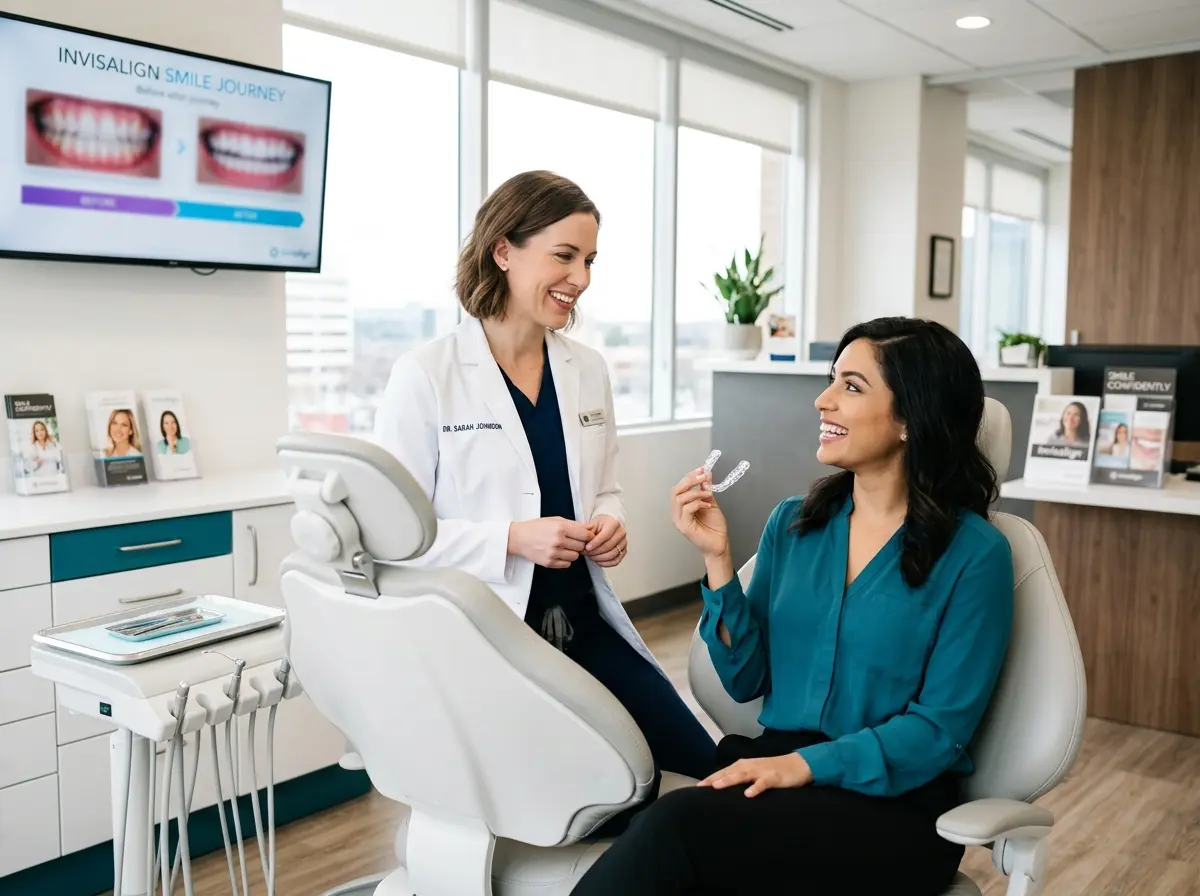
Your waiting room is real estate. Use it. Before-and-after displays, tasteful signage, and even a simple iPad kiosk with Invisalign information can spark curiosity without requiring anyone on your team to initiate the conversation. Patients who are interested will ask — and then your team can follow through with enthusiasm rather than feeling like they're cold-calling their own patients.
Don't underestimate the power of patient testimonials either. A framed photo and quote from a real patient who loves their results is worth more than any stock-photo brochure. Ask your happiest Invisalign patients if they'd be willing to share their story. Most people are genuinely flattered to be asked.
Quick Reminder About Stella
Stella is an AI robot employee and phone receptionist designed to greet patients, promote services, and answer questions — both in your waiting room as a physical kiosk and over the phone 24/7. She runs on a straightforward $99/month subscription with no upfront hardware costs, and she's ready to start working the moment you set her up. For a dental practice looking to promote Invisalign consistently without adding to your team's workload, she's a genuinely practical addition.
Your Next Steps Start Today
Marketing Invisalign to your existing patients isn't complicated, and it doesn't require a huge investment. What it requires is intention. Start by auditing how consistently your team is bringing up Invisalign in appointments — you may find the answer is "almost never," and that's okay. It's fixable. Build a simple chair-side talking point, send one well-crafted email to your patient list, update your waiting room materials, and then stay consistent.
From there, layer in the tools that help you maintain that consistency without burning out your staff. Automate your follow-up sequences. Use technology to keep patients informed and engaged. Let your waiting room work harder. The patients are already there — they just need someone to start the conversation.
The practice that markets Invisalign proactively to its existing base will consistently outperform the one waiting for patients to ask. Your patients trust you, they're already in your chair, and some of them are quietly hoping you'll bring it up. So bring it up.