Introduction: Your Results Are Stunning — Now Prove It
You've spent years perfecting your craft, investing in top-tier equipment, hiring skilled injectors, and building a med spa that genuinely delivers results. Your clients walk out glowing. They tell their friends. They leave you five-star reviews that make your heart sing. And yet — your Instagram grid looks like it was assembled by someone who just discovered filters in 2014, your website "gallery" has approximately four photos, and your marketing library is basically a graveyard of missed opportunities.
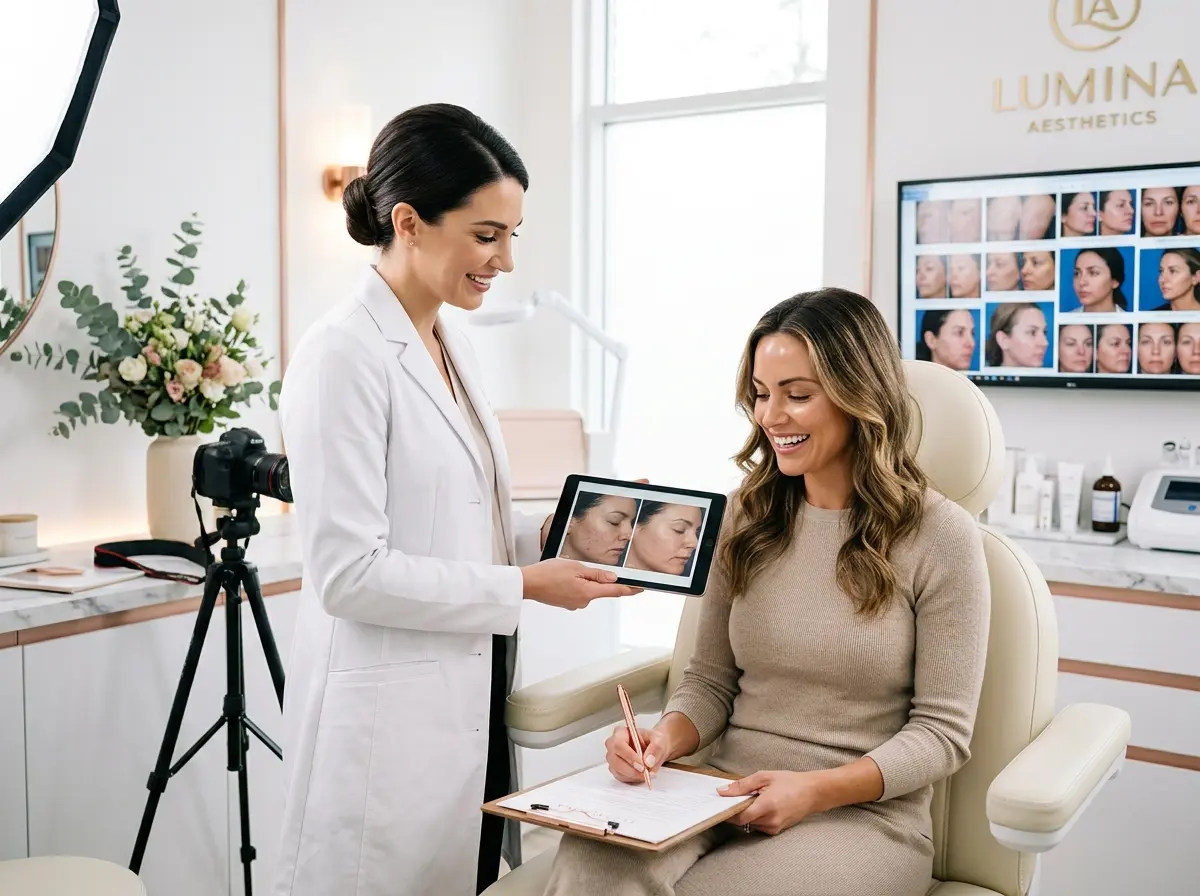
Here's the uncomfortable truth: before-and-after photos are the single most persuasive marketing asset a med spa can have, and most med spas are either not collecting them systematically or letting signed releases gather dust in a filing cabinet somewhere between last year's tax forms and a half-eaten granola bar.
If you're serious about growing your med spa — and we assume you are, since you clicked on this — you need a before-and-after photo release system that doesn't just check a legal box but actively builds a marketing library you can use for years. Let's talk about how to build one that actually works.
Why Before-and-After Photos Are Non-Negotiable for Med Spa Growth
The Psychology of Social Proof in Aesthetic Medicine
Prospective clients considering Botox, filler, laser treatments, or body contouring are making deeply personal decisions. They're not buying a pair of shoes they can return if they don't fit. They're trusting you with their face. That level of trust doesn't come from a clever tagline or a stock photo of a woman laughing near a cucumber — it comes from seeing real results on real people.
Studies in consumer behavior consistently show that before-and-after imagery dramatically increases conversion rates for aesthetic services. One survey found that over 70% of consumers said visual testimonials — including transformation photos — were more influential than written reviews when making purchase decisions about appearance-related services. When a potential client sees someone with a similar skin tone, age, or concern and watches it transform, your credibility skyrockets in a way no amount of ad spend can replicate.
The Legal Reality You Cannot Ignore
Before you get excited and start snapping away, let's be very clear: using patient photos without a properly executed release is not just bad practice — it can expose your med spa to serious legal liability. HIPAA regulations apply to medical spas, and using identifiable patient images without documented written consent is the kind of mistake that ends careers and invites regulatory scrutiny.
Your photo release system needs to capture the patient's name, the date, the specific treatments being documented, and explicit authorization for each intended use — social media, website, print advertising, and so on. It should be separate from your general treatment consent forms, clear in plain language, and stored somewhere you can actually find it when your marketing team asks for it at 9 p.m. on a Tuesday.
Building Consistency Into Your Collection Process
The practices with robust before-and-after libraries didn't get there by occasionally remembering to ask. They built the photo release and collection step into their standard patient workflow — as automatic as reviewing post-care instructions or scheduling a follow-up. Consider designating a specific point in your intake process where photo consent is addressed, making it feel like a natural part of the experience rather than an afterthought. Train your team so that every provider, every time, knows exactly what to say and where the forms live.
Streamlining Your Intake and Consent Workflow
How Stella Can Help You Capture Consent and Client Information Efficiently
This is where technology can do some heavy lifting for you. Stella, the AI robot employee and phone receptionist, is built for exactly this kind of intake workflow. Whether she's greeting clients as they arrive at your kiosk or gathering information during a phone call before the appointment even happens, Stella can walk clients through conversational intake forms — including photo release consent questions — in a natural, friendly way that doesn't feel like filling out government paperwork.
Her built-in CRM lets you tag clients by treatment type, consent status, and photo usage authorization, so when your marketing team needs "three great lip filler befores-and-afters from the past six months," you're not digging through a spreadsheet or worse — calling the front desk to ask if anyone remembers signing something. Stella also answers phone calls 24/7, meaning a prospective client calling at 10 p.m. to ask about your Sculptra package can get real answers, book a consultation, and even begin the intake process before they've set foot in your spa.
Organizing and Leveraging Your Photo Library for Maximum Marketing Impact
Creating a Tagging and Categorization System That Scales
Collecting photos is only half the battle. The other half is being able to find and use them when you need them. A well-organized photo library is tagged by treatment type, concern addressed, approximate age range, skin tone or type, and photo usage permissions. Cloud-based storage solutions like Google Drive, Dropbox, or dedicated medical photo apps such as TouchMD or DermPhoto allow your team to access, organize, and retrieve images quickly — without emailing files around or having someone scroll through their personal iPhone camera roll at a team meeting.
Build a consistent naming convention from day one. Something like "LipFiller_Client0042_Before_2024-09" isn't glamorous, but future-you will be extremely grateful when you're pulling assets for a Q4 campaign and don't have to open 300 mystery files to find them.
Turning Your Library Into a Multi-Channel Marketing Engine
Once you have a real library — and yes, it takes a few months to build, so start now — the marketing possibilities expand significantly. Here's how smart med spas are putting their photo assets to work:
- Social media: Before-and-after carousels on Instagram consistently outperform standard promotional posts in both reach and saves. Post regularly and vary the treatments you highlight.
- Email campaigns: Feature a "Treatment of the Month" result in your newsletter. Real results drive click-through rates far better than generic promotional language.
- Website galleries: A well-organized, filterable results gallery can significantly reduce the number of "Can I see some examples?" calls your front desk receives.
- Consultation materials: Providers who walk clients through relevant before-and-after images during consultations report higher treatment acceptance rates and more confident clients.
- Paid advertising: Before-and-after imagery (where permitted by platform policies) is among the highest-performing creative for med spa ad campaigns on Meta and Google.
Respecting Client Privacy While Maximizing Reach
Some clients will enthusiastically consent to full-face photos with their name attached. Others will only agree to partial images or anonymous use. Both are valuable — and both should be respected to the letter of what was consented to. Creating tiered categories in your library (full consent, partial consent, anonymous use only) helps you stay compliant while still maximizing what you can use. Never assume that a client who consented to website use also consented to paid social advertising — those are different permissions and should be documented separately. A little extra diligence here protects your client relationships and your reputation.
Quick Reminder About Stella
Stella is an AI robot employee and phone receptionist that works at your front door and answers your phones — so your team can focus on delivering excellent care instead of fielding the same questions all day. At just $99/month with no upfront hardware costs, she's an surprisingly affordable addition to any med spa that wants to look and operate more professionally without adding headcount.
Conclusion: Start Building Your Library Today — Not "Soon"
Here's the thing about "soon": it never actually arrives. Every week you delay implementing a real before-and-after photo release system is another week of stunning results walking out your door undocumented, another competitor building the library you should have, and another prospective client choosing the med spa with the better Instagram gallery over yours.
To get started, take these concrete steps this week:
- Draft or update your photo release form with help from a healthcare attorney familiar with your state's requirements. Make sure it covers all intended uses.
- Integrate the release into your standard intake workflow so it happens automatically with every new client and every new treatment cycle.
- Set up a cloud-based photo storage system with a clear naming and tagging convention before you upload a single image.
- Assign ownership — someone on your team should be responsible for photo collection, organization, and release tracking. It doesn't happen by committee.
- Start using what you collect within 30 days. A library that never gets published is just a hard drive's worth of wasted potential.
Your results are the product. Document them like it matters — because it absolutely does. The med spas that are dominating their local markets right now aren't necessarily doing better work than you are. They're just better at showing it.