Introduction: Because "Winging It" Is Not a Kitchen Strategy
Let's be honest — you didn't open a restaurant to run a guessing game every night. Yet, without a formal line check procedure before each service, that's essentially what you're doing. You're hoping the soup is seasoned correctly, trusting that the fish is at the right temperature, and believing — with the faith of a thousand line cooks — that everything on that pass is going to be perfect. Spoiler alert: it won't always be.
A line check is one of the most unglamorous, underappreciated, and absolutely non-negotiable habits in a well-run restaurant kitchen. It's the culinary equivalent of a pilot's pre-flight checklist — and unless you'd board a plane with a pilot who skips that step, you shouldn't be sending plates out without one. According to the National Restaurant Association, poor food quality and inconsistency rank among the top reasons customers don't return. One bad experience, and that guest isn't coming back. They're writing a review instead.
The good news? A formal line check procedure is simple to implement, takes less time than you think, and pays dividends in consistency, food cost control, and staff accountability. Let's break down exactly why this habit should be as sacred in your restaurant as the chef's knife roll.
What a Line Check Is (and Why Most Restaurants Do It Wrong)
The Definition Behind the Discipline
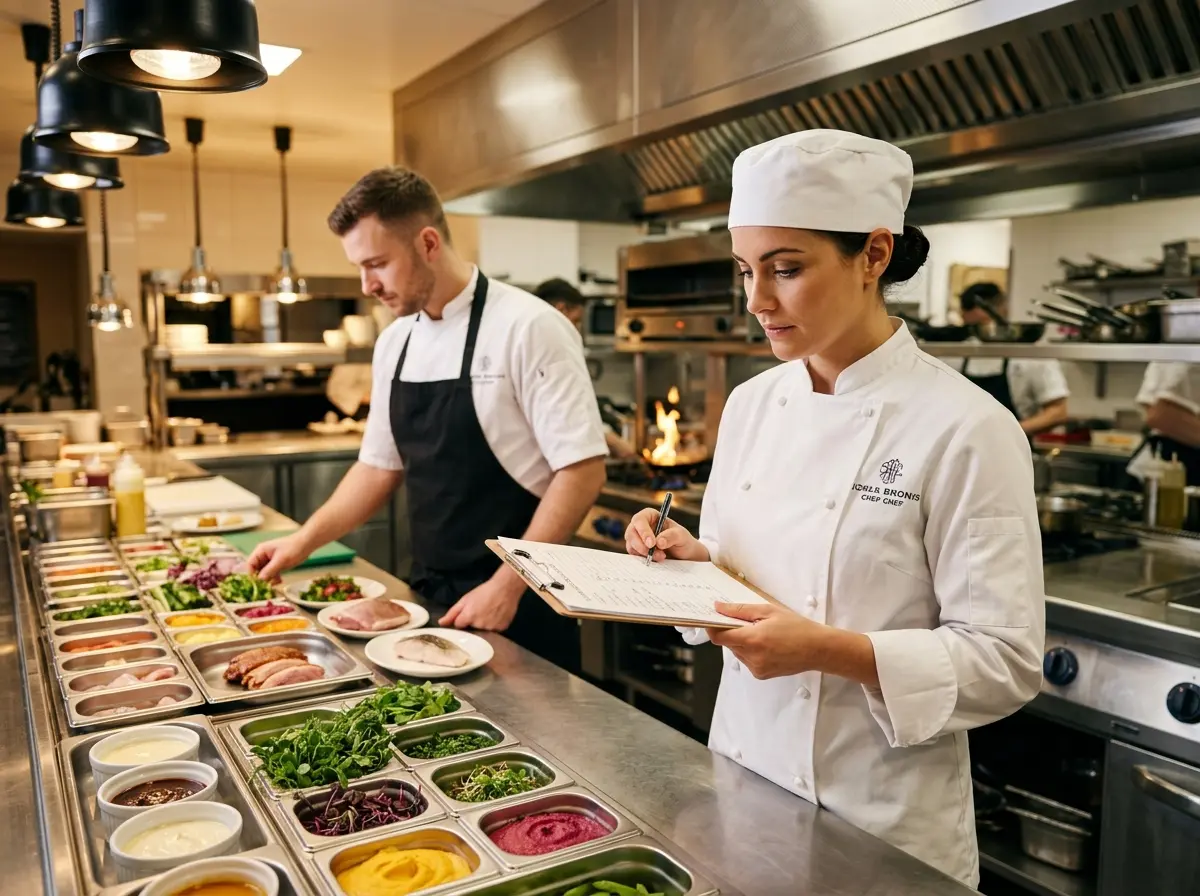
A line check is a systematic, pre-service inspection of every station on your line — conducted by a chef or manager — to verify that all food items meet your standards for quality, temperature, taste, portioning, and presentation. It's not a vibe check. It's not a quick glance into a few pans. It's a structured walkthrough with a written form, a thermometer, a tasting spoon, and eyes sharp enough to catch the prep cook who decided the brunoise was "close enough."
Most restaurants that do perform some version of a line check are doing it informally — a rushed walkthrough, a few questions to the sous chef, maybe a bite of something if it smells good. That's not a line check. That's optimism with a clipboard.
What a Proper Line Check Actually Covers
A formal line check should include, at minimum, the following elements for each station and each item on the line:
- Temperature verification — hot foods above 140°F, cold foods below 40°F, no exceptions
- Taste and seasoning — does it match the standard recipe? Every. Single. Time.
- Portion accuracy — are proteins weighed? Are sauces ladled correctly?
- Visual presentation — does it look like the photo in the recipe card?
- Par levels and quantity — is there enough to get through service without scrambling?
- Freshness and dating — is anything expired, improperly labeled, or suspiciously optimistic about its shelf life?
- Equipment status — are burners, fryers, and refrigeration units performing correctly?
This should be documented on a physical or digital line check form, signed off by the responsible chef or manager, and archived. If something fails the check, it gets corrected before service begins — not mid-rush when table 12 is already waiting on their entrée.
The Cost of Skipping It
Let's talk numbers. Food waste in the restaurant industry costs operators an estimated $162 billion annually in the United States alone. A meaningful portion of that waste is directly attributable to food that enters service without proper quality checks and ends up being sent back, comped, or quietly thrown away. Beyond food cost, there's the reputational cost — a dish that goes out under-seasoned or at the wrong temperature doesn't just disappoint one guest, it creates a negative story that often ends up on Yelp, Google, or worse, a food blogger's Instagram.
How the Right Tools and Systems Can Support Your Line Check Process
Building Accountability Into Your Operation
The line check doesn't exist in isolation — it's part of a broader culture of operational discipline. And here's where technology can quietly carry some of the load, especially for the parts of your restaurant that happen outside the kitchen. While your kitchen team is running the line check, your front-of-house and management staff should be equally prepared for service. That means phones answered, guests greeted, questions fielded — without pulling a manager off the floor for every inquiry.
That's where Stella, the AI robot employee and phone receptionist, can genuinely help. For restaurants with a physical location, Stella stands inside the space and greets walk-in guests, promotes daily specials, and answers questions about the menu, hours, or policies — freeing your staff to focus on service execution rather than fielding the same questions on repeat. On the phone side, Stella answers calls 24/7, handles reservation inquiries, and collects customer information through conversational intake forms, so your managers aren't buried in voicemails during pre-service prep. It's not a replacement for a great team — it's operational horsepower in the spots where humans are spread thin.
Building a Line Check Procedure That Actually Sticks
Creating Your Line Check Form
The best line check form is the one your team will actually use consistently — which means it needs to be clear, fast to complete, and specific to your menu. Generic templates exist online, but a form that lists ingredients you don't carry or stations you don't have will be ignored within a week. Build yours from scratch using your actual menu and station layout.
Organize the form by station (cold apps, hot apps, sauté, grill, fry, dessert, etc.), and list each item with columns for temperature, taste (pass/fail), portion (correct/incorrect), visual (pass/fail), and a notes field. Add a timestamp, the name of the person conducting the check, and a sign-off line. Digital versions on a tablet are increasingly popular and make archiving effortless — but a laminated paper form with a dry-erase marker works just as well if that's your kitchen's reality.
Training Your Team to Own the Process
A line check form without trained eyes behind it is just paper. Your chefs and managers need to understand why the line check matters, not just how to fill out the form. Invest time in training sessions that walk through each standard — what the correct temperature looks and tastes like, what a properly portioned plate looks like, what "passing" actually means for each item. Role-play the line check with your sous chefs. Have new managers shadow a veteran through a full check before running one independently.
Accountability matters too. When a station fails a line check, the response shouldn't be punitive — it should be corrective and educational. Build a culture where flagging a problem before service is celebrated, not punished. The alternative — a problem flagged by a guest at the table — is far more expensive in every sense.
Making It a Non-Negotiable Ritual
The restaurants that do line checks consistently aren't doing it because they're particularly disciplined by nature. They're doing it because they've made it structural — it's scheduled, it's timed, it's part of the service opening sequence, and service literally does not begin until it's complete. Set a hard rule: no service opens without a completed, signed line check form. Build it into your opening checklist, your manager's responsibilities, and your training materials. When new hires see that this is non-negotiable on day one, they carry that standard forward.
Some operators run a quick debrief after service to compare what failed the line check against what was sent back during service. Over time, this data tells a story — recurring failures at the same station, the same items, or the same prep cook's shifts. That's information you can act on before it becomes a pattern that costs you guests.
Quick Reminder About Stella
Stella is an AI robot employee and phone receptionist designed to support businesses like yours — greeting guests in person, answering phone calls around the clock, promoting specials, and handling routine questions so your team can stay focused on what they do best. At just $99/month with no upfront hardware costs, she's an easy addition to a restaurant operation that's serious about running efficiently from the host stand to the kitchen pass.
Conclusion: Consistency Is the Product You're Actually Selling
Your guests don't come back because of a single extraordinary meal. They come back because they trust that the experience will be consistently excellent — that the steak will be perfectly seasoned every Tuesday, that the soup will be hot in January and July, and that the fish special they raved about will taste exactly as good when they bring their in-laws. That trust is built through systems, and the line check is one of the most important systems in your kitchen.
Here's your action plan to get started:
- Map your stations — list every station and every item that will be on the line for the next service period.
- Build your form — create a line check form specific to your menu with clear pass/fail criteria for each item.
- Set the standard — train your management team on what "passing" means, with tastings and visual references.
- Make it mandatory — add the line check to your service opening sequence and do not open service until it's complete.
- Review the data — track failures over time and use that information to address recurring gaps in prep quality or technique.
Consistency is not an accident. It's a habit, repeated daily, by a team that's been given the right tools and the right expectations. Start your line check procedure before your next service — your guests, your food costs, and your Google rating will thank you.