Your Service Lane Is a Revenue Engine — So Why Is Your Phone Killing the Vibe?
Let's paint a picture. A customer calls your dealership to schedule a service appointment. They've been a loyal customer for three years. They're not looking for a fight — they just want an oil change and maybe a tire rotation. Simple enough, right? Except they're placed on hold for four minutes, transferred twice, accidentally disconnected, and then — in a moment of pure automotive irony — they give up and schedule at the dealership across town.
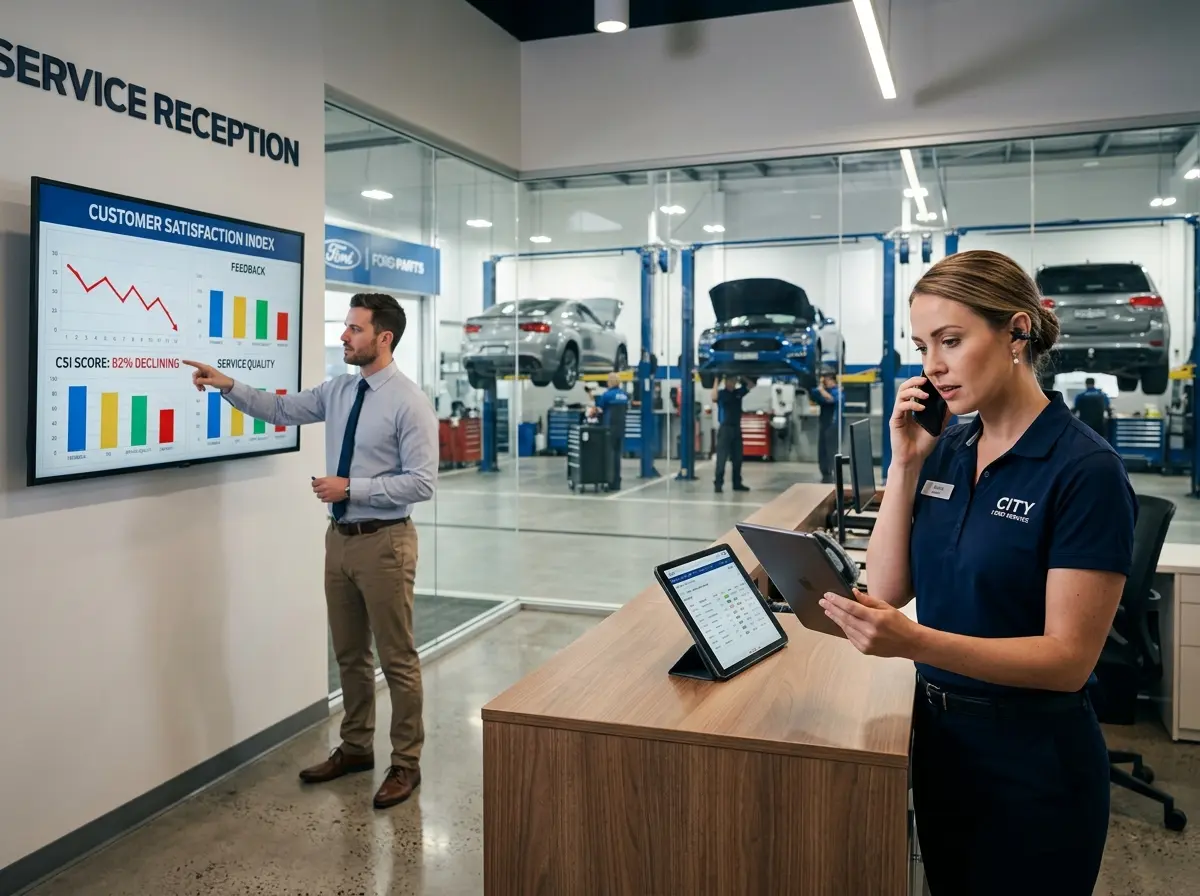
Sound familiar? If it does, you're not alone. And here's the uncomfortable truth: your CSI scores aren't suffering because your technicians are bad at their jobs. They're suffering because the experience starts long before the car pulls into your service bay. It starts with the phone call. And for many dealerships, that first touchpoint is where customer satisfaction goes to die.
CSI (Customer Satisfaction Index) scores are the lifeblood of your OEM relationship, your bonuses, and frankly, your reputation. Yet dealerships routinely invest thousands in loaner fleets, espresso machines, and waiting room TVs — while completely neglecting the one moment that shapes a customer's entire perception of their visit: the moment they try to reach you. Let's fix that.
The Hidden Ways Your Service Lane Phones Are Destroying Customer Trust
The Hold Time Problem Is Worse Than You Think
Studies consistently show that the average caller will abandon a hold queue after just 90 seconds. Yet the average dealership service department puts callers on hold for two to four minutes — sometimes significantly longer during peak hours. That's not a customer service strategy; that's a customer repellent strategy.
What makes this particularly painful is that the customers calling your service lane are often already emotionally primed for frustration. Their check engine light is on. Their car is making a noise that sounds expensive. They're not calling because they're bored — they're calling because they need help. Every second they spend on hold is a second they spend reconsidering their loyalty to your brand. By the time a service advisor finally picks up, that customer has already mentally drafted their one-star Google review.
The fix isn't simply "hire more people." Staffing is expensive, turnover in dealership service departments is notoriously high, and adding bodies doesn't guarantee consistency. What you need is a reliable first line of communication that never puts someone on hold because it's too busy helping the person in front of it.
Inconsistent Answers Are a CSI Ticking Time Bomb
Here's a scenario that plays out in dealerships every single day. A customer calls Monday morning and asks how much a brake job costs. The advisor who answers gives them a rough estimate. The customer comes in Thursday. A different advisor — perfectly competent, perfectly well-meaning — gives them a slightly different number. Now the customer feels misled, even if no one did anything wrong.
Inconsistency breeds distrust, and distrust tanks CSI scores. Customers don't fill out satisfaction surveys thinking about your technician's labor efficiency. They fill them out thinking about how the experience felt. And if it felt inconsistent, confusing, or like you couldn't get your story straight, that feeling is what ends up in the OEM's data set.
After-Hours Calls Are Silent Revenue Leaks
Your service department closes at 6 PM. Your customers' car problems do not. A significant portion of service scheduling decisions happen in the evening — after work, after dinner, when people finally have a moment to deal with the nagging issue they've been ignoring all week. If your phone goes to a generic voicemail (or worse, just rings indefinitely), you're handing those appointments to competitors who are available.
The math is simple and a little painful. Even if you're missing just five service appointments per week due to after-hours unavailability, at an average repair order of $300–$400, that's potentially $6,000–$8,000 in monthly revenue quietly walking out the door. No dramatic incident, no angry customer — just a missed call and a lost opportunity, repeated over and over again.
A Smarter First Impression Starts With Smarter Technology
How AI Can Stabilize Your Service Lane Communication
This is where Stella enters the picture — and where the conversation shifts from problem to practical solution. Stella is an AI robot employee and phone receptionist designed to handle exactly the kind of communication gaps that are quietly undermining your CSI scores. On the phone side, she answers calls 24/7 with consistent, accurate information about your services, pricing, hours, and policies — no hold music, no transfers to voicemail, no "let me check on that and call you back" dead ends.
For dealerships with a physical service lane waiting area, Stella also operates as a human-sized in-store kiosk, greeting customers proactively and answering questions while your advisors handle the technical work. She can promote current service specials, collect customer information through conversational intake forms, and feed everything into a built-in CRM — complete with AI-generated customer profiles, custom tags, and manager push notifications when voicemails come in. The result is a front-of-house experience that feels polished, consistent, and professional at every touchpoint, from the first phone call to the waiting room check-in.
Practical Steps to Rebuild Your Service Lane Call Experience
Audit Your Current Phone Process Honestly
Before you can fix the problem, you need to understand exactly where it's breaking down. Spend one week doing something most dealership managers never actually do: call your own service department. Call at 8 AM on a Monday. Call at 5:45 PM on a Friday. Call on Saturday morning. Document what happens. How long are you on hold? Are the answers consistent? Is the tone friendly and professional, or is it the voice of someone who has answered the same question forty times today and deeply wishes they were somewhere else?
Be ruthless in your evaluation. Your customers are. Also pull your phone system data if you have it — missed call rates, average hold times, and call abandonment rates tell a story that's often more sobering than leadership expects. Use that data as your baseline.
Train for the Emotional Tone, Not Just the Script
Most dealership phone training focuses on what to say. That's necessary, but it's not sufficient. Customers are remarkably sensitive to how something is said — the energy behind the words, the pace of the conversation, whether the person on the other end sounds genuinely helpful or quietly resentful. CSI surveys measure perception, and perception is emotional.
Invest in training your service advisors on phone tone, active listening, and de-escalation. Role-play difficult calls. Celebrate advisors who get positive call feedback. Create a culture where the phone is treated as seriously as the face-to-face interaction — because in your customer's mind, it absolutely is. One practical tip: have advisors smile while they talk on the phone. It sounds ridiculous, but it genuinely changes the vocal tone, and customers can hear the difference.
Create a Closed-Loop System for Follow-Up
One of the most underrated drivers of CSI scores is follow-up — not the generic "thank you for your business" text, but a genuine, personalized check-in after a service visit. Did the repair fix the problem? Are they happy with the experience? Do they have any questions about what was done?
This kind of follow-up communicates that you care about the outcome, not just the transaction. It also gives you an early warning system — if a customer is unhappy, you want to know before they tell the OEM surveyor. Build a follow-up process into your service workflow, assign ownership to it, and treat it as non-negotiable. A customer who feels heard after a mild complaint is often more loyal than one who never had a problem at all.
A Quick Reminder About Stella
Stella is an AI robot employee and phone receptionist that works 24/7 to answer calls, greet in-store customers, promote services, collect intake information, and manage customer contacts — all for $99/month with no upfront hardware costs. She's not a replacement for your people; she's the reliable, consistent front line that makes your people more effective. Setup is simple, she's always ready, and she never has a bad day.
The CSI Score You Want Is Already Within Reach
Here's the good news: you don't need a complete operational overhaul to meaningfully improve your CSI scores. The biggest wins are often hiding in the simplest places — a phone call that gets answered promptly, a consistent answer to a pricing question, a follow-up text that makes a customer feel remembered. These aren't expensive fixes. They're discipline and system fixes.
Start with the audit. Understand exactly where your service lane communication is falling short. Then address the structural gaps — whether that means better training, smarter technology, improved follow-up protocols, or all three. Your OEM's survey questions aren't asking whether your alignment rack is state-of-the-art. They're asking whether the customer felt valued. And that experience is shaped far more by your communication process than by your equipment.
The dealerships that consistently win on CSI aren't necessarily the ones with the fanciest facilities. They're the ones that treat every customer interaction — including the ones that happen over the phone at 8 PM on a Tuesday — as an opportunity to earn loyalty. Make that your standard, and the scores will follow.