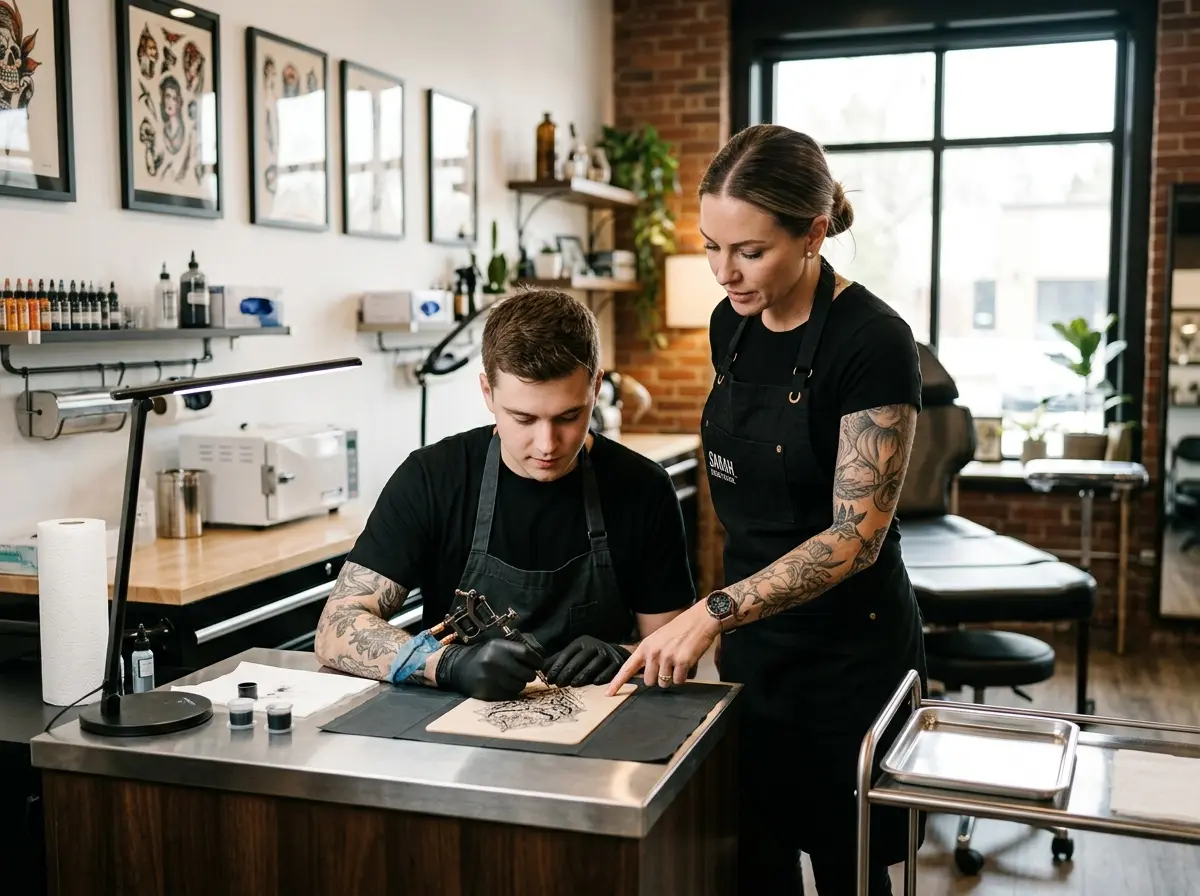
So You Want to Build an Apprenticeship Program (Without Losing Your Mind)
Let's be honest: finding great tattoo artists isn't exactly like posting a job listing for a data entry clerk and watching the applications roll in. The tattoo industry runs on skill, mentorship, and a culture of earned trust — and if you want your studio to thrive long-term, building a legitimate apprenticeship program isn't just a nice idea. It's a survival strategy.
The problem? Most studio owners figure this out the hard way. They take on an apprentice with no structure, no curriculum, and no clear expectations — and six months later, they're either babysitting a frustrated artist or watching someone they trained walk across the street to a competitor. Sound familiar? You're not alone.
The good news is that a well-designed apprenticeship program does more than develop talent. It builds your studio's reputation, creates loyalty, and positions you as a destination for serious artists who want to learn from the best. Here's how to build one that actually works.
Laying the Foundation: What a Real Apprenticeship Program Looks Like
Before you post a single flyer or take a single portfolio review meeting, you need to define what your program actually is. Too many studios treat apprenticeships like an informal "hang around and figure it out" arrangement. That works great if you enjoy chaos. For everyone else, structure is your friend.
Define Your Program's Scope and Timeline
A professional apprenticeship program should have a clear beginning, middle, and end. Industry-standard apprenticeships typically run between one and three years, depending on the apprentice's starting skill level and the depth of your program. Within that timeframe, you should map out milestone phases — foundational skills and studio culture in the early months, technical tattoo work under supervision in the middle phase, and supervised client work with increasing independence toward the end.
Put it in writing. A formal apprenticeship agreement protects both you and the apprentice, outlines compensation (if any), clarifies ownership of work created during training, and sets expectations about exclusivity, conduct, and graduation criteria. It also signals that you're serious — which, in turn, attracts serious candidates.
Develop a Curriculum (Yes, an Actual Curriculum)
You wouldn't hand someone a tattoo machine on day one, so don't hand them a vague promise to "teach them everything you know" either. A structured curriculum covers a lot of ground beyond needle technique. Consider organizing your program around core competency areas:
- Sanitation and safety protocols — non-negotiable, and legally significant in most jurisdictions
- Studio operations — how appointments are scheduled, how clients are handled, how the shop runs day-to-day
- Art and design fundamentals — drawing, composition, flash design, and understanding how art translates to skin
- Machine mechanics and needle knowledge — building, tuning, and understanding the tools
- Client communication — consultation skills, managing expectations, handling revisions gracefully
- Business basics — pricing, tipping culture, professional boundaries, and building a clientele
You don't have to reinvent the wheel every time. Once you document your curriculum, it becomes a reusable asset that makes every future apprenticeship smoother and more consistent.
Establish Clear Evaluation Criteria
How will you know when your apprentice is ready to advance? Gut feeling is a legitimate part of this industry — but it's not enough on its own. Define observable, measurable benchmarks at each stage. This might include completing a minimum number of practice pieces, demonstrating consistent line quality, passing a sanitation knowledge test, or conducting a mock client consultation that you evaluate against a rubric. Clear criteria remove ambiguity, reduce conflict, and give apprentices something concrete to work toward. They'll thank you for it — eventually.
Attracting the Right Candidates (And Filtering Out the Rest)
Once your program is structured, the next challenge is finding people worth putting into it. Here's the uncomfortable truth: most people who apply for tattoo apprenticeships are not ready. That's not a knock on their passion — it's just the reality. Your job is to build a process that surfaces the rare candidates who are.
Create a Portfolio Submission Process That Does the Heavy Lifting
A strong portfolio submission process filters candidates before you invest any of your time. Require applicants to submit a portfolio of original artwork (not traced, not digital-only), a written statement explaining why they want to apprentice at your studio specifically, and optionally a short video introduction. This immediately separates people who are serious from people who thought submitting their Instagram grid would be sufficient.
Promote your open applications through your studio's social media, local art school connections, and tattoo conventions. Word of mouth still matters enormously in this industry — let your existing artists and clients know you're looking. The best apprentices often come through trusted referrals.
Streamlining Studio Operations While You Focus on Training
Here's something nobody tells you when you decide to run an apprenticeship program: it takes a significant amount of your time and mental bandwidth. And your studio still needs to run. Clients still need to be answered. Phones still need to be picked up. Walk-ins still need to be greeted. You can't do it all yourself — and frankly, you shouldn't have to.
Let Technology Handle the Routine So You Can Focus on the Important Stuff
This is where smart operational tools make a real difference. Stella, the AI robot employee and phone receptionist, is one example worth knowing about. Stella handles the front-of-house work that constantly pulls studio owners away from what matters — greeting customers who walk in, answering phones 24/7, promoting current specials, and fielding the endless stream of "what are your hours?" and "how much does a small tattoo cost?" questions that eat up your day.
While you're evaluating portfolios, running training sessions, or actually tattooing clients, Stella keeps operations humming at the front desk and on the phone line without missing a beat. For a studio building an apprenticeship program, reducing the operational noise means you can invest more of your real attention into developing talent — which is the whole point.
Retaining Your Graduates and Building a Studio Legacy
Congratulations — your apprentice has made it through the program and they're genuinely talented. Now what? This is the part where many studio owners drop the ball entirely, investing years into someone only to watch them leave the moment they have options. Retention isn't guaranteed, but it's absolutely influenced by the environment you build.
Create a Path Forward, Not Just a Finish Line
When an apprenticeship ends, the relationship shouldn't. Talented artists want to know there's room to grow within your studio. Think about what you can offer beyond the apprenticeship itself — a booth rental arrangement with favorable terms for graduates, priority scheduling for client slots, creative freedom to develop their own style, or even a mentorship role in future apprenticeship cohorts. When artists can see a future at your studio, they're far less motivated to leave it.
Have honest conversations about compensation, expectations, and goals before the program ends. Don't let your graduating apprentice make decisions in an information vacuum. If you want them to stay, tell them — and make the offer worth staying for.
Build a Studio Culture That Artists Actually Want to Be Part Of
Culture is the thing that keeps people even when the money is comparable elsewhere. A studio known for mutual respect, creative collaboration, fair business practices, and genuine mentorship becomes a place artists want to call home. That reputation also feeds your next round of applicants — the best candidates research studios carefully, and a strong culture makes you the obvious choice.
Invest in team dynamics. Celebrate wins publicly. Handle conflicts directly and privately. Create rituals that reinforce your studio's values, whether that's a monthly portfolio critique session, attending conventions together, or simply maintaining a workspace that people are proud to show clients. The small things compound over time into something meaningful.
Track Your Program's Success and Iterate
After each apprenticeship cycle, conduct a formal review. What went well? What took longer than expected? Where did the curriculum fall short? Ask your graduate for honest feedback too — they have a perspective you don't. Use that information to refine the program before the next cohort begins. A program that improves with every cycle becomes a genuine competitive advantage, and eventually, a defining part of your studio's identity.
Quick Reminder About Stella
Stella is an AI robot employee and phone receptionist designed for businesses like yours — she greets customers in-store, answers phone calls around the clock, promotes your services and specials, and handles the repetitive front-desk work that quietly consumes your day. At $99/month with no upfront hardware costs, she's the kind of staff member who never calls in sick, never needs a lunch break, and never requires her own apprenticeship.
Build Something Worth Being Apprenticed Into
The studios that attract and retain top talent aren't necessarily the most famous or the most expensive — they're the ones that have built something intentional. A structured program. A real curriculum. A culture that makes artists want to stay. That's what separates the shops that are still thriving in fifteen years from the ones that are just surviving until next quarter.
Here are your actionable next steps to get started:
- Draft your apprenticeship agreement with the help of a local attorney familiar with employment or contractor law in your state.
- Outline your curriculum in phases — even a rough version is infinitely better than nothing.
- Define your evaluation benchmarks for each phase before you take on your next apprentice.
- Create a formal application process and publish it where serious artists will find it.
- Audit your studio operations for tasks that can be handled by technology, so your time is protected for mentorship and craft.
Building a great apprenticeship program is one of the highest-leverage things you can do for your studio's future. It's also a lot of work — but you're in the tattoo business. Hard work that produces something lasting is kind of your whole thing.