Introduction: Because Fluffy Deserves Better Than a Clipboard from 2009
Let's be honest — the pet owner who just wrestled their anxious golden retriever into a carrier, drove 25 minutes, and somehow found parking is not in the mood to fill out a four-page paper form with a pen that barely works. And yet, here we are. In a world where you can order a custom birthday cake for your dog online in under two minutes, many veterinary practices are still kicking off the patient experience with the equivalent of a DMV waiting room.
Digital patient intake is no longer a luxury reserved for fancy human hospitals and tech-forward dental practices. It's a practical, proven approach that reduces check-in chaos, minimizes staff interruptions, and — perhaps most importantly — makes pet owners feel like they're walking into a modern, competent practice rather than a time capsule. According to the American Veterinary Medical Association, practices that streamline administrative processes report measurably higher client satisfaction scores and lower staff burnout rates. Those two things are not a coincidence.
This guide walks through what digital intake actually looks like in a veterinary setting, why it matters more than you might think, and how to implement it without losing your mind (or your staff) in the process.
Understanding the Real Cost of Manual Intake
The Hidden Time Tax on Your Front Desk
Every time a new patient walks through your door and hands your receptionist a handwritten form, someone has to decipher it, type it, verify it, and file it. That process takes anywhere from five to fifteen minutes per patient — and in a busy practice seeing 30 to 50 patients a day, that math gets painful fast. Your front desk team didn't go into veterinary administration to transcribe illegible phone numbers; they're there to help manage the flow of a complex, emotionally charged environment.
Manual intake also introduces errors at almost every step. Misspelled pet names, wrong vaccination dates, missing medication history — these aren't just inconveniences, they're potential patient safety issues. When your technician has to stop mid-appointment to clarify whether "Biscuit" is on one medication or two, everyone loses time and focus.
What Pet Owners Actually Want
Today's pet owners skew younger than the veterinary industry sometimes assumes. Millennials are now the largest pet-owning demographic in the United States, and they have predictable expectations: they want to complete forms from their phone before they arrive, they want confirmation that their information was received, and they really, really do not want to repeat themselves three times to three different people. Digital intake meets all of those expectations without requiring you to hire a software engineer or overhaul your entire practice management system.
Offering a digital intake option also signals something important to clients: that your practice values their time. In a competitive market where pet owners have options, first impressions — including the intake process — carry real weight in whether a client becomes a long-term relationship or a one-time visit.
How Technology Can Help — And Where Stella Fits In
Automating the Front Door Experience
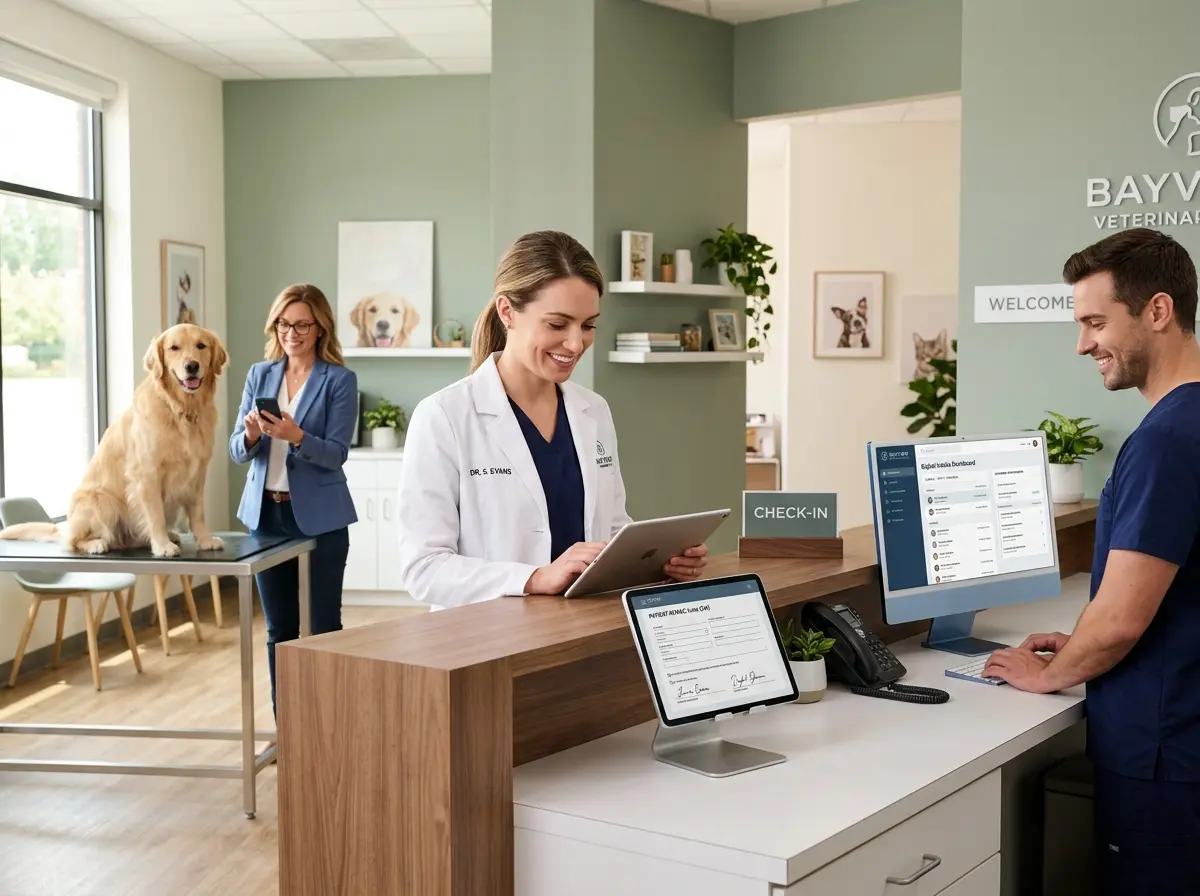
The front desk of a veterinary practice is one of the most chaotic real estate in the business world. You've got phones ringing, a nervous cat in a carrier, a dog who has decided the waiting room is his personal kingdom, and a stack of callbacks from this morning. Stella, the AI robot employee and phone receptionist, is built exactly for this kind of environment. As a physical kiosk stationed inside your practice, she can greet arriving clients, walk them through check-in, answer common questions about services and policies, and collect intake information conversationally — without pulling a human staff member away from something more complex.
On the phone side, Stella answers calls 24/7, handles routine inquiries, and can collect new patient information through conversational intake forms before a client ever sets foot in the clinic. That pre-visit data flows directly into her built-in CRM, complete with custom fields, tags, and AI-generated profiles — so when Mrs. Thompson and her anxious tabby arrive on Tuesday morning, your team already knows what they need to know. No clipboards required.
Building a Digital Intake System That Actually Works
Choosing the Right Intake Points
Effective digital intake doesn't mean replacing every human touchpoint with a screen — it means being strategic about where automation adds the most value. For veterinary practices, the highest-impact intake points are typically new patient registration, pre-visit health history updates, appointment reminders with embedded intake links, and post-visit follow-up forms. Each of these moments represents an opportunity to gather accurate information without consuming staff time.
The key is meeting clients where they already are. Most pet owners check their phones dozens of times a day — a text message with a link to a short intake form, sent 24 to 48 hours before an appointment, will get completed far more reliably than a form handed over at the front desk under time pressure. Keep the form focused: species, breed, age, current medications, vaccination history, and the primary reason for the visit. You can always gather more during the appointment itself.
Integrating Intake Data With Your Practice Management System
Digital intake is only as useful as what you do with the data afterward. If staff are manually re-entering information from an online form into your practice management software, you've just moved the transcription problem rather than solving it. Look for intake tools that integrate directly with your existing systems — whether that's Avimark, Cornerstone, ezyVet, or another platform — so that client-submitted information populates automatically into the correct records.
For practices that aren't yet using a full practice management suite, a CRM with custom fields and intake form capabilities can serve as an effective bridge. The goal is a single source of truth for every patient: one record, consistently updated, accessible to every team member who needs it without anyone having to hunt through a filing cabinet or ask a colleague to repeat themselves.
Training Your Team and Setting Client Expectations
Even the best digital intake system will fail if your team doesn't use it consistently or if clients don't understand why they're being asked to complete forms before arriving. Invest a small amount of time in staff training — not technical training, but communication training. Your front desk team should be able to explain the new process confidently and positively: "We send a quick form before your visit so we can have everything ready when you arrive — most people complete it in about three minutes." That framing makes it a benefit, not a burden.
On the client side, consider adding a brief explanation to your appointment confirmation messages. Pet owners who understand that pre-visit intake means faster check-in and more time with the veterinarian are overwhelmingly supportive of the change. Resistance usually comes from confusion, not stubbornness — clear communication resolves most of it before it starts.
Quick Reminder About Stella
Stella is an AI robot employee and phone receptionist available for just $99/month with no upfront hardware costs. She works in-person as a kiosk inside your practice and answers phone calls around the clock — handling questions, collecting intake information, and keeping your front desk team focused on what matters most. If you haven't explored what she can do for a veterinary practice, it's worth a look.
Conclusion: Small Changes, Significant Results
Modernizing your patient intake process doesn't require a massive technology overhaul or a six-month implementation timeline. It requires a clear understanding of where your current process creates friction — for clients, for staff, and for patient care — and a willingness to replace that friction with something better.
Here's a practical starting point:
- Audit your current intake process. Time it. Count the steps. Ask your front desk team where the pain points are. You might be surprised by how much time disappears into administrative tasks that could be automated.
- Identify your first digital intake touchpoint. New patient registration is usually the highest-value place to start. Build a short, mobile-friendly form and begin sending it with appointment confirmations.
- Connect your intake data to your records system. Eliminate re-entry wherever possible. If your current tools don't support integration, explore options that do.
- Communicate the change to clients proactively. Frame it as a benefit — because it genuinely is one.
- Evaluate what AI tools, like Stella, can handle at the kiosk and on the phone. Intake, greeting, routine Q&A, and call handling are all tasks that don't need to consume a human staff member's attention.
Your patients can't fill out their own intake forms — but their owners can, and they'll appreciate the chance to do it on their own terms. Giving them that option is one of the simplest, highest-return investments a veterinary practice can make. Fluffy deserves a smooth check-in. So does everyone involved.