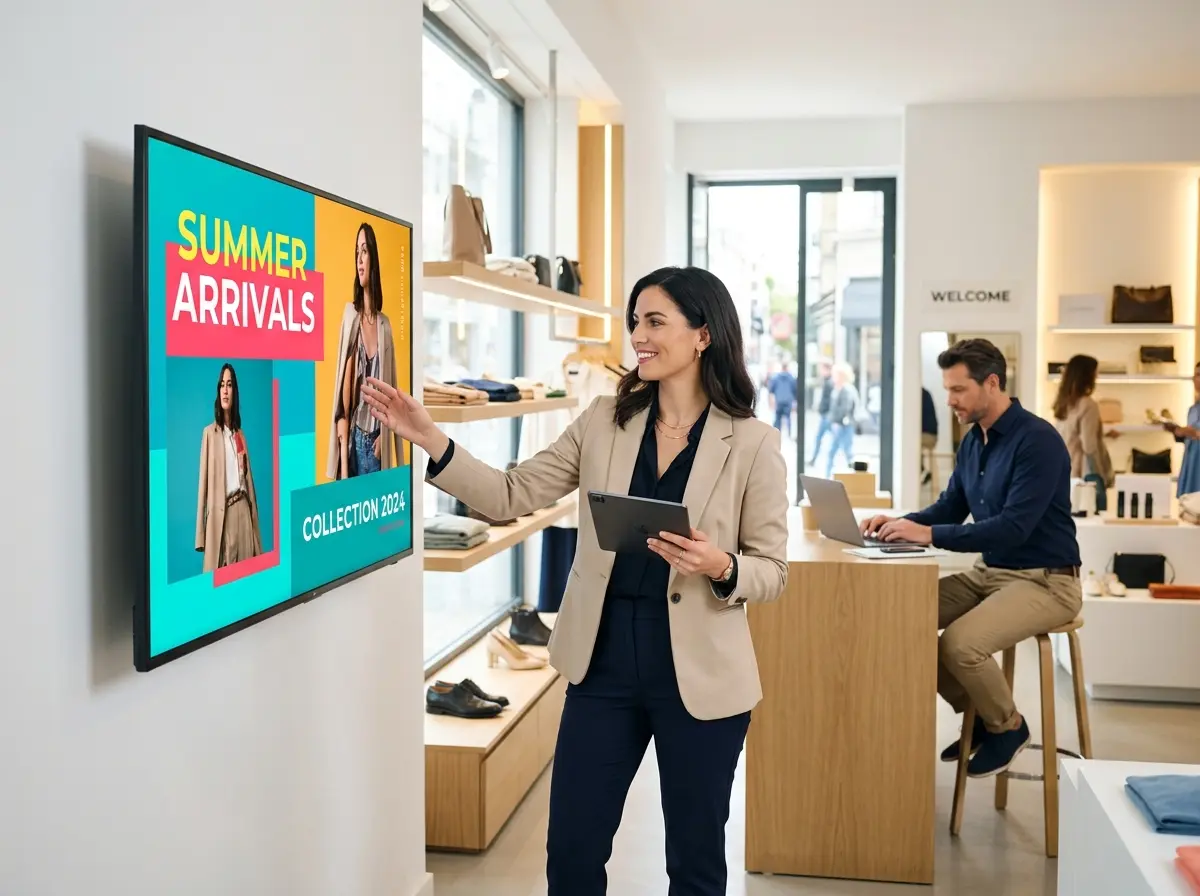
Introduction: The Secret Weapon You're Probably Ignoring
Let's be honest — when most retailers think about marketing, they picture social media campaigns, email blasts, or maybe a carefully curated loyalty program. Digital signage? That's just a fancy TV in the corner, right? Wrong. Dead wrong, in fact.
Digital signage is one of the most underrated, underutilized, and frankly underappreciated tools in the modern retailer's marketing arsenal. While you've been agonizing over your Instagram aesthetic, your competitors with bright, dynamic displays are quietly pulling customers off the street, boosting their average order values, and promoting specials without lifting a finger after setup. Studies show that digital signage can increase overall sales by up to 33% and boost brand awareness by 47.7% — numbers that are hard to argue with, even on a Monday morning.
The best part? You don't need a marketing degree, a dedicated IT team, or a suspiciously large budget to get started. Digital signage is genuinely one of the highest-impact, lowest-effort marketing tools available to retailers today. This guide will walk you through exactly what it is, why it works, and how to make it work for your business — no jargon, no fluff, and only a minimal amount of sarcasm.
What Digital Signage Actually Is (And Why It Works)
Beyond the "Fancy TV" Definition
Digital signage is any screen-based display system used to communicate information, promotions, or branding to an audience — typically customers in a physical space. This includes everything from a single monitor at your checkout counter showing today's specials, to a network of displays across multiple store locations updating in real time from a central dashboard. The hardware can be as simple as a consumer-grade TV with a media player stick, or as sophisticated as a large-format LED wall. What matters isn't the screen itself — it's the content and the strategy behind it.
What separates digital signage from a printed poster isn't just that it glows. It's that it's dynamic. You can change messaging instantly, schedule content to rotate by time of day, and display different promotions to different audiences. That "Buy One Get One" deal you're running only on Tuesday afternoons? Your digital sign can know that — and your printed flyer definitely cannot.
The Psychology Behind Why It Works
Human brains are hardwired to notice movement and light. Static signage, no matter how beautifully designed, becomes invisible after a customer has seen it a few times. Digital signage, with its motion graphics, rotating content, and vivid colors, continues to capture attention on repeat visits. Research from Nielsen found that 76% of Americans have entered a store they had never visited before based solely on its signs. That's not marketing magic — that's just how human attention works, and digital signage exploits it brilliantly (in the nicest possible way).
Beyond attraction, digital signage also influences purchasing behavior once customers are inside. Displaying complementary products together, promoting limited-time offers with a visual countdown, or simply reminding customers of a service they didn't know you offered — these are subtle nudges that add up to real revenue over time.
Types of Digital Signage Retail Businesses Actually Use
Not all digital signage looks the same, and that's a feature, not a bug. Here are the most common types you'll encounter as a retailer:
- Promotional displays: Highlight current sales, new arrivals, or limited-time offers near entrances or high-traffic areas.
- Menu or product boards: Common in food retail and restaurants, these replace printed menus with live, updatable digital versions.
- Wayfinding signage: Help customers navigate larger spaces, find departments, or locate specific products.
- Queue and checkout displays: Capture attention during dwell time at the register — prime real estate for impulse promotions and upsells.
- Window displays: Attract foot traffic before customers even step inside, especially effective during evening hours when illuminated.
Pairing Digital Signage With Smart In-Store Technology
Where Physical Displays Meet Intelligent Engagement
Digital signage is excellent at broadcasting — it puts information in front of customers passively and consistently. But what happens when a customer sees your promotion and has a question? Or when they want to know if a product comes in a different size, or whether your loyalty discount applies to the item on screen? That's where signage hits its ceiling, and where a smarter layer of in-store technology picks up the slack.
Stella, the AI robot employee and phone receptionist, works alongside digital signage as the interactive, conversational counterpart to your static displays. While your screens broadcast promotions, Stella stands in-store and answers the questions those promotions inevitably generate — talking naturally with customers about products, services, specials, and policies. She proactively greets customers, upsells and cross-sells based on their interests, and collects customer information — all without pulling your staff away from what they're doing. She also answers phone calls 24/7 with the same knowledge she uses in person, so the experience stays consistent whether a customer is standing in your store or calling from their couch. At $99/month with no upfront hardware costs, she's a surprisingly affordable upgrade to any physical retail environment.
Getting Started: Setting Up Digital Signage Without Losing Your Mind
Choosing the Right Hardware and Software
The barrier to entry for digital signage has dropped dramatically over the past decade. You no longer need to hire an AV integrator or sign a multi-year contract with an enterprise vendor. For most small to mid-sized retailers, a solid setup involves three components: a commercial-grade display (look for screens rated for extended daily use rather than standard consumer TVs, which aren't built for all-day operation), a media player or smart signage stick, and a cloud-based content management system (CMS) to control what's shown and when.
Popular content management platforms like ScreenCloud, Yodeck, and OptiSigns offer affordable monthly subscriptions, drag-and-drop content editors, and scheduling features that don't require any technical expertise. Most integrate with tools you already use — Google Slides, Canva, social media feeds, and even weather or calendar data to trigger contextually relevant content automatically.
Creating Content That Actually Moves the Needle
Here's where a lot of retailers stumble: they invest in the hardware, set up the software, and then display the equivalent of a digital business card on loop. Great digital signage content follows a few simple rules.
Keep messages short and bold. Customers aren't stopping to read an essay — you have about three seconds to communicate your core message before their attention moves on. Use high-contrast visuals, minimal text, and a clear call to action. Rotate content regularly so repeat visitors continue to see something fresh. And match your content to the moment — morning commuters, lunchtime browsers, and weekend shoppers have different mindsets and respond to different messaging. Scheduling your signage CMS to reflect those shifts takes about ten minutes to set up and pays dividends immediately.
Measuring Performance and Optimizing Over Time
One of digital signage's underappreciated advantages is measurability — at least when you approach it intentionally. Use unique promo codes on specific signs to track redemption rates. Compare sales data on promoted items during signage campaigns versus baseline periods. Solicit direct customer feedback by occasionally displaying a simple QR code linking to a short survey. Over time, you'll develop a clear picture of which content formats, offers, and placements drive the most response — and you can double down accordingly. Digital signage isn't a "set it and forget it" tool in the long run, but the ongoing optimization effort is genuinely minimal compared to the return.
Quick Reminder About Stella
Stella is a human-sized AI robot kiosk and phone receptionist designed for businesses of all types — retail, restaurants, gyms, salons, medical offices, and more. She greets customers in-store, promotes deals, answers questions, upsells, and handles phone calls around the clock, all for $99/month with no hardware costs and an easy setup. Whether or not you invest in digital signage, she's the kind of always-on, never-complaining employee every business owner quietly dreams about.
Conclusion: Start Small, Think Big, and Stop Ignoring Your Screens
Digital signage is not complicated, it is not expensive to start, and it is absolutely not just a fancy TV. It is a proven, practical marketing tool that works while you're doing literally everything else that running a retail business demands of you. The research backs it up, the technology has never been more accessible, and the content tools available today mean you don't need a graphic designer on retainer to make something that looks professional.
Here's your action plan for the next two weeks:
- Audit your current signage. Walk through your store as a customer would and note where you have dead visual space, outdated printed signs, or high-traffic areas with no messaging at all.
- Pick a starting point. One screen, one location — your checkout counter or entrance is usually the highest-value placement. Don't try to overhaul everything at once.
- Sign up for a free trial of a CMS platform. ScreenCloud, Yodeck, and OptiSigns all offer trials. Build a simple content rotation in under an hour and see how it feels.
- Define success metrics. Decide how you'll measure impact — promo code redemptions, item sales lift, or customer questions about displayed offers are all valid starting points.
- Revisit and refine monthly. Set a calendar reminder. Review what's working, refresh what isn't, and keep the content current.
Your customers are already looking at your walls. The only question is whether those walls are working for you. Make them work.