The Service Lane Is Broken — And Customers Are Tired of It
Picture this: a customer pulls into your dealership's service lane at 7:45 AM. They're already a little grumpy because their check engine light came on during their commute. They walk up to the counter, wait five minutes while your service advisor finishes a phone call, and then spend another ten minutes answering the same questions they answered last time — and the time before that. By the time their car is checked in, they've mentally drafted their one-star review.
Sound familiar? If you run a dealership's service department, you already know the service lane is one of the most operationally chaotic corners of the automotive world. It's high-volume, time-sensitive, and deeply dependent on human staff who are perpetually juggling too many customers at once. The result? Inconsistent experiences, missed upsell opportunities, frustrated customers, and an overworked team that's just trying to survive until lunch.
The good news is that AI is quietly transforming how forward-thinking dealerships handle all of this — and no, we're not talking about replacing your best service advisor with a robot. We're talking about giving your entire service operation a much-needed upgrade in personalization, efficiency, and customer communication. Let's dig in.
What Personalization Actually Means in the Service Lane
It's More Than Remembering Someone's Name
When most people hear "personalization," they think of a barista writing your name on a cup — cute, but hardly transformative. In the service lane, real personalization means something far more valuable: knowing a customer's vehicle history before they open their mouth, anticipating what service might be due, and communicating with them in the way they actually prefer. It means the difference between a customer who feels like a loyal VIP and one who feels like ticket number 47.
According to a McKinsey study, 71% of consumers expect companies to deliver personalized interactions — and 76% get frustrated when that doesn't happen. In the automotive service world, where customers are spending hundreds (sometimes thousands) of dollars and entrusting you with a vehicle they depend on daily, that expectation is even higher. The bar is set, and a lot of dealerships are limping under it.
The Data Problem: You Have It, You're Just Not Using It
Here's the mildly uncomfortable truth: most dealerships already have mountains of customer data sitting in their DMS (Dealer Management System). Vehicle purchase history, previous service records, contact preferences, mileage at last visit — it's all there. The problem isn't the data. The problem is that it lives in a silo, disconnected from the actual customer interaction happening at the service counter or over the phone.
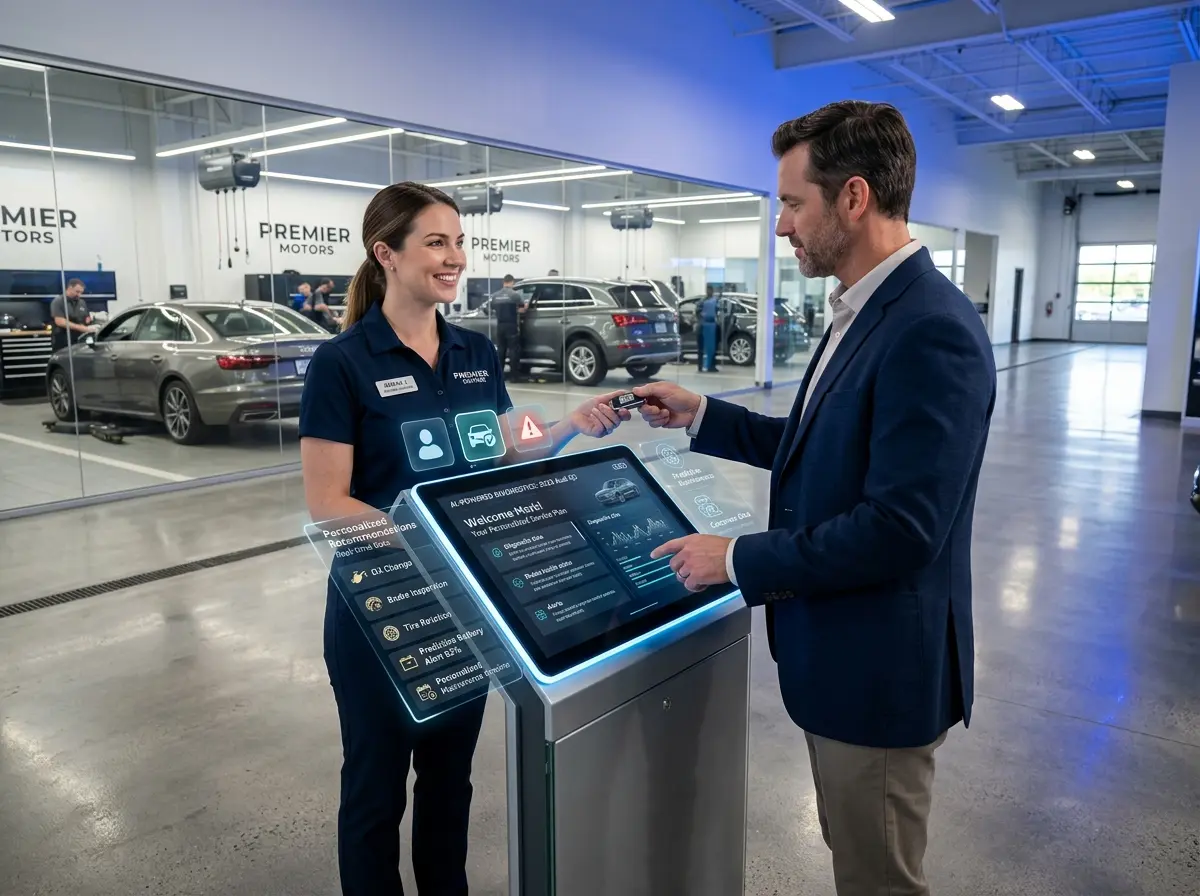
AI bridges that gap. By integrating with your existing systems and surfacing relevant customer information at the moment of interaction, AI tools can help your team — or even automated touchpoints — greet customers with context. "Hi, Mr. Thompson — your 2021 Tahoe is in for an oil change today. Based on your mileage, you might also be due for a tire rotation. Want us to take a look?" That's not magic. That's just using the data you already have, intelligently.
Proactive Communication: The Competitive Edge Most Dealers Ignore
Personalization doesn't start when a customer walks in the door — it starts long before that. AI-powered communication tools allow dealerships to send targeted service reminders based on actual vehicle data, not just generic "time for your oil change!" blasts that go to everyone regardless of their last visit. When a customer gets a reminder that feels specific to their car and their situation, they're significantly more likely to respond and book.
Beyond reminders, AI can power follow-up messages after service visits, satisfaction check-ins, and even recall notifications — all personalized and timed intelligently. The dealerships that are winning in the service lane right now are the ones treating customer communication like a relationship, not a broadcast.
AI Tools That Are Actually Making a Difference at the Dealership
In-Store Presence and Phone Handling — Where Stella Fits In
One area where AI is having an immediate, visible impact is in how dealerships handle the front-line customer experience — both in person and over the phone. Stella, an AI robot employee and phone receptionist, is a great example of this in action. She stands as a human-sized kiosk inside your service area and proactively greets customers as they walk in, answers questions about services, current promotions, and policies — all without pulling a service advisor away from an active write-up.
On the phone side, Stella answers calls 24/7 with the same knowledge she uses in person, handles intake, collects customer information through conversational forms, and can forward calls to staff based on configurable conditions. For service departments that lose appointment opportunities every time a call goes unanswered after hours, this is a genuine revenue recovery tool — not just a novelty. Her built-in CRM also keeps track of customer interactions, generating AI-powered profiles and summaries that help your team stay informed without doing extra data entry.
Turning Service Visits Into Upsell Opportunities (Without Being Pushy)
The Art of the Relevant Recommendation
Upselling in the service lane has a bad reputation — mostly because it's often done badly. "While we have it up, do you want us to replace your cabin air filter, wiper blades, battery, all four tires, and maybe your transmission fluid?" Nobody likes that. But relevant recommendations, delivered at the right moment with the right context, are actually appreciated by customers. The difference is personalization.
AI systems can analyze a vehicle's service history and flag genuinely relevant add-ons before the advisor even speaks to the customer. If someone is coming in for brakes and their last tire rotation was 18,000 miles ago, that's a legitimate recommendation — not a cash grab. When AI surfaces these insights automatically, your advisors can present them confidently and honestly, which builds trust rather than eroding it. Studies from the National Automobile Dealers Association (NADA) consistently show that service department revenue is one of the most critical profit centers for dealerships — AI-assisted upselling is one of the highest-ROI investments you can make in that department.
Personalizing the Waiting Experience
The service lane doesn't end at check-in. What happens while the customer waits — or once they've dropped off their car and gone to work — matters just as much. AI-driven status update systems can send personalized, real-time notifications so customers aren't calling in every 45 minutes to ask if their car is ready yet. (Your service advisors will thank you for this one.)
For customers who wait on-site, a smart in-store presence can keep them informed, answer questions about what's being done to their vehicle, and even highlight current service specials or accessories — turning idle waiting time into an engagement opportunity. The key is that all of this feels helpful and relevant, not like someone is trying to sell them something while they're trapped in a waiting room with three-year-old magazines.
Post-Visit Follow-Up That Actually Builds Loyalty
The visit is over, the car has been picked up — now what? Most dealerships send a generic satisfaction survey and call it a day. AI enables something much more powerful: personalized follow-up based on what actually happened during the visit. Did the customer decline a service recommendation? An AI system can flag them for a targeted follow-up in 30 days. Did they have a particularly long wait? A personalized acknowledgment and small incentive can go a long way toward retaining that relationship.
Loyalty in the service lane is earned through consistent, thoughtful touchpoints over time — and AI makes delivering those touchpoints at scale actually feasible for a team that's already stretched thin. The dealerships building the strongest CSI scores right now aren't doing it with more staff. They're doing it with smarter systems.
Quick Reminder About Stella
Stella is an AI robot employee and phone receptionist built for businesses like yours — she works the floor as a human-sized kiosk, greets customers, promotes specials, and answers questions, while also handling phone calls around the clock as a fully capable AI receptionist. She runs on a straightforward $99/month subscription with no upfront hardware costs and is designed to be up and running without a complicated setup process. For a service department looking to do more with its existing team, she's worth a serious look.
Where to Go From Here
If you're running a dealership service department and you're still relying entirely on manual processes and institutional memory to deliver a personalized experience, the gap between you and your more tech-forward competitors is growing — quietly, steadily, and expensively. The customers you're losing to the shop down the street aren't always leaving because of price. They're leaving because someone else made them feel known.
Here's a practical starting point:
- Audit your current data usage. What customer and vehicle information do you already have? Is it being surfaced at the point of interaction, or is it buried in your DMS?
- Identify your biggest friction points. Is it check-in wait times? Missed calls after hours? Generic communication? Prioritize the highest-impact problem first.
- Start small and measure. You don't need to overhaul everything at once. Implement one AI-powered touchpoint — whether that's automated service reminders, an in-store AI presence, or 24/7 phone coverage — and track the impact before expanding.
- Train your team around the tools, not against them. AI works best when your human staff sees it as support, not competition. When advisors spend less time answering repetitive questions, they can spend more time building the genuine relationships that keep customers coming back.
The service lane doesn't have to be a chaotic, impersonal gauntlet. With the right AI tools in place, it can be one of the strongest loyalty-building experiences your dealership offers. And honestly, with the margins at stake in service revenue, there's never been a better time to stop doing things the hard way.