Introduction: The Dashboard You Built But Never Open
Be honest. You spent a solid weekend building a beautiful spreadsheet — color-coded tabs, formulas that took three YouTube tutorials to figure out, maybe even a chart or two — and you have opened it exactly twice since then. Once to admire it, and once to remember why you stopped looking at it.
You're not alone. Most gym owners are drowning in data they don't use and starving for insights they actually need. The problem usually isn't motivation — you didn't open five gym locations by being lazy. The problem is that most performance dashboards are either so complicated they require a finance degree to interpret, or so vague they tell you nothing actionable. Neither version gets checked daily. Both collect digital dust.
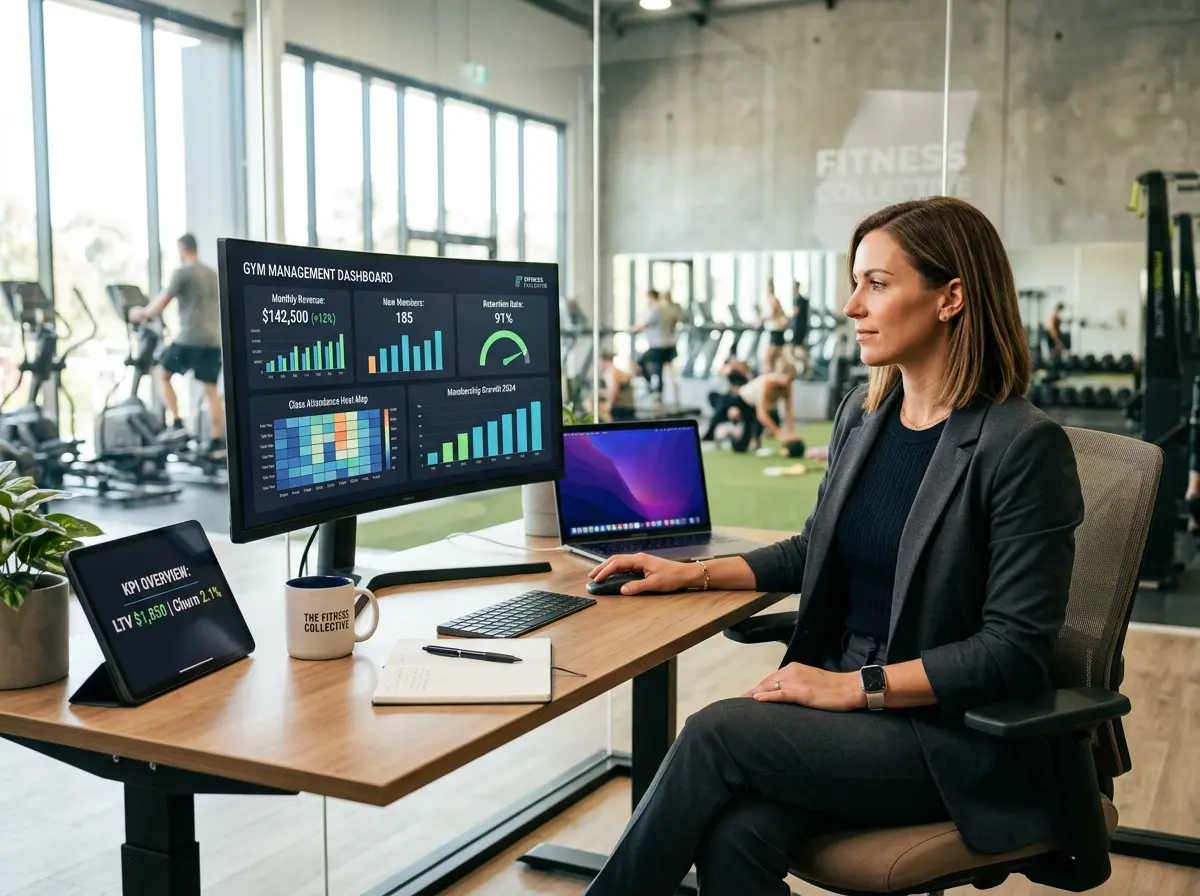
A truly useful gym performance dashboard is one you want to open every morning with your coffee. It's simple, it's honest, and it tells you exactly where your business stands in under five minutes. This post will walk you through how to build one — and more importantly, how to make it stick as a daily habit that actually moves the needle.
The Metrics That Actually Matter
Stop Tracking Everything — Track the Right Things
The first mistake gym owners make is trying to measure everything simultaneously. Total revenue, individual class attendance, personal training session counts, merchandise sales, lead conversion rates, member satisfaction scores — all of it dumped into one place. It sounds thorough. It's actually paralyzing.
Your daily dashboard should have no more than 7 to 10 core metrics. Think of these as your gym's vital signs. A doctor doesn't run every possible test during a routine checkup — they check blood pressure, heart rate, and a few key indicators. You should do the same. The goal is a quick, confident read on your gym's health, not an academic research paper.
Start by asking yourself: "If this number moved significantly in the wrong direction, would I want to know immediately?" If the answer is yes, it belongs on the dashboard. If the answer is "eventually," it belongs in your monthly review instead.
The Core Six for Gym Owners
While every gym has unique priorities, most successful fitness businesses track a consistent set of foundational metrics daily. Here's what should be on your dashboard:
- Active Member Count — Your real-time membership total. Not leads, not trial members. Paying, active humans.
- Daily Check-Ins — How many members actually showed up today? Engagement predicts retention better than almost any other metric.
- New Member Sign-Ups (Day / Month-to-Date) — Growth at a glance.
- Cancellations (Day / Month-to-Date) — The number most owners are afraid to look at, which is exactly why it needs to be front and center.
- Net Member Change — Sign-ups minus cancellations. This single number tells you whether you're growing or bleeding out, no math required.
- Daily Revenue — Memberships, sessions, retail, and add-ons combined.
If you want to go slightly deeper without overcomplicating things, add your lead-to-member conversion rate and average revenue per member. Studies in the fitness industry consistently show that gyms with active churn monitoring retain members at rates 15 to 20 percent higher than those flying blind — and those numbers compound fast when you're managing hundreds of memberships.
Where to Pull Your Data From
The best dashboard is one that doesn't require manual data entry every morning. If you're using gym management software like Mindbody, Zen Planner, or ClubReady, most of these metrics are already being tracked. The goal is to surface them in one unified view rather than logging into four different platforms. Google Looker Studio (formerly Data Studio) is a free, powerful option that connects to many data sources. For simpler setups, a well-structured Google Sheet with automatic imports can do the job beautifully. Pick the tool that removes friction — because friction is the enemy of daily habits.
How Stella Can Help Fill the Gaps Your Dashboard Can't See
The Data Behind the Data
Your dashboard will tell you what happened — but it won't always tell you why. Why did three members cancel this week? Why did phone inquiries spike on Tuesday but nobody signed up? Why are walk-in conversions lower than last month? These are the questions that keep gym owners up at night, and spreadsheets aren't exactly great conversationalists.
This is where Stella — an AI robot employee and phone receptionist — can add a layer of insight that your dashboard simply can't generate on its own. Stella greets every customer who walks into your gym, answers phone calls around the clock, and collects data on every interaction. That means you get visibility into what prospective members are actually asking about, which promotions are generating the most engagement, and where potential customers are dropping off in the conversation — all without adding a single task to your staff's plate.
Stella's built-in CRM automatically logs customer contacts, generates AI-powered profiles, and captures intake information through conversational forms during calls or at the kiosk. Instead of guessing why your conversion rate dipped, you can actually review what questions leads were asking before they didn't sign up. That's the kind of qualitative context that turns a confusing data point into an actionable fix.
Making Your Dashboard a Daily Non-Negotiable
Design for Speed — The Five-Minute Rule
If your dashboard takes more than five minutes to review each morning, you won't review it each morning. That's just human psychology, and no amount of discipline will fully override it long-term. Design your dashboard with ruthless simplicity in mind. Key numbers should be visible the moment you open it — no scrolling, no clicking through tabs, no decoding color legends. Use large fonts for your most critical metrics, red/green conditional formatting for at-a-glance status, and keep supplementary detail one click away rather than cluttering the main view.
Think of it like a cockpit dashboard. A pilot doesn't read the entire instrument panel equally — their eyes go to the most critical gauges first, and secondary information is there when needed. Your dashboard should work the same way. Build it so the most important question — "Is my gym growing or shrinking right now?" — gets answered in the first three seconds.
Build a Review Ritual That Sticks
The dashboard itself is only half the battle. The habit is the other half. Attach your daily dashboard review to something you already do every morning — drinking your first cup of coffee, arriving at the gym before staff, or reviewing your calendar. Behavioral science consistently shows that habit stacking (pairing a new habit with an existing routine) dramatically increases follow-through compared to willpower alone.
Consider setting a recurring calendar block — even just 10 minutes — labeled something motivating. "Daily Business Pulse" works. "Stare at Numbers" is honest but uninspiring. Pick something that signals importance without feeling like a chore.
Weekly Trends Beat Daily Panic
One caution worth mentioning: a single day's data can be noisy. If your Tuesday check-ins are half of Monday's, that might just mean Tuesday is slower — not that your gym is failing. Train yourself to notice daily numbers in the context of a rolling 7-day average. Most dashboards can display this automatically. The goal of daily review isn't to react to every fluctuation — it's to spot genuine trends before they become genuine problems. A membership dip that looks minor over one day might reveal a concerning pattern when you zoom out to the week. Catching that pattern on day seven instead of day thirty is what separates proactive owners from reactive ones.
Quick Reminder About Stella
Stella is an AI robot employee and phone receptionist built for businesses like yours. She stands inside your gym to greet and engage walk-ins, answers every phone call 24/7 so no lead goes unanswered, promotes your current deals, and feeds customer interaction data directly into a built-in CRM — all for $99/month with no upfront hardware costs. She's the team member who never calls in sick and never misses a potential member walking through the door.
Conclusion: Build It Simple, Check It Daily, Fix What It Reveals
The most powerful gym performance dashboard in the world is worthless if it lives in a browser tab you never open. The best one is the simplest one you'll actually use — consistently, daily, and with enough context to take action on what you see.
Here's your action plan to get started:
- Choose your 6 to 8 core metrics and ruthlessly cut everything else from the daily view.
- Connect your gym management software to a visualization tool like Google Looker Studio or a clean Google Sheet — eliminate manual data entry wherever possible.
- Design for the five-minute rule — your most critical numbers should be visible the moment the dashboard opens.
- Stack the habit — attach your daily review to an existing morning routine so it becomes automatic rather than optional.
- Review weekly trends, not just daily snapshots, to separate meaningful patterns from normal noise.
- Supplement your numbers with qualitative insight — tools like Stella can capture what's happening in real customer conversations, adding context your spreadsheet can't provide.
Your gym's data is already talking. Build a dashboard worth listening to — and make it a habit to actually listen. The owners who check their numbers daily aren't more obsessive than the ones who don't. They're just better informed, and better informed almost always wins.