Stop Guessing What Your Clients Want — Their Intake Forms Already Told You
Here's a scenario that plays out at med spas every single day: A client fills out an intake form mentioning she's been struggling with hyperpigmentation and dry skin. She checks in, gets her scheduled facial, and leaves — without anyone ever mentioning the chemical peel series or the hydration booster add-on that would have been perfect for her. Opportunity missed. Revenue left on the table. Client still walking around with unaddressed skin concerns.
The frustrating part? She told you exactly what she needed. It was right there in black and white on the intake form that someone glanced at for four seconds before filing away.
Intake forms are one of the most underutilized assets in the med spa industry. Most businesses treat them purely as liability protection — collect the medical history, check the box, move on. But savvy med spa owners are starting to realize that intake forms are a goldmine of personalization data, and using that data to drive smart upsell recommendations isn't just good business — it's genuinely better client care. When you recommend something that directly addresses a concern your client already told you about, that's not a sales pitch. That's listening.
Let's talk about how to actually do this, from the questions you ask to the system you use to act on the answers.
Building Intake Forms That Are Actually Useful for Personalization
The problem with most med spa intake forms is that they were designed by someone who was primarily worried about lawsuits. Which is fair. But a form that only captures allergies and contraindications isn't helping you serve your clients better — it's just helping you sleep at night. You need both. Here's how to build forms that protect you and power personalized recommendations.
Ask About Goals, Not Just History
Most intake forms ask what medications a client is on. Far fewer ask what the client actually wants to achieve. Adding a simple "What are your top skin concerns?" or "What results are you hoping to see in the next 3–6 months?" question opens the door to a completely different kind of conversation — one where your team already knows the destination before the appointment even starts.
Go beyond the surface level. Ask about lifestyle factors like sun exposure, stress levels, and skincare routine consistency, because these directly influence what services will deliver the best results. A client who admits she "sometimes" removes her makeup before bed probably isn't a candidate for your most aggressive resurfacing treatment right out of the gate, but she might be perfect for a corrective facial series with some education built in. The goal is to gather information that naturally maps to your service menu.
Use Tiered Questions to Identify Upsell Triggers
Think of your intake form as a decision tree. Certain answers should automatically flag relevant add-ons or upgraded services. For example, if a client indicates she's concerned about fine lines around the eyes, that's a direct signal for an eye treatment add-on or a neuromodulator consultation. If she mentions she's preparing for a major event in the next month, that's a trigger for an accelerated treatment package with optimal timing built in.
Some specific upsell triggers to build into your form:
- Active acne or breakout history → LED light therapy add-on, clarifying booster serum
- Dullness or uneven tone → Vitamin C infusion, brightening peel series
- Dehydration or tightness → Hydration booster, at-home moisture protocol
- Upcoming event or wedding → Glow package, pre-event treatment timeline
- Previous injectables elsewhere → In-house injector consultation, loyalty program enrollment
These aren't random upsells. Each one is a logical next step based on what the client already told you she needs. That's the difference between pushy and personalized.
Keep It Conversational, Not Clinical
The tone of your intake form matters more than most people think. A form that reads like a tax document creates friction and leads to vague, rushed answers. A form that feels warm and curious — like a conversation with a knowledgeable friend — gets more thoughtful responses. Use plain language, avoid jargon, and explain briefly why you're asking. "We ask about your stress levels because it can affect how your skin responds to certain treatments" is a lot more inviting than just "Stress level (circle one): Low / Medium / High."
How Stella Can Help You Collect and Act on Intake Data
This is where technology can do a lot of the heavy lifting for you — and where Stella, the AI robot employee and phone receptionist, genuinely changes the game for med spas. Stella can collect intake form information conversationally, whether that's during a phone call when a client books an appointment, through a web form, or directly at her in-person kiosk when clients arrive at your location.
That means by the time a client walks through your door, Stella has already captured her goals, concerns, and relevant history — and that data lives in Stella's built-in CRM, complete with custom fields, tags, and AI-generated client profiles. Your staff can walk into every appointment already knowing what to recommend, without needing to have an awkward "so what brings you in today?" conversation while trying to read a scribbled paper form. Stella handles the intake, you handle the results.
Turning Form Data Into Personalized Recommendations Your Clients Will Actually Appreciate
Collecting great intake data is only half the equation. The other half is building a system that consistently translates those answers into relevant, timely recommendations — without requiring your estheticians to have superhuman memories or your front desk staff to become data analysts.
Create a Simple Intake-to-Recommendation Map
Start by sitting down with your service menu and creating a straightforward mapping document: if a client answers X, recommend Y. You don't need sophisticated software to do this initially — a well-designed spreadsheet or a printed reference card at the front desk can work. The important thing is making the logic explicit and consistent, so that every team member is making the same recommendations for the same triggers, not just whatever they personally happen to remember to mention.
Once this map exists, you can build it into your booking flow, your CRM tags, and your pre-appointment communication. A client who flagged hyperpigmentation on her intake form should be receiving an email before her appointment that says something like, "Based on your skin goals, you might want to ask your esthetician about our Brightening Booster add-on — it pairs beautifully with the service you have scheduled." That kind of personalization doesn't feel like marketing. It feels like service.
Train Your Team to Use Intake Data as a Starting Point, Not an Afterthought
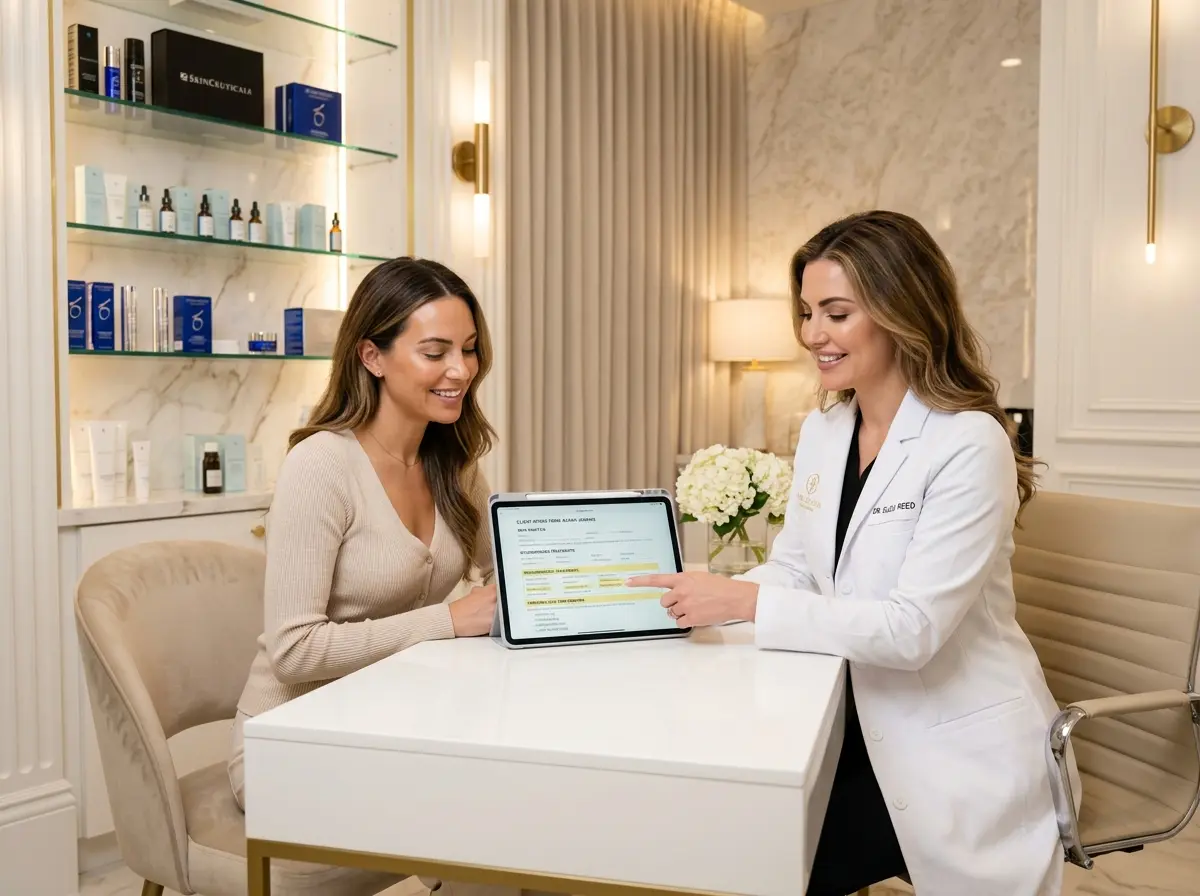
Technology and systems can set the table, but your team still needs to sit down for the meal. Make it a standard part of your pre-appointment workflow that the provider reviews the client's intake responses — especially first-time clients — and identifies one or two relevant recommendations to mention naturally during the appointment. Not as a pitch, but as part of the treatment conversation.
Research consistently shows that clients are significantly more receptive to service recommendations when those recommendations are clearly tied to their stated goals. According to a McKinsey report, personalization can drive a 10–15% revenue lift in retail and service environments. In a med spa context, where services can range from $100 to several thousand dollars, even a modest improvement in upsell conversion rate has a meaningful impact on monthly revenue. The math is worth doing.
Close the Loop with Follow-Up and Rebooking
The intake form conversation doesn't end when the appointment does. Post-appointment follow-up is one of the most overlooked opportunities in the med spa business. If a client mentioned during intake that she wanted to address fine lines, and she just completed her first chemical peel, she's now the perfect candidate for a follow-up message that talks about what to expect next, what complementary services would build on her results, and why booking her next appointment within a specific window will optimize her outcomes.
This kind of follow-up works because it's grounded in the conversation you already had. You're not blasting a generic promotional email to your entire list — you're continuing a personalized dialogue that started the moment she filled out her intake form. That's the kind of client relationship that builds loyalty, drives referrals, and keeps retention numbers healthy even in a competitive market.
A Quick Reminder About Stella
Stella is an AI robot employee and phone receptionist built for businesses like yours. She greets clients in person at her kiosk, answers your phones 24/7, collects intake information conversationally, and stores everything in a built-in CRM — so your team always has the context they need to make smart, personalized recommendations. At $99/month with no upfront hardware costs, she's the kind of team member who never calls in sick and never forgets to ask the right questions.
Start Using What Your Clients Are Already Telling You
The personalization gap at most med spas isn't a data problem — it's a systems problem. Your clients are already sharing what they need. They're writing it down on forms, telling your receptionist when they book, and hinting at it in every question they ask during their appointment. The opportunity is in building the processes and tools to actually use that information consistently.
Here's where to start:
- Audit your current intake form. Does it capture goals and concerns, or just medical history? Rewrite it with personalization in mind.
- Build your intake-to-recommendation map. Match your most common intake responses to your most relevant add-ons and upgrades.
- Standardize the review process. Make reading intake responses part of every provider's pre-appointment routine — not optional.
- Automate where you can. Use your CRM and booking system to tag clients based on their answers and trigger personalized follow-up communications.
- Measure the results. Track which intake triggers are driving the most add-on bookings and refine your approach accordingly.
Your clients are already talking. It's time to start listening — systematically, consistently, and in a way that actually benefits them. Because when personalized recommendations come from a genuine understanding of what someone wants, nobody feels sold to. They just feel taken care of. And that's what keeps them coming back.