Because "We'll Call You When It's Ready" Stopped Working Sometime Around 2009
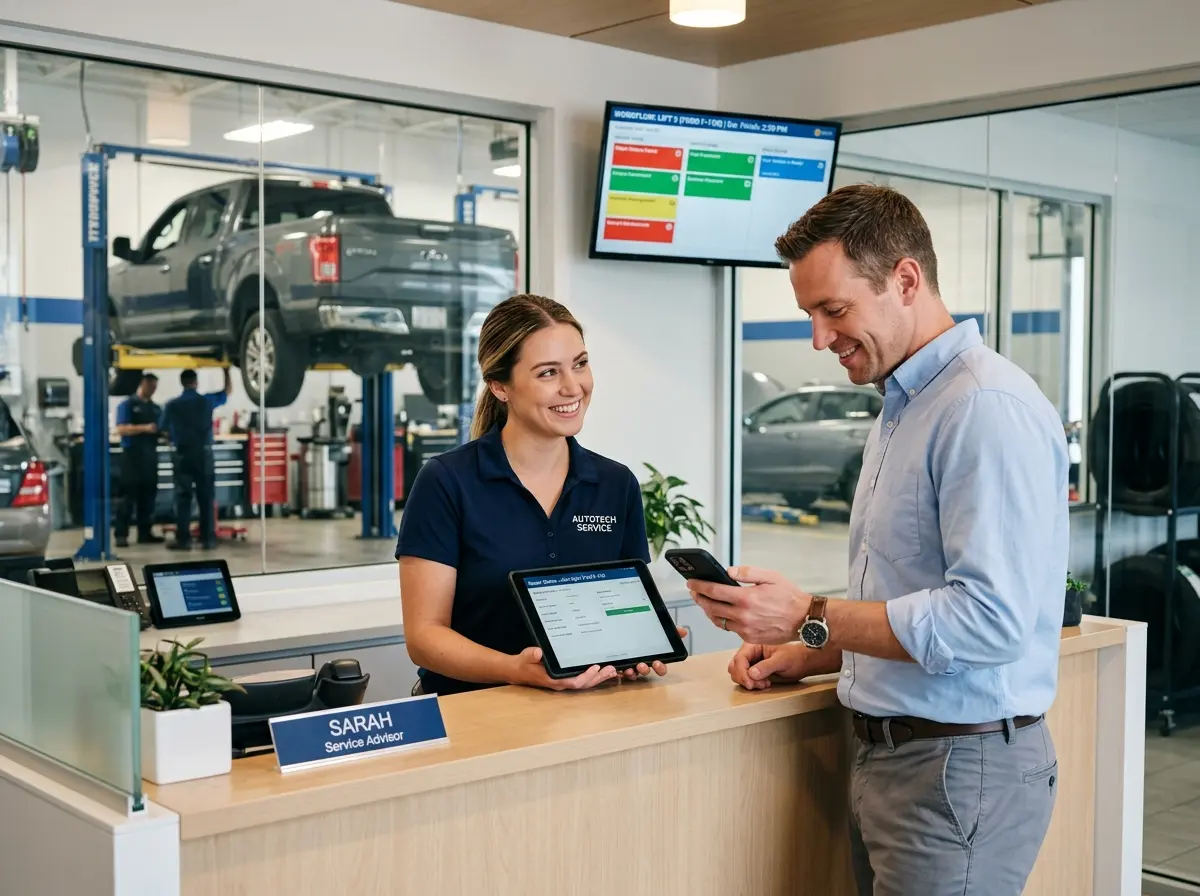
Let's paint a familiar picture. A customer drops off their vehicle at 8 AM, heads to work, and spends the next six hours wondering whether their car has been touched, whether the technician discovered something catastrophic hiding behind the serpentine belt, or whether they should just start shopping for a new car entirely. Meanwhile, your service advisors are elbow-deep in phone calls, repair orders, and the particular chaos that hits every shop around 11 AM on a Tuesday. Nobody wins.
Here's the thing — your customers aren't being needy. They're being human. When someone leaves behind a vehicle that costs them $30,000 and is essential to getting their kids to school, they want to know what's happening. And in an era where you can track a $12 Amazon package in real time, a complete communication blackout from an auto shop feels a little… prehistoric.
The good news is that text-based service updates are one of the highest-ROI, lowest-effort improvements a shop can make — and customers love them when done right. This guide breaks down exactly how to structure those updates so they actually land, rather than land in the spam folder alongside a suspicious email from a Nigerian prince.
What Makes a Service Update Text Actually Good
Timing Is Everything (And Most Shops Get It Wrong)
The goal of a service update is to answer the question the customer is about to ask before they have to ask it. This requires thinking through the natural anxiety checkpoints in the service process — and there are more of them than you might think.
Most customers experience peak anxiety at three moments: right after drop-off (did anyone actually look at my car?), after the inspection is complete (how bad is it?), and during the wait for parts or approvals (why is nothing happening?). If your texts hit those three windows proactively, you've already eliminated the majority of inbound "just checking in" calls that eat up your service advisors' time.
A reasonable text cadence might look like this: a confirmation text within 15 minutes of vehicle intake, an inspection-complete text with findings and estimated cost, an approval-requested text if additional work is found, a work-in-progress update for anything taking longer than expected, and a vehicle-ready notification. That's five logical touchpoints that keep the customer informed without overwhelming them — and each one replaces a phone call your team no longer has to make.
The Content of the Text Matters Just as Much as the Timing
There is a meaningful difference between a text that says "Your vehicle is being serviced. We'll be in touch." and one that says "Hi Sarah! Your 2019 Honda CR-V is in the shop with technician Mike. We've completed the inspection and found a few things to go over with you — we'll send the details shortly." One of these feels like a system-generated afterthought. The other feels like a service experience.
Good service update texts share a few characteristics. They use the customer's name. They reference the specific vehicle. They explain what just happened or what's coming next. They avoid technical jargon that means nothing to a non-mechanic (saying "your MAS is reading high" is significantly less helpful than "your mass airflow sensor is malfunctioning, which is causing the rough idle you mentioned"). And they include a clear next step — whether that's a link to approve a repair, a number to call with questions, or simply an expected completion time.
Compliance Isn't Glamorous, But It Is Mandatory
Before you fire off texts to your entire customer list, it's worth a brief moment of un-fun legal reality. The Telephone Consumer Protection Act (TCPA) requires that customers opt in to receive text messages from your business, and non-compliance can result in fines that will make your most expensive lift repair look like a bargain. Always collect written or digital opt-in consent at intake, make it easy for customers to opt out, and document both. This isn't the exciting part of the conversation, but it's the part that keeps your shop out of a class-action lawsuit — which is arguably more important than all the other parts combined.
How Technology (Including Some Friendly AI) Can Handle the Heavy Lifting
Automating the Update Workflow Without Losing the Human Touch
Most shop management systems — including popular platforms like Mitchell 1, Shop-Ware, and Tekmetric — offer built-in texting workflows that can be triggered automatically at various repair order stages. If you're not using this feature, you're leaving both efficiency and customer satisfaction on the table simultaneously, which is an impressive way to miss two opportunities at once.
Automation handles the consistency problem. Service advisors who are good at sending updates send them when they remember to. Automation sends them every single time without fail, at exactly the right stage, without ever forgetting because the parts department just walked in with a question. The key is to configure your templates carefully so they feel personal rather than robotic — and to build in any touchpoints that your software doesn't handle automatically as manual tasks for your advisors.
Where Stella Fits Into the Auto Shop Communication Picture
Stella, the AI robot employee and phone receptionist, is worth knowing about if your front desk is regularly swamped with inbound calls from customers checking on their vehicles. Stella answers calls 24/7 with full knowledge of your shop's services, hours, and policies — meaning a customer who calls at 7 PM to ask whether their car will be ready tomorrow actually gets a useful answer instead of a voicemail. She can also greet walk-in customers at your kiosk, handle intake questions, and collect customer information through conversational forms — which integrates neatly into keeping customer contact records accurate for your texting workflow. For shops dealing with high call volume during peak hours, having Stella on the front lines frees your service advisors to focus on the customers who are physically standing in front of them.
Turning Service Updates Into a Retention and Reputation Tool
The Follow-Up Text Is Where Most Shops Leave Money Behind
The vehicle-ready text is not the end of the conversation — it's actually the beginning of the next one. A well-timed follow-up message sent 24 to 48 hours after pickup accomplishes several things at once. It gives customers a chance to share any concerns before they leave a negative review. It demonstrates that your shop cares about the experience beyond the transaction. And it creates a natural opening to mention upcoming service needs, seasonal specials, or a next appointment.
Something as simple as "Hi Sarah! We hope your CR-V is running smoothly. Our records show your next oil change will be due around March — want us to send you a reminder? And if you have any questions about yesterday's service, we're always happy to help." This is not aggressive sales behavior. It's good service, and customers genuinely appreciate it. Studies consistently show that retained customers spend more over time and refer more new business than any advertising campaign you could run — and this text costs you approximately $0.01 to send.
Connecting Text Communication to Your Online Reputation
Here's a tactical move that high-performing shops have figured out: include a review request in your follow-up text, but only after you've given the customer an opportunity to flag any concerns privately. A two-step approach works well — the first follow-up message asks how everything went and invites feedback directly, and if the response is positive (or if there's no complaint), a second message a day or two later includes a direct link to your Google Business Profile for a review.
This approach filters for happy customers without suppressing legitimate complaints, which keeps you on the right side of Google's review policies and basic ethics simultaneously. A shop with 200 four- and five-star reviews built through consistent follow-up texting is going to outperform a competitor with 40 reviews in virtually every customer acquisition scenario imaginable. Your text messages, done consistently, are quietly building one of your most valuable long-term business assets.
Handling Bad News Gracefully Over Text
Some service updates involve delivering information that customers don't want to receive — an unexpected repair, a longer timeline than promised, a part that's backordered until Thursday. These moments matter enormously for customer retention, and the instinct to avoid them (hoping the customer doesn't notice the delay) is precisely the wrong move.
Proactive bad-news texts follow a simple structure: acknowledge what happened, explain why briefly without over-explaining, tell the customer what you're doing about it, and offer a clear next step. "Hi Sarah — quick update on your CR-V. We ordered the brake caliper this morning, but our supplier just notified us it won't arrive until Thursday. We're sorry for the extra wait. We'll have the vehicle ready Thursday afternoon and will send you an update by noon. Let us know if you have any questions." Customers are far more forgiving of problems they're warned about than problems they discover on their own.
Quick Reminder About Stella
Stella is an AI robot employee and phone receptionist built for businesses like auto shops — she answers calls around the clock, greets customers at an in-store kiosk, manages intake, and keeps your front desk from drowning in "just checking on my car" calls. At $99/month with no upfront hardware costs, she's one of the more straightforward additions a busy shop can make to its communication stack.
Putting It All Together: Your Action Plan Starts This Week
Implementing a strong text-based service update system doesn't require a massive overhaul. It requires deciding that consistent, proactive communication is a priority — and then building the workflow to make it automatic. Here's how to get started in a practical sequence:
- Audit your current communication touchpoints. Write down every moment in your service process where a customer might reasonably wonder what's happening. Those are your text triggers.
- Review your shop management software's texting features. Most platforms have more automation capability than shops actually use. Spend an hour with the settings before assuming you need a third-party tool.
- Draft templates for each touchpoint that include the customer's name, the vehicle, the current status, and a clear next step. Keep them conversational, not corporate.
- Add opt-in consent to your intake process and document it. Handle this once and handle it correctly.
- Build in the follow-up text at 24–48 hours post-pickup, and connect it to your review request workflow for satisfied customers.
The shops that win on customer experience in the next five years won't necessarily be the ones with the nicest waiting rooms or the most impressive equipment. They'll be the ones that made customers feel informed, respected, and genuinely taken care of — starting with a text message that arrived before anyone had to ask. That's a competitive advantage worth building, one touchpoint at a time.