Is Your Phone Quietly Bleeding Patients?
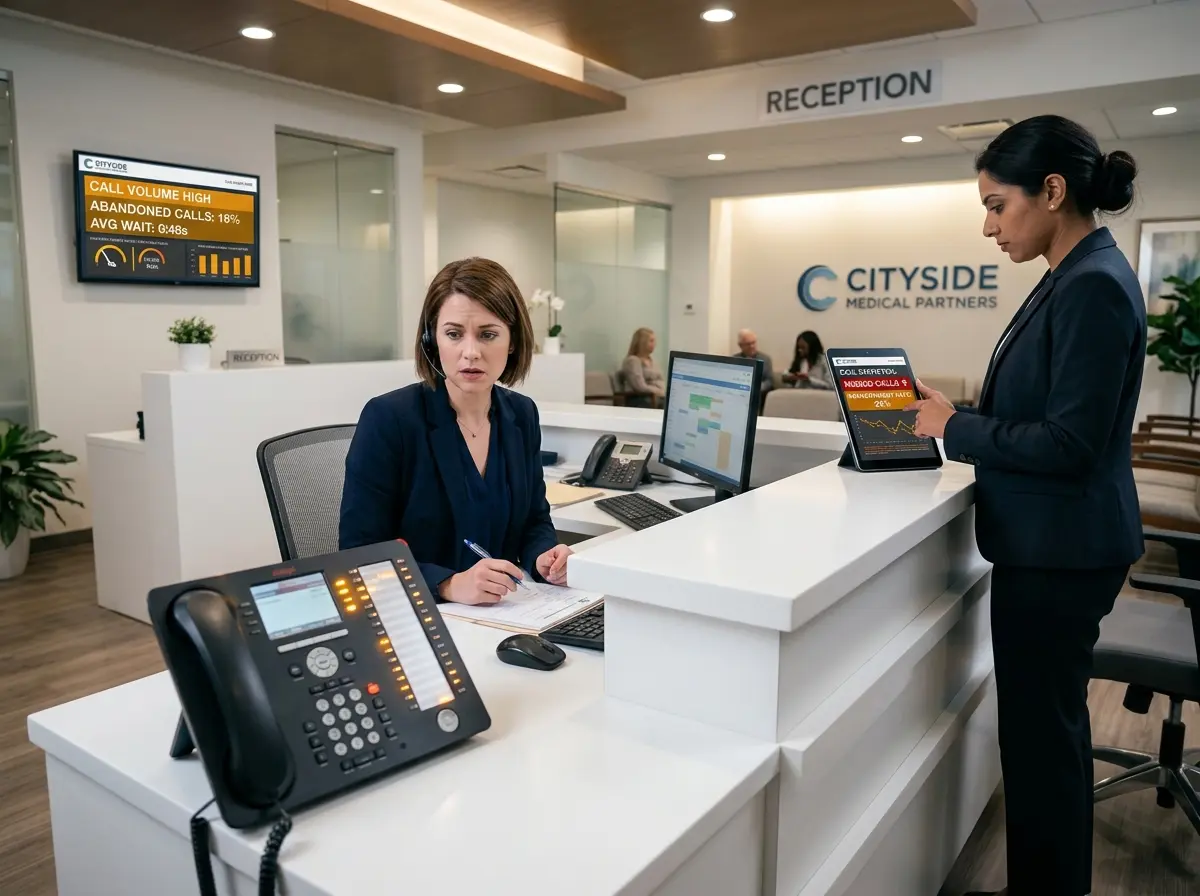
Let's talk about something most medical practice managers never put on their radar — the call abandonment rate. You've got your patient satisfaction scores pinned to the wall, your appointment fill rate color-coded on a spreadsheet, and maybe even a framed copy of your Google star rating near the front desk. But how many patients called your practice today, waited on hold, and then just... hung up? Went somewhere else? Booked with your competitor down the street who picked up faster?
If you don't know the answer, you're not alone — but you're also leaving money, and more importantly, patient relationships, on the table. The average call abandonment rate in healthcare hovers around 7–8%, but many busy practices quietly suffer rates of 15% or higher without ever realizing it. That's not a rounding error. That's a waiting room that never fills up.
The good news: this is one of the most fixable problems in practice management. You just have to start paying attention to it.
Understanding Call Abandonment in a Medical Setting
What It Is and Why It Happens
Call abandonment occurs when a caller hangs up before reaching a live person or completing their intended interaction. In a medical office, this typically happens during hold times, during transfers between staff, or — and this one stings — when calls simply go unanswered because everyone at the front desk is dealing with a patient in person. It's not a staffing failure, necessarily. It's a structural one. Your phones and your front desk are competing for the same limited human attention, and the phones often lose.
The reasons patients abandon calls are painfully predictable: hold times exceeding two minutes, confusing phone trees, getting transferred multiple times, or calling after hours and reaching a voicemail that feels like shouting into the void. Each of these is a friction point — and in healthcare, friction doesn't just annoy people, it delays care and drives them to find another provider.
How to Actually Measure It
If your phone system is more than a few years old, it may not offer robust analytics out of the box. But there are a few approaches worth pursuing. First, check whether your VoIP or phone provider offers a call analytics dashboard — many do, and most practice managers never look at it. You're looking for total inbound calls versus total answered calls, average hold time before abandonment, and time-of-day patterns for when abandonment spikes.
Second, talk to your front desk staff honestly. They know intuitively when phones are overwhelming them — they just may not have the language to frame it as a measurable problem. A simple tally sheet for a week can give you directional data that's surprisingly accurate. The goal isn't perfection; it's awareness. You can't fix what you refuse to measure.
The Real Cost of a Dropped Call
Here's the math that should make you put down your coffee. If your practice receives 100 calls per day and even 8% abandon, that's 8 patients daily who didn't schedule, didn't refill, didn't ask their question. Over a month, that's roughly 160–170 missed interactions. If even half of those were appointment opportunities at an average value of $150 per visit, you're looking at over $12,000 in lost monthly revenue — from a metric you weren't tracking. Now imagine those aren't just revenue opportunities, but patients who needed timely care. That's the version of this story that should keep you up at night.
How Technology Can Close the Gap
AI Receptionists and the Always-Available Advantage
The most direct fix for call abandonment is elegant in its simplicity: answer every call, every time. That sounds obvious, but for a busy medical office where the front desk staff are simultaneously checking in patients, verifying insurance, and answering in-person questions, "answer every call" is easier said than done — unless you bring in help that doesn't need a lunch break.
Stella is an AI robot employee and phone receptionist that answers calls 24/7 with full knowledge of your practice's services, hours, policies, and offerings. She can handle the high-volume routine calls that clog your phone lines — appointment availability questions, directions, insurance queries, prescription refill routing — and free your human staff to focus on the patients standing right in front of them. She can also collect patient information through conversational intake forms during the call itself, feeding cleanly into a built-in CRM with custom fields, tags, and AI-generated summaries. That means fewer abandoned calls and better data on who's calling and why. For practices with a physical location, she also stands at the front as an in-person kiosk, greeting patients and reducing the front desk logjam that often causes phones to go unanswered in the first place.
Reducing Abandonment Without Rebuilding Your Entire Operation
Quick Wins That Cost Almost Nothing
Not every fix requires new technology. Some of the most impactful changes to call abandonment rates come from operational tweaks that cost nothing but attention. Start by auditing your hold messaging — if patients are sitting on hold in silence or listening to a recording that just says "your call is important to us" on loop, they're mentally checking out within 90 seconds. Replace silence with useful information: appointment reminders, health tips, or a simple acknowledgment of expected wait time. Transparency reduces frustration dramatically.
Next, look at your staffing schedule against your call volume data. Most practices have predictable call spikes — Monday mornings, right after lunch, and the hour before closing are classic high-traffic windows. If you're scheduling your most junior staff during those windows, or if those are the times your front desk is most likely to be managing in-person check-ins simultaneously, you've found a structural problem with a structural solution. Adjust coverage, even temporarily, and watch your abandonment rate respond.
Setting Up Callbacks and After-Hours Flows
One of the most underutilized tools in practice management is the callback option. Rather than asking patients to wait on hold indefinitely, give them the option to receive a call back when a staff member is available. Many patients — particularly working adults calling during their lunch break — will gladly take this option, and it converts what would have been an abandoned call into a scheduled, intentional follow-up. Several modern VoIP systems offer this natively, and AI receptionists can be configured to offer and log callback requests automatically.
After-hours call handling deserves equal attention. A significant portion of abandonment happens outside business hours when calls go to voicemail with no acknowledgment of when they'll be returned. Even a well-crafted voicemail greeting with a specific callback window ("we return all messages by 10am the next business day") sets expectations and reduces the likelihood that a patient simply gives up and searches for another provider. Better still, an AI receptionist that operates after hours can answer questions, take structured messages with AI-generated summaries, and send immediate push notifications to managers — so nothing slips through the cracks while the office sleeps.
Making Abandonment Rate a Standing Metric
The single most important thing you can do after reading this is to make call abandonment a regular agenda item in your practice management meetings — not a one-time project you revisit in a year. Set a baseline this month. Define a target (industry best practice aims for under 5%). Assign someone ownership of monitoring it. Review it monthly alongside your appointment fill rate and patient satisfaction scores. When a metric gets watched, it almost always gets better. That's not magic — it's just accountability working exactly as advertised.
Quick Reminder About Stella
Stella is an AI robot employee and phone receptionist designed for businesses of all types — including medical practices that are tired of missed calls, overwhelmed front desks, and patients who slipped away because no one picked up. She answers calls 24/7, handles routine inquiries, collects intake information, and keeps your team focused on the work that actually requires a human touch. At just $99/month with no upfront hardware costs, she's the kind of staff member who never calls in sick and never puts a patient on hold indefinitely.
Start Measuring, Then Start Fixing
Call abandonment isn't a dramatic, headline-grabbing problem. It doesn't show up on your patient satisfaction surveys because those patients never became patients. It doesn't trigger a compliance alert or flag in your EMR. It just quietly costs you — in revenue, in relationships, and in the kind of reputation that only builds slowly and erodes fast.
Here's your action plan, starting this week:
- Pull your call data. Contact your phone or VoIP provider and request a report on inbound call volume versus answered calls for the last 30 days. If they can't provide it, it may be time to evaluate your phone system.
- Identify your abandonment windows. Look for the times of day and days of the week when abandonment spikes. That's where your intervention belongs.
- Fix your hold and after-hours experience. Update your on-hold messaging, add a callback option, and ensure after-hours voicemail sets clear expectations.
- Consider AI-assisted call handling. If your front desk is consistently overwhelmed, the answer isn't always "hire more staff." Sometimes it's smarter infrastructure.
- Make it a metric you own. Set a target, assign accountability, and review it monthly.
Your patients are trying to reach you. The only question is whether you're ready to pick up.