Introduction: The Lenses Are Right There. Are You Selling Them?
Let's be honest — your patients are already sitting in the chair. They've already committed to an appointment. They're already thinking about their vision. And yet, optical shops across the country consistently leave hundreds of dollars per transaction on the table because nobody thought to mention anti-reflective coating at the right moment. If that sentence made you wince a little, congratulations — you're in the right place.
Upselling lens upgrades isn't about being pushy. It's about being helpful. Most patients genuinely don't know the difference between standard polycarbonate lenses and high-definition digital lenses. They don't know that blue light filtering could change how they sleep at night, or that photochromic lenses would make their summer commute dramatically more comfortable. They're not holding out on you — they're just waiting for someone to explain it to them. That someone should be your staff, your systems, and yes, even your technology.
This guide breaks down a practical, repeatable approach to upselling lens upgrades at every appointment — without making your patients feel like they walked into a timeshare presentation. We'll cover how to train your team, how to time your conversations strategically, and how smart tools can support the whole process so nothing slips through the cracks.
Building the Foundation: Training, Language, and Mindset
Stop Thinking of Upselling as a Dirty Word
The single biggest barrier to effective upselling in optical practices isn't patient resistance — it's staff hesitation. Many opticians and front desk team members feel uncomfortable recommending upgrades because they don't want to seem like they're "selling." But here's the reframe: if a patient leaves your practice without knowing that premium anti-reflective coating reduces eye strain by up to 30%, and they spend the next year squinting at their laptop, you haven't protected their wallet — you've just failed to help them. Position every lens upgrade conversation as a clinical recommendation with lifestyle benefits, not a retail pitch. That mindset shift changes everything.
Create a Consistent Upgrade Menu and Train to It Religiously
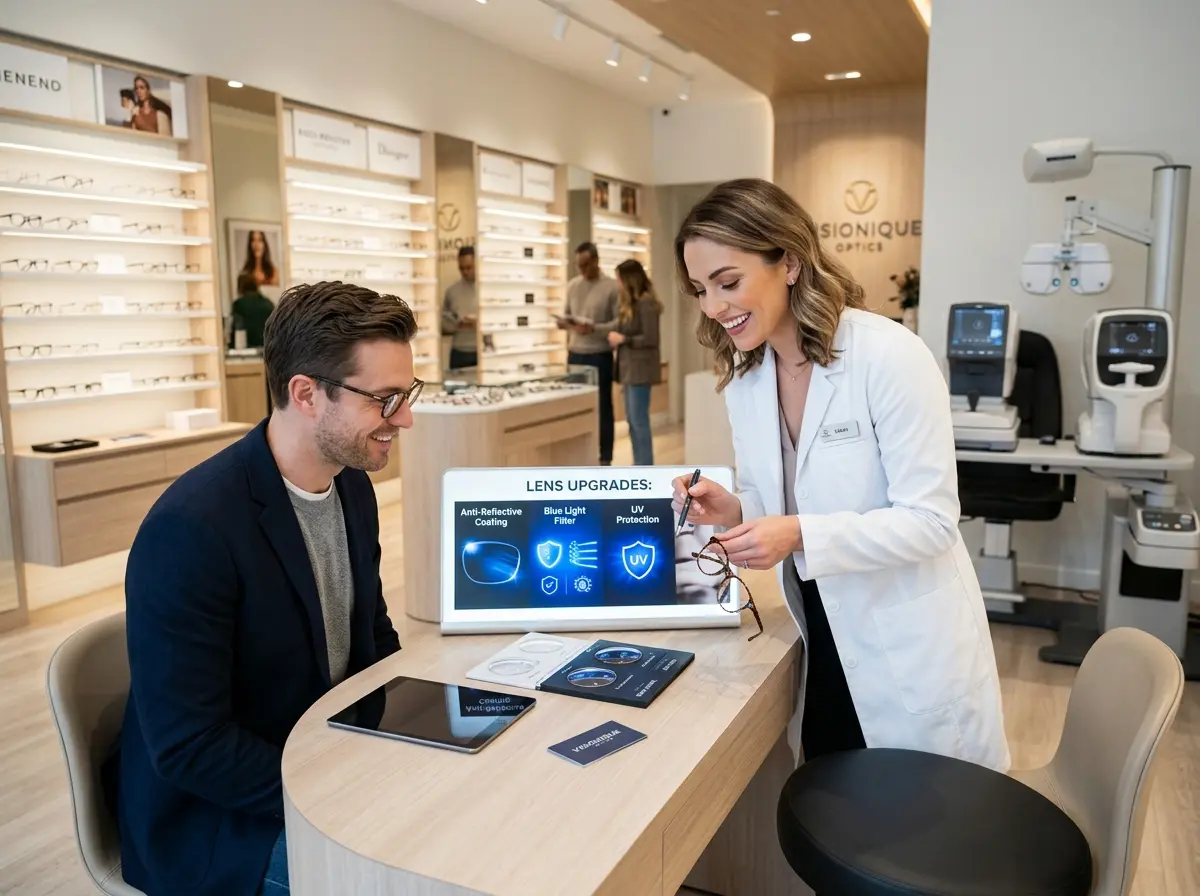
Your team cannot sell what they don't understand. Build a clear, concise internal "upgrade menu" that lists every lens enhancement you offer — blue light filtering, anti-reflective coating, photochromic lenses, high-index materials, digital HD lenses — along with two or three key talking points for each. Then practice. Role-play common patient objections like "Is that really necessary?" or "What's the cheapest option?" so your staff can respond confidently and naturally rather than fumbling through a product brochure while the patient stares at the ceiling.
Consider using a tiered "good, better, best" framing when presenting lens options. Patients respond well to having a structured choice rather than an overwhelming menu of add-ons. Present the middle option with genuine enthusiasm — research consistently shows it's the most commonly selected tier — and let patients self-select up or down from there.
Time the Conversation Strategically
Timing matters enormously. The best moment to introduce lens upgrades is immediately after the exam, while the optometrist's findings are still fresh. If the doctor mentions increased screen time sensitivity or light sensitivity, that's your cue to walk the patient directly into a conversation about blue light filtering or photochromic options. Front-loading the upgrade conversation at the beginning of the frame selection process — before price anchoring sets in — dramatically improves conversion rates. Once a patient has mentally committed to a $150 frame budget, suggesting a $120 lens upgrade feels enormous. Introduce it while the numbers are still fluid.
How Technology Can Work the Room (and the Phone Lines)
Let Smart Tools Carry the Load Between Appointments
Here's a scenario that plays out in optical shops daily: a patient calls to ask about their order status, your receptionist picks up mid-frame adjustment with another customer, the caller gets a rushed answer, and nobody thinks to mention that they're also due for a contact lens fitting or that your practice is currently running a promotion on progressive lenses. That's a missed opportunity that didn't have to happen.
Stella, an AI robot employee and phone receptionist, is built for exactly this kind of gap. For optical shops with a physical location, Stella stands as a human-sized kiosk inside your store, proactively engaging patients who are waiting, browsing frames, or simply looking around — making her a natural opportunity to mention current lens promotions or answer common questions about upgrade options. She never forgets to bring up the blue light special. She never has a bad day. And on the phone side, she answers every call 24/7 with the same product knowledge your best staff member uses in person, so patients asking about lens options after hours get a real, informative conversation instead of a voicemail box. At $99/month with no upfront hardware costs, she's also considerably less expensive than a full-time front desk hire.
The Patient Conversation: Scripts, Objections, and Closing
Use the Doctor's Notes as Your Opening
A warm handoff from the optometrist is gold. When the doctor says something like, "You mentioned spending a lot of time on screens — I'd recommend asking about our blue light options at the front," they've essentially pre-sold the upgrade for you. If your practice doesn't have a formal handoff system, build one. A simple internal note on the patient's chart flagging recommended upgrades based on their exam findings gives your opticians a legitimate, medically-grounded reason to bring up premium lenses. Patients are far more receptive to upgrades that feel like a continuation of clinical care than to ones that feel like an afterthought at the register.
Handle Objections Without Backing Down (Or Being Annoying)
The most common objection you'll hear is price-related, and the best response is almost never to immediately offer a discount. Instead, isolate the concern. "Is it the monthly budget, or are you unsure whether the upgrade will make a difference for you?" Often the hesitation is about perceived value, not actual financial constraint. This is where having specific, relatable examples helps — "Most of our patients who work in offices tell us the anti-reflective coating alone was worth it after the first week" is far more persuasive than rattling off coating specifications.
If a patient genuinely can't afford the full upgrade, offer a priority ranking. Ask them which part of their lifestyle causes the most visual discomfort and match one upgrade to that specific pain point. A partial win is still a win — and a patient who got a great result from their first upgrade is considerably more likely to add another next time.
Follow Up After the Sale to Build Upgrade Loyalty
The post-purchase experience is wildly underutilized in optical retail. A simple follow-up message two weeks after pickup — asking how the new lenses are working out — opens the door for referrals, reviews, and future upsell conversations. If a patient reports loving their photochromic lenses, that's your cue to note it in their record and bring it up proactively at their next exam. If they have a complaint, you've caught it early enough to fix it before it becomes a negative review. Either way, you're building the kind of patient relationship that makes the next upsell conversation feel like a natural continuation of ongoing care rather than a sales pitch.
Quick Reminder About Stella
Stella is an AI robot employee and phone receptionist that helps optical shops — and businesses across dozens of industries — greet customers, answer questions, promote offerings, and handle calls around the clock. She works as an in-store kiosk presence and as a 24/7 phone receptionist, all for $99/month with no setup headaches. If your front desk is stretched thin during busy hours or you're tired of missed calls becoming missed revenue, she's worth a serious look.
Conclusion: Small Conversations, Big Revenue Impact
Lens upgrades aren't a luxury add-on that only certain patients deserve to hear about — they're a meaningful part of the vision care you're already providing. When your team is trained to talk about upgrades confidently, when your timing is strategic, and when your technology is helping carry the load between human touchpoints, the revenue impact is significant. Studies from optical industry associations suggest that practices with structured upgrade recommendation protocols see 20–35% higher per-patient revenue compared to those without. That's not magic — that's just having the right conversations at the right times.
Here's your action plan: audit your current upgrade presentation process this week. Is it consistent? Is it timed correctly? Are there gaps where patients are leaving without hearing about options that would genuinely help them? Fix the biggest gap first — whether that's a staff training session, a better handoff protocol, or simply making sure your waiting area and phone interactions are working for you instead of just maintaining the status quo.
Your patients came to you for better vision. Give them every tool available to achieve it — and your practice will be better for it too.