Lights, Camera, More Leads: Why Local Contractors Can't Afford to Skip Video
Let's be honest — most local contractors don't get into the trades because they dream of becoming YouTube stars. You got into it because you're good with your hands, you solve real problems, and there's something deeply satisfying about a job done right. Unfortunately, your future customers don't know any of that yet, and they're not going to find out by staring at your blank Facebook page from 2017.
Video marketing has quietly become one of the most powerful tools available to local service businesses, and contractors who are using it well are pulling ahead of the competition in a serious way. According to Wyzowl's 2023 State of Video Marketing report, 89% of consumers say watching a video has convinced them to buy a product or service. That's not a small nudge — that's nearly everyone. And when someone needs a roofer, an HVAC tech, or a remodeling contractor, the business that shows up on video looking competent and trustworthy is almost always the one that gets the call.
The good news? You don't need a film crew, a Hollywood budget, or a business degree to make this work. You need a smartphone, a basic strategy, and the willingness to show up on camera once in a while. This guide walks you through exactly how to do that.
Building a Video Strategy That Actually Gets You Jobs
Start With the Questions Your Customers Are Already Asking
The single best source of video content you'll ever find is the list of questions your customers ask you every day. "How long does this take?" "How much does it usually cost?" "Do I really need to replace the whole thing, or can you just fix part of it?" Every one of those questions is a video waiting to happen, and when someone types that question into Google or YouTube, you want your face to show up with the answer.
This approach — often called the "They Ask, You Answer" method, popularized by Marcus Sheridan — is particularly effective for contractors because the questions are so practical and specific. A two-minute video explaining what to expect during a kitchen remodel walkthrough, or why your area's soil conditions affect foundation repair costs, positions you as a knowledgeable expert long before that customer ever picks up the phone. It builds trust without a sales pitch, which is exactly what skeptical homeowners are looking for.
Start by writing down 10 to 15 common questions you hear from customers. Those are your first 10 to 15 videos. That's your content calendar for the next several months. Done.
The Before-and-After Formula Is Your Best Friend
If question-and-answer videos are the foundation of your strategy, before-and-after project videos are the roof — they're what close the deal. Nothing communicates the value of your work more clearly than a 60-second video that starts with a crumbling driveway and ends with a clean, freshly poured concrete surface. No explanation needed. The work speaks for itself.
The key here is consistency. Make it a habit to film a quick walkthrough before you start any significant job, and another one when you're done. You don't need to narrate anything fancy — just pan the camera slowly, maybe say a sentence or two about what was done, and let the transformation do the heavy lifting. Post these on Instagram Reels, YouTube Shorts, Facebook, and TikTok. The short-form video format is tailor-made for this kind of content, and the algorithms reward it with free reach.
One roofing contractor in the Midwest started posting before-and-afters on Instagram Reels three times a week and grew from 200 followers to over 8,000 in under a year — more importantly, he reported a noticeable uptick in inbound calls from homeowners who said they "found him on Instagram." That's the real metric that matters.
Where to Post and How Often (Without Losing Your Mind)
The biggest mistake most contractors make with video is trying to be everywhere at once and then burning out after three weeks. Pick two platforms and do them well. For most local contractors, that means YouTube (for searchability and longevity) and one short-form platform like Instagram Reels or TikTok (for reach and discovery).
YouTube videos have an indefinitely long shelf life — a video you post today can still be bringing in leads two years from now if it ranks for a relevant search. Short-form platforms burn brighter but fade faster, which is why they work well together. Aim for one to two YouTube videos per month and three to five short clips per week. Repurpose aggressively: film one job, cut it into a long YouTube video, a 60-second Reel, and a quick tip clip. One piece of raw footage can fuel a week's worth of content if you think about it the right way.
Handling the Leads That Your Videos Generate
Don't Let a Good Video Strategy Go to Waste at the Phone
Here's a scenario that plays out more often than contractors would like to admit: a homeowner watches your excellent, trust-building video on YouTube, decides you're the contractor they want, and calls your number — only to get voicemail. They hang up and call your competitor. All that effort, all that content, and the lead slipped through a crack that costs nothing to fix.
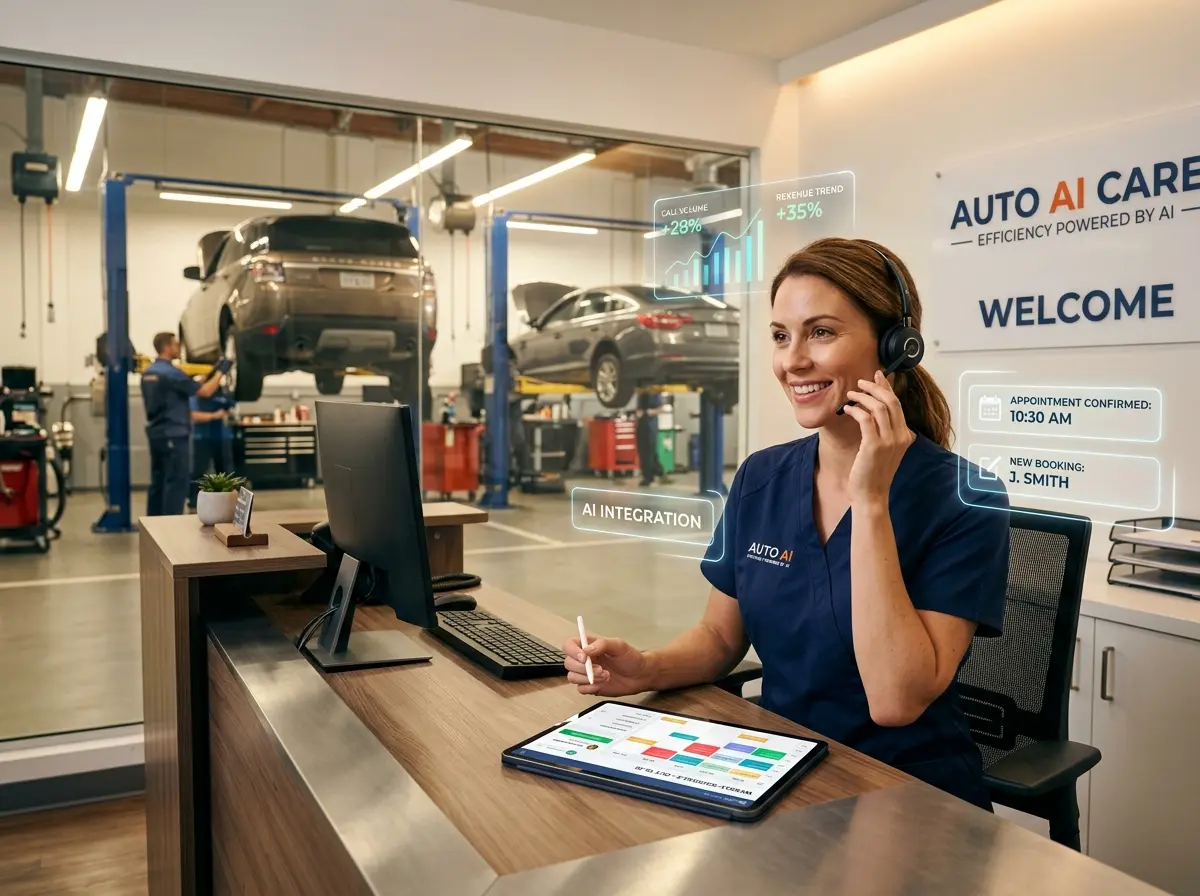
Stella, the AI robot employee and phone receptionist, makes sure that never happens. She answers every call 24/7 with the same professionalism and business knowledge she'd use in person at your front counter — handling questions about services, availability, and pricing, collecting customer information through conversational intake forms, and forwarding calls to human staff when conditions call for it. If your video marketing is working around the clock to bring in leads, your phone coverage should be doing the same. Stella also keeps a built-in CRM with AI-generated contact profiles so you can actually track and follow up with every lead that comes in, rather than losing them in a pile of sticky notes.
Making Your Videos Look and Sound Like You Mean Business
You Don't Need Fancy Equipment — But You Do Need Good Audio
New contractors almost always make the same mistake when they start filming: they spend $800 on a camera and nothing on audio. Here's the uncomfortable truth — viewers will forgive shaky footage or imperfect lighting far more readily than they'll forgive muffled, hard-to-hear audio. If someone can't understand what you're saying, they're gone in ten seconds.
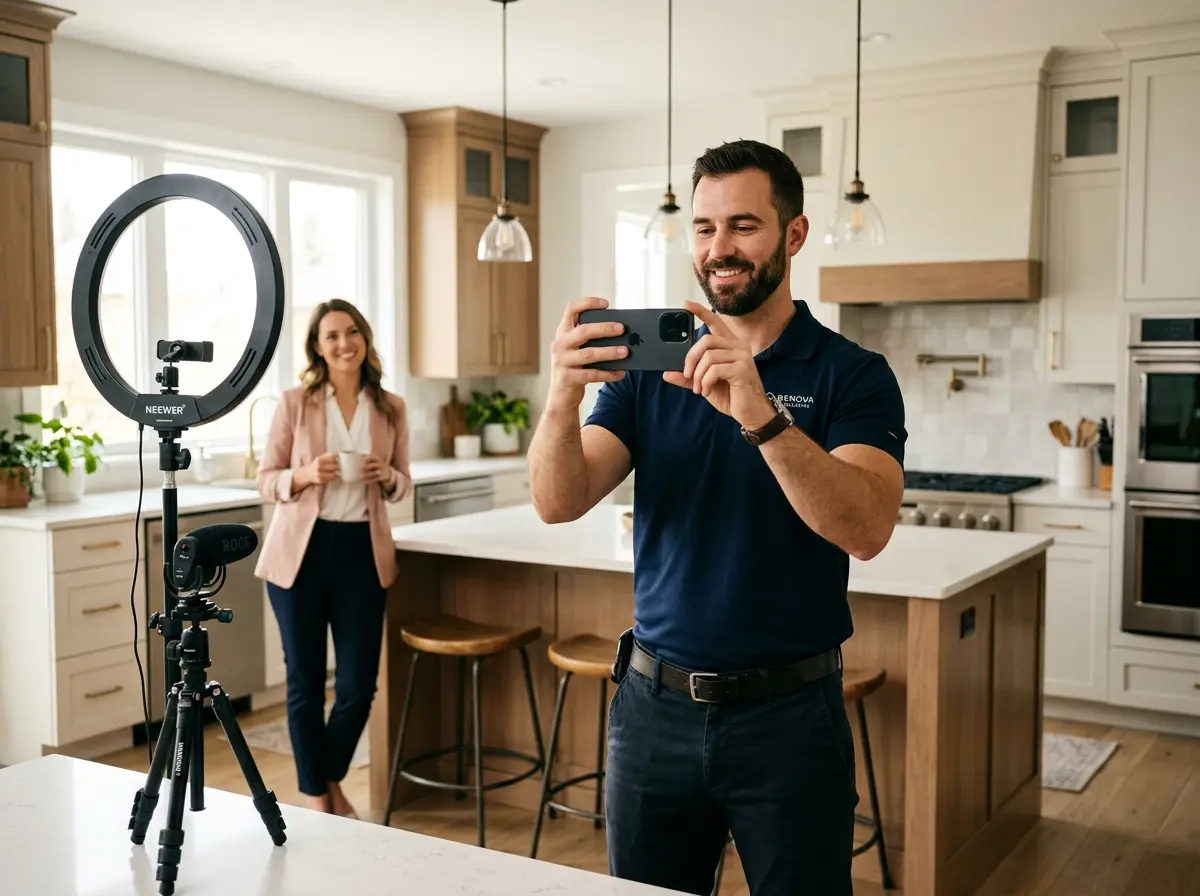
A lapel microphone (also called a lavalier mic) that clips to your shirt can be found for $20 to $50 on Amazon and will immediately make your videos sound significantly more professional. Pair that with filming outdoors in natural light or near a window, and you've solved 80% of the production quality problem without spending a fortune. Your phone's camera is almost certainly good enough. Stop waiting until you have "better equipment" — that's just a well-dressed excuse.
Show Your Face and Your Personality
Local contractor marketing lives and dies on trust, and trust comes from people feeling like they know you. The contractors who perform best on video are almost never the most polished or the most technically skilled presenters — they're the ones who feel real. Show up as yourself. Laugh when something's funny. Get a little fired up when you talk about shoddy work you've seen on renovation shows. Let people see that you actually care about what you do.
A concrete contractor who posts videos ranting (professionally and good-naturedly) about common DIY mistakes builds a loyal audience because people enjoy watching someone who genuinely loves their craft. That personality becomes your brand differentiator in a market where every other contractor's website looks exactly the same. Homeowners hire people they like and trust — video is simply the fastest way to establish both.
Use Local SEO to Make Your Videos Findable
Creating great videos is only half the equation. Getting them in front of people in your service area is the other half, and that's where local SEO basics come in. When you upload to YouTube, include your city and service type in the video title — not "How to Fix a Leaky Roof" but "How to Fix a Leaky Roof in Austin, Texas." Include your service area in the description, add relevant tags, and link back to your website or Google Business Profile.
Speaking of your Google Business Profile — did you know you can post videos there too? Many contractors overlook this completely. A short project video posted to your Google Business Profile can show up directly in local search results and on Google Maps, putting your work in front of homeowners who are actively searching for a contractor right now. It's one of the most underused and highest-return moves in local contractor marketing, and it costs nothing but a few minutes of your time.
Quick Reminder About Stella
Stella is an AI robot employee and phone receptionist built for businesses like yours — she answers calls 24/7, greets customers, promotes your services, handles intake, and manages a built-in CRM so no lead falls through the cracks. She runs on a flat $99/month subscription with no upfront hardware costs and is ready to go with minimal setup. Whether your video marketing brings in a trickle or a flood of new inquiries, Stella makes sure every one of them gets a professional, knowledgeable response.
Your Next Move: Start Simple and Stay Consistent
Video marketing for local contractors isn't complicated, but it does require consistency — and that's where most people drop off. The contractors who win with video aren't producing cinematic masterpieces. They're showing up regularly, answering real questions, showcasing real work, and letting authenticity do what no ad spend can fully replicate.
Here's a simple action plan to get started this week:
- Write down 10 questions your customers ask most often. These are your first 10 videos.
- Film one before-and-after on your next job. Even a rough first attempt is better than nothing.
- Set up or optimize your YouTube channel and Google Business Profile so your videos have somewhere to live and be found.
- Pick up an inexpensive lapel mic so your audio doesn't undermine your otherwise solid content.
- Make sure your phone coverage matches your marketing effort — if videos are working at 2 a.m. to bring in leads, your phones should be too.
The contractors who start building their video presence today are the ones who will be booked out six months in advance in two years. The ones who wait until "things slow down" to think about marketing will still be waiting. Your competition is already on camera — the only question is whether you're going to show up alongside them or let them have the whole stage to themselves.
Pick up your phone, hit record, and introduce your future customers to the contractor who's actually going to take care of their home. They're already out there looking for you.