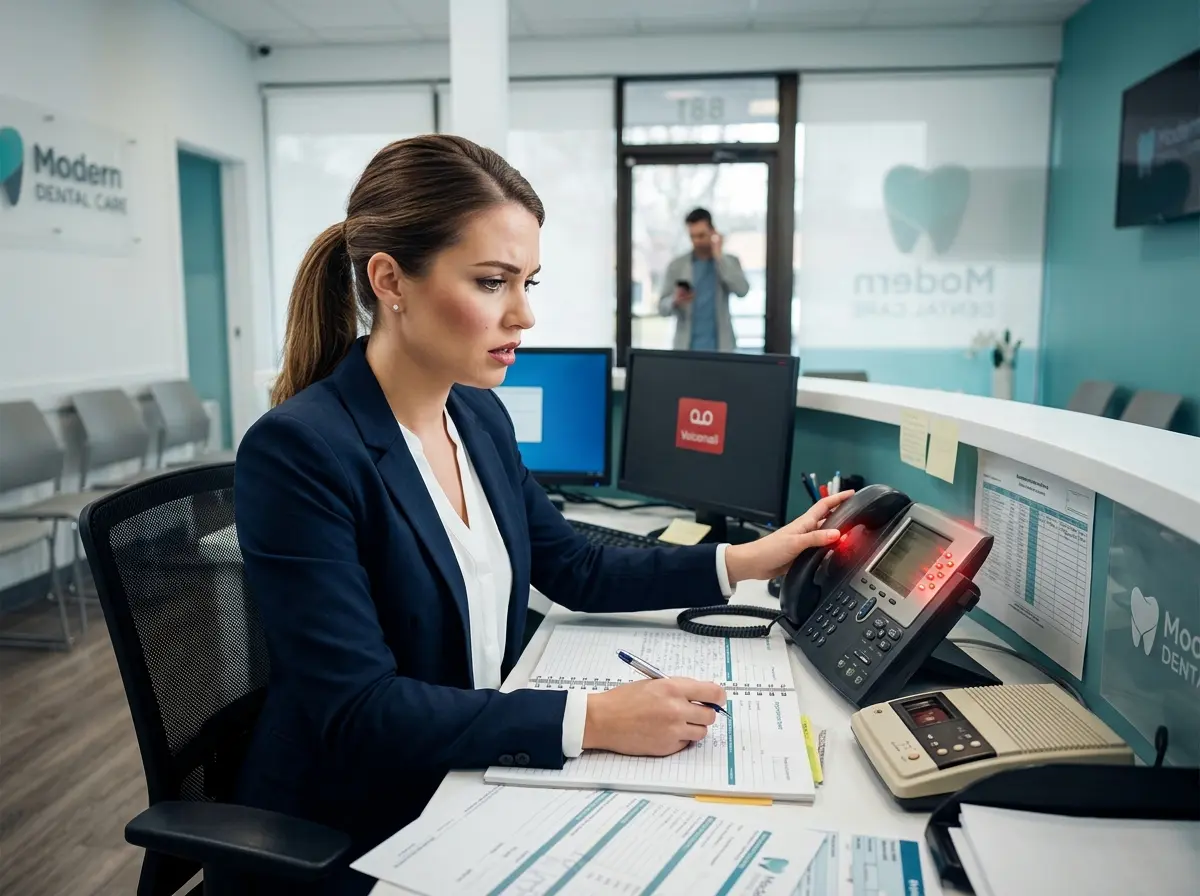
Your Patients Are Calling. No One Is Answering.
Let's paint a picture. A potential new patient — let's call her Karen — has a toothache. She's finally motivated enough to find a dentist, which, as any dental professional knows, is basically a miracle. She Googles dentists near her, finds your practice, and calls. What happens next determines whether she becomes a loyal patient worth thousands of dollars in lifetime revenue, or whether she becomes someone else's loyal patient.
If she hits a voicemail, there's a good chance she hangs up and calls the next practice on the list. According to research from Dental Economics, the average dental practice misses somewhere between 25% and 40% of its incoming calls. That's not a rounding error — that's a leaky bucket draining your new patient pipeline while you're busy, you know, actually doing dentistry.
The good news? This is a completely fixable problem. The bad news? Ignoring it is expensive. Let's talk about why this keeps happening, what it's costing you, and what you can do about it today.
The Hidden Cost of Missed Calls in Dental Practices
What One Missed Call Actually Costs You
Most dental practice owners think of a missed call as a minor inconvenience. Someone will call back, right? Maybe. But the data tells a different story. Studies consistently show that 80% of callers who reach a voicemail do not leave a message. They just hang up. And in an era where patients have three other dental offices to choose from within five miles, patience is not a virtue they're exercising.
Consider the math. The average new dental patient generates between $1,500 and $2,000 in revenue in their first year, and significantly more over a lifetime of care. If your practice misses just ten calls a month — and many practices miss far more — and even half of those were new patient inquiries, you could be leaving tens of thousands of dollars on the table annually. That's not a staffing problem. That's a revenue problem wearing a staffing problem's lab coat.
The Lunch Break Black Hole and After-Hours Abyss
Here's where it gets particularly painful for dental offices. Your busiest call windows often align perfectly with the times your front desk is least available: the lunch hour and the after-work rush between 5 and 7 PM. Your staff is human — they eat, they go home, they occasionally need a bathroom break longer than 90 seconds. Unfortunately, prospective patients don't schedule their toothaches around your office hours.
After-hours calls are an especially brutal missed opportunity. Someone sitting at home at 8 PM, finally mustering the courage to book that overdue cleaning, hits your voicemail and almost certainly doesn't call back. That patient — and their spouse, and eventually their kids — never walks through your door. The answering machine didn't just miss a call. It turned away a family.
The Callback Problem: When "We'll Call You Back" Isn't Good Enough
Even when voicemails do get left, callback protocols in busy dental offices are notoriously inconsistent. Messages get missed, written down wrong, or returned at inconvenient times when the patient can't answer. Phone tag is not a patient acquisition strategy. By the time your front desk reaches the caller, there's a decent chance they've already booked somewhere else — or talked themselves out of going to the dentist at all, which is arguably worse for their health and definitely worse for your schedule.
A Smarter Front Desk That Never Takes a Lunch Break
How AI Phone Receptionists Are Changing the Game for Dental Practices
This is where technology earns its keep. Stella is an AI robot employee and phone receptionist designed specifically to solve this problem — not just for dental offices, but for any practice or business tired of losing customers to the void. She answers calls 24/7 with full knowledge of your services, office hours, pricing, insurance questions, and current promotions. She never transfers a patient to hold music. She never forgets to mention the new patient special. And she absolutely never calls in sick on a Monday.
For dental practices in particular, Stella can handle the high-volume, repetitive inquiries that clog up your front desk — questions about appointment availability, what insurances you accept, how to prepare for a procedure, and whether you offer teeth whitening. She can collect new patient intake information conversationally during the call itself, feeding it directly into her built-in CRM so your team has everything they need before the patient even walks in. For practices with a physical waiting room or lobby, she can also greet patients in person as a friendly, knowledgeable kiosk presence — answering questions and promoting services while your staff focuses on care.
Fixing Your Phone Problem: Practical Steps for Dental Practices
Audit Your Current Call Handling First
Before you can fix the problem, you need to know its actual size. Most practice management software can give you basic call volume data, but you may need a dedicated call tracking tool to see missed call rates, call durations, and peak call times. Spend one week tracking every incoming call your practice receives, when it comes in, whether it was answered, and what happened next. The results are usually humbling — and motivating.
Pay close attention to:
- Calls during the noon hour and between 5–7 PM
- Calls on Fridays and the day before holidays
- Calls that went to voicemail and received no callback within 24 hours
- New patient calls specifically (you can train staff to flag these)
Train Your Team on the Value of Every Call
Front desk staff in dental offices are often undertrained in phone communication relative to their importance. A patient calling your practice for the first time is making a snap judgment about your entire operation based on that first interaction. If they reach a harried, distracted receptionist who puts them on hold immediately, that sets the tone — and not a good one.
Invest in short, regular training sessions on phone etiquette, new patient scripting, and objection handling. Role-play common scenarios like insurance questions, cost concerns, and appointment anxiety. Your front desk team is your first line of relationship building, and equipping them well pays dividends in conversion rates and patient retention. That said, training can only go so far when the root issue is capacity — there simply aren't enough hours in the day for a two-person front desk to answer every call, greet every patient, and manage check-ins simultaneously.
Create a Real After-Hours Protocol (Not Just a Voicemail)
If you're going to use voicemail for after-hours calls, at the very minimum your message should be warm, specific, and should set clear callback expectations. "Your call is important to us" followed by silence until morning is not a protocol — it's a placeholder. Tell callers when they can expect to hear back, give them an emergency contact option for urgent dental situations, and if possible, direct them to a web page where they can book an appointment online right now, without waiting for a human.
Better yet, consider an AI solution that can handle these calls in real time so that the after-hours experience feels just as professional as calling during business hours. The technology exists. The patients are calling. The only question is whether you're ready to answer.
Quick Reminder About Stella
Stella is an AI robot employee and phone receptionist that works 24/7 — answering calls, greeting in-person visitors, collecting patient information, and managing customer contacts through her built-in CRM. She's available for just $99/month with no upfront hardware costs, and she's ready to work from day one. For dental practices tired of losing new patients to an answering machine, she might be the most reliable team member you've never had to hire.
Stop Losing Patients to the Beep
The dental industry is competitive, and patient acquisition is hard enough without handing warm leads to your competitors simply because no one picked up the phone. The steps forward are clear: audit your call handling, train your team, fix your after-hours experience, and consider the kind of technology that ensures no call — and no patient — falls through the cracks.
Your next steps are straightforward:
- Run a one-week missed call audit to understand the real scope of the problem in your practice.
- Review your current voicemail and after-hours messaging and update it to be warm, specific, and actionable.
- Train your front desk team on new patient call scripting and phone etiquette.
- Explore AI receptionist tools that can cover the gaps your human staff simply cannot — especially after hours and during peak volume periods.
Karen — your hypothetical toothache patient from the beginning of this article — is out there right now, phone in hand, ready to become someone's loyal new patient. Make sure it's yours. Answer the call.