When "Emergency" Means Different Things to Different People
If that scenario made you wince, you're in good company. HVAC companies across the country are hemorrhaging money, burning out their best technicians, and damaging customer relationships — not because of bad equipment or poor service, but because of unqualified emergency dispatches. The problem isn't that customers call at odd hours. The problem is that no one is asking the right questions before rolling a truck.
The Real Cost of Unqualified Emergency Dispatches
It's Not Just Wasted Fuel
According to industry estimates, HVAC companies can spend anywhere from $150 to $400 per truck roll, factoring in labor, fuel, vehicle depreciation, and administrative overhead. Multiply that by even a handful of unnecessary dispatches per month, and you're looking at thousands of dollars in annual losses — losses that don't show up on a single line item but slowly erode your margins all the same.
Technician Burnout Is a Retention Crisis Waiting to Happen
Customer Expectations Are a Two-Way Street
Here's the part that stings a little: customers who trigger unnecessary dispatches often don't feel great about it either — especially when they get the bill. A customer who calls in a panic at midnight and gets charged an emergency rate for a tripped breaker is likely to feel embarrassed, overcharged, or both. That's not a recipe for a five-star Google review. A better intake process actually protects the customer experience just as much as it protects your bottom line.
How AI Can Triage HVAC Calls Before Anyone Gets in a Truck
Intelligent Intake, Around the Clock
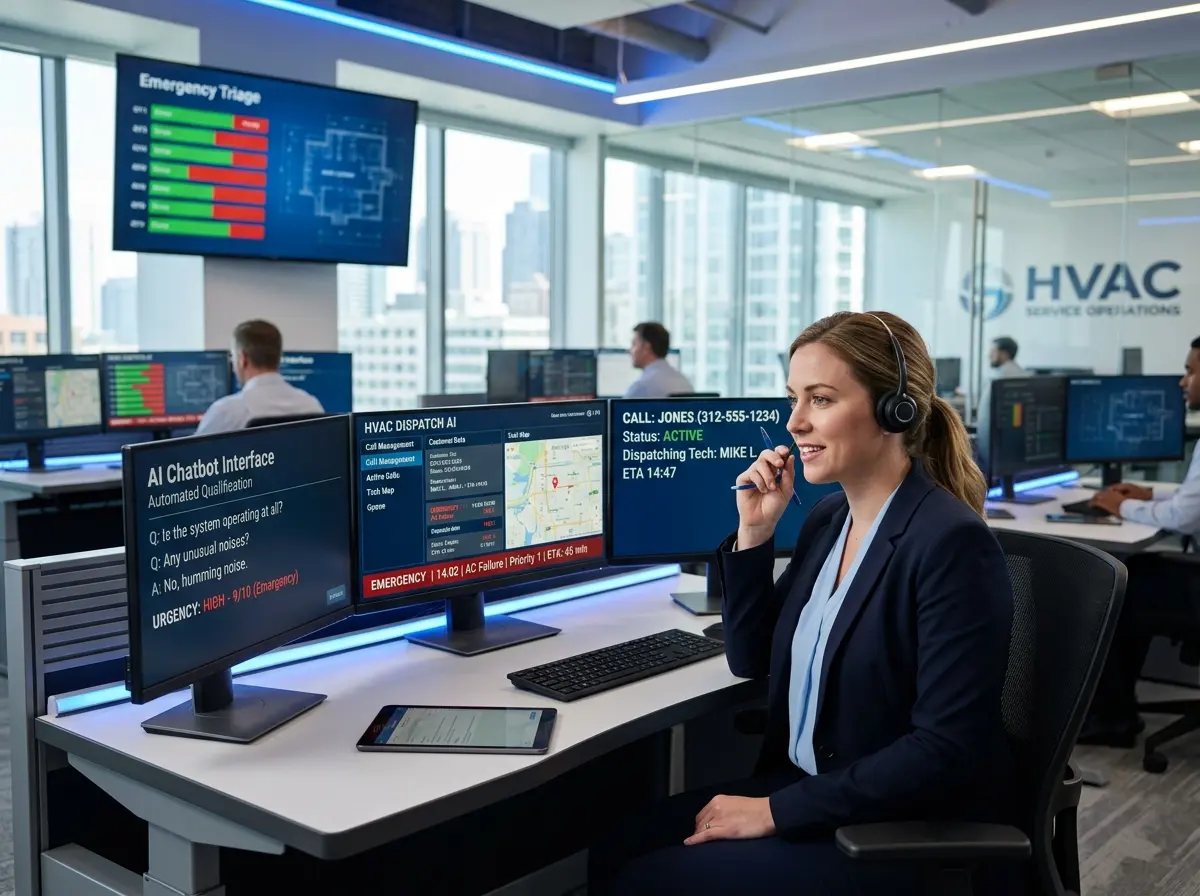
Stella, the AI robot employee and phone receptionist, is designed to handle exactly this kind of front-line qualification. When a customer calls your HVAC company after hours, Stella answers immediately — no hold music, no voicemail, no "press 1 for emergencies" maze — and begins a natural, conversational intake process. She can ask targeted diagnostic questions: Is the system making any unusual sounds? Are any circuit breakers tripped? When did the issue start? Is there any visible ice on the unit? Has the filter been changed recently?
Based on the responses, Stella can categorize the call, capture all relevant details through her built-in intake forms and CRM, and either escalate to an on-call human immediately or schedule a next-available appointment — all without waking anyone up unnecessarily. Every interaction is logged, summarized with AI-generated notes, and pushed to your team so no detail is lost by morning.
Building an AI-Assisted Emergency Protocol That Actually Works
Define What "Emergency" Means for Your Business
Script the Right Diagnostic Questions
- What is the current indoor temperature, and what is the weather outside?
- Is anyone in the home with a medical condition affected by temperature?
- Is the system completely non-functional, or is it running but underperforming?
- Have you checked your thermostat settings, batteries, and circuit breaker?
- When did you first notice the problem — just now, or has it been building?
- Is there any unusual smell, smoke, or visible damage?
These questions aren't just for filtering calls — they're genuinely useful information for your technician if a dispatch is warranted. Arriving on-site with context is always better than arriving cold.
Set Clear Escalation Rules and Respect Them
A Quick Reminder About Stella
Stella is an AI robot employee and phone receptionist built for businesses just like yours. She answers calls 24/7, conducts conversational intake, logs everything into a built-in CRM, and escalates to your team only when it counts — so you stop paying for truck rolls that should have been a thermostat tutorial. At $99/month with no upfront hardware costs, she's one of the more sensible investments you'll make this year.
Stop Letting 3 AM Thermostat Calls Run Your Business
The HVAC industry runs on trust, technical expertise, and the ability to show up when people genuinely need help. None of those things are served by dispatching your best technician to reset a tripped breaker at 4 AM. A smart, AI-powered qualification process doesn't make your service less responsive — it makes it more intelligent.
- Document your emergency criteria — get your senior techs in a room and define, in writing, what qualifies as a true after-hours emergency for your business.
- Build your diagnostic question flow — work from that list of high-signal questions and map out a logical triage conversation.
- Set your escalation rules — decide exactly which answers trigger dispatch, which trigger a callback, and which route to next-day scheduling.
- Implement AI phone qualification — whether through Stella or another solution, get an AI receptionist answering those after-hours calls before a human has to.
- Review and refine — use call logs and CRM data to audit your triage results monthly and adjust your criteria as patterns emerge.