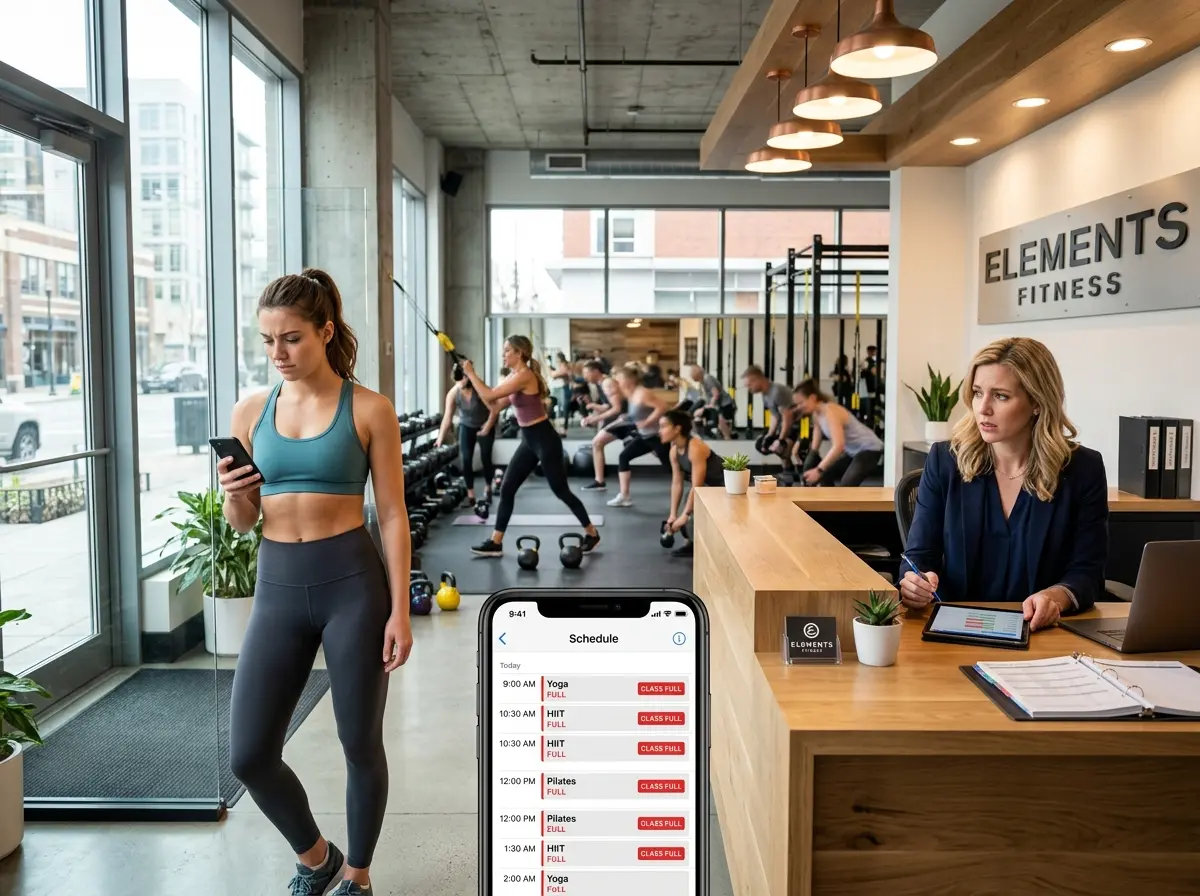
When "Sorry, Class Is Full" Becomes Your Most Expensive Phrase
Picture this: a motivated, dues-paying member opens your gym's app on a Tuesday morning, ready to book the 6 PM spin class. They tap around, get confused by the interface, assume the class is full (it isn't), and quietly cancel their membership two weeks later. You never knew they were frustrated. You never knew they left. And you definitely never knew the class had six open spots the whole time.
This is the silent membership leak that gym owners rarely talk about — not because it doesn't exist, but because it's invisible. Unlike a broken treadmill or a leaking roof, poor class scheduling software doesn't announce itself. It just quietly drives members away while you're busy doing literally everything else that keeps a gym running.
If your class scheduling system is clunky, confusing, or just plain outdated, you're not just losing convenience — you're losing people. And in an industry where the average gym loses 50% of new members within the first six months, every friction point matters. Let's dig into why this happens, what it costs you, and what you can actually do about it.
The Hidden Ways Bad Scheduling Software Drives Members Out the Door
The "I Can't Figure This Out" Problem
Most gym owners choose scheduling software based on features — waitlists, payment integration, instructor management. All reasonable priorities. But there's one factor that often gets ignored: whether a normal human being can actually use it without wanting to throw their phone.
If your members have to create an account, download a separate app, remember a password, navigate three menus, and then discover the class they wanted is somehow both "available" and "unavailable" at the same time — you've already lost them. People don't call customer support when a booking app frustrates them. They just stop trying. Research consistently shows that users abandon digital tasks within seconds of hitting friction, and gym-goers are no exception. They have options. Other gyms, YouTube workouts, and that dusty treadmill in their garage are all waiting patiently.
The fix here isn't necessarily buying the most expensive platform on the market. It's being ruthlessly honest about whether your current system passes the "my least tech-savvy member" test. If your 68-year-old water aerobics regular can book a class in under 90 seconds without calling the front desk, you're in good shape. If she can't, you have work to do.
Real-Time Availability That Isn't Actually Real-Time
There's a special kind of frustration reserved for showing up somewhere you were told had availability — only to find it didn't. Whether it's a delayed sync between your scheduling platform and your booking interface, or an instructor who manually updated a spreadsheet that no one else knew about, stale availability data is a trust-killer.
Members who get burned once might forgive you. Members who get burned twice start shopping around. Make sure your scheduling system reflects live, accurate class capacity — including real-time waitlist movement — and that it updates instantly across every surface where members can see it: your website, your app, and any in-person displays.
The Waitlist That Goes Nowhere
A waitlist feature is only useful if it actually does something. Too many gyms have waitlists that notify members of an open spot with approximately 11 minutes of notice — not enough time for someone with a job, a commute, or a child to actually make it to class. Others have notification systems that land in spam, or send text alerts that half the member base never opted into.
Audit your waitlist workflow. How much notice do members typically get? Are the notifications actually reaching them? Is there a way for members to set their own preferences for how much lead time they need? A waitlist that works is a retention tool. A waitlist that doesn't is just a list of people who gave up.
Where Technology Can Step In (and Where Stella Fits the Picture)
Plugging the Communication Gaps Your Software Leaves Behind
Even with the best scheduling platform in the world, members still have questions — and those questions often come in outside of staffed hours. "Is there still space in Saturday's HIIT class?" "What happens if I miss my reservation?" "Can I get on the waitlist over the phone?" These calls don't stop at 5 PM, but your front desk staff does.
This is where Stella, the AI robot employee and phone receptionist, can meaningfully support your gym. Stella answers calls 24/7 with the same knowledge your staff would use in person — including current class details, policies, promotions, and FAQs — so members always get a real, informed response instead of voicemail. For gyms with a physical location, Stella also operates as an in-store kiosk, greeting walk-ins, answering questions about the schedule, and proactively highlighting upcoming classes or membership deals. She doesn't replace your scheduling software, but she fills the communication gap that almost every gym has — the one where members give up because no one answered.
Fixing the Problem: What Actually Works
Choosing (or Auditing) Your Scheduling Platform with Member Experience in Mind
If you're evaluating new software or reconsidering what you already have, here are the questions that actually matter for member retention:
- How many steps does it take to book a class from scratch? Fewer is almost always better.
- Does it work well on mobile? The majority of your members are booking from their phones.
- How does it handle cancellations and waitlist promotions? Is the process automatic, fast, and clearly communicated?
- Can you embed booking directly into your website? Sending members to a third-party URL adds friction and feels disconnected from your brand.
- What do your actual members say? A quick five-question survey sent to your member list will tell you more than any feature comparison chart.
Popular platforms like Mindbody, Pike13, and Glofox each have their strengths and weaknesses, and the "right" choice depends heavily on your gym's size, class volume, and member demographics. What matters more than the brand is how thoroughly you configure and maintain it — and whether your team is actually trained to use it properly.
Making Cancellations Easy Without Enabling No-Shows
Here's a tension gym owners know well: you want members to cancel if they can't make it (so spots open up for others), but you don't want people reserving classes they never intend to attend. The solution most gyms land on is a cancellation window — typically somewhere between two and twelve hours before class — combined with a no-show policy that has actual teeth.
Whatever policy you choose, make sure it's crystal clear. It should be explained at sign-up, visible in the app, and consistently enforced. Members who understand the rules tend to follow them. Members who feel blindsided by a late-cancel fee tend to leave reviews about it.
Using Data to Stop Guessing About What Members Want
Your scheduling software is sitting on a goldmine of information that most gym owners never look at: which classes fill up instantly, which ones are consistently half-empty, which time slots have the highest no-show rates, and which instructors drive the most bookings. This data should be influencing your schedule every quarter, not just when someone complains.
If Tuesday at 7 AM has been fully booked with a ten-person waitlist for three months, that's a strong signal you need a second Tuesday morning class — or a larger room. If your Thursday noon yoga has five consistent attendees and costs you an instructor fee every week, that's a different kind of signal. Let the numbers guide the schedule, and you'll be giving members more of what they actually want instead of what you assume they want.
Quick Reminder About Stella
Stella is an AI robot employee and phone receptionist that works for gyms, studios, and all kinds of businesses — answering calls around the clock, greeting members in person at a kiosk, and handling questions so your staff can focus on what they do best. At just $99/month with no upfront hardware costs, she's the kind of front-desk support that doesn't call in sick, doesn't forget the membership specials, and never puts a frustrated member on hold indefinitely.
Your Next Steps Start Today
Losing members to a bad booking experience is one of those problems that feels small until you do the math. If even three members per month quietly cancel because they couldn't find a class spot or got fed up with the app, and your average member is worth $600 per year — that's $1,800 in annual recurring revenue walking out the door over a software problem you could fix.
Here's a practical action plan to get started:
- Book a class yourself using the same process your members use. Time it. Note every point of confusion.
- Send a short member survey specifically about the booking experience. Ask what's frustrating, not just what's good.
- Pull your scheduling data and identify the top three classes with persistent waitlists — those are your immediate expansion opportunities.
- Review your waitlist notification settings and test them personally to confirm they work as expected.
- Evaluate your after-hours communication gap — if members can't get answers about class availability when your staff is gone, consider what tools can fill that gap.
Your gym's classes are the product. The scheduling system is the storefront. And just like a physical storefront with a broken door and confusing signage will turn customers away before they ever spend a dollar, a frustrating digital booking experience will cost you members before they ever get a chance to fall in love with what you offer. Fix the door. Make it easy. Keep the members you've already worked so hard to earn.