So, You Want Customers to Find You Before Your Competitors?
Here's a fun scenario: A pipe bursts in someone's kitchen at 7:45 PM on a Tuesday. Water is spraying everywhere, the dog is losing its mind, and the homeowner is frantically Googling "plumber near me." Now, the real question is — does your business show up, or does your competitor two miles away get that $400 emergency call?
If you're not actively working on Local SEO, the answer is probably the latter. And that's a lot of money going down someone else's drain (pun absolutely intended).
Local SEO — or Local Search Engine Optimization — is the practice of making your plumbing business more visible in location-based searches. It's how you get your name, phone number, and five-star reviews in front of people who are right now, in your service area, desperately in need of your help. This isn't some abstract digital marketing concept. It's a practical, high-ROI strategy that even the least tech-savvy business owner can implement. Let's break it down.
The Foundation: Getting Your Google Business Profile Right
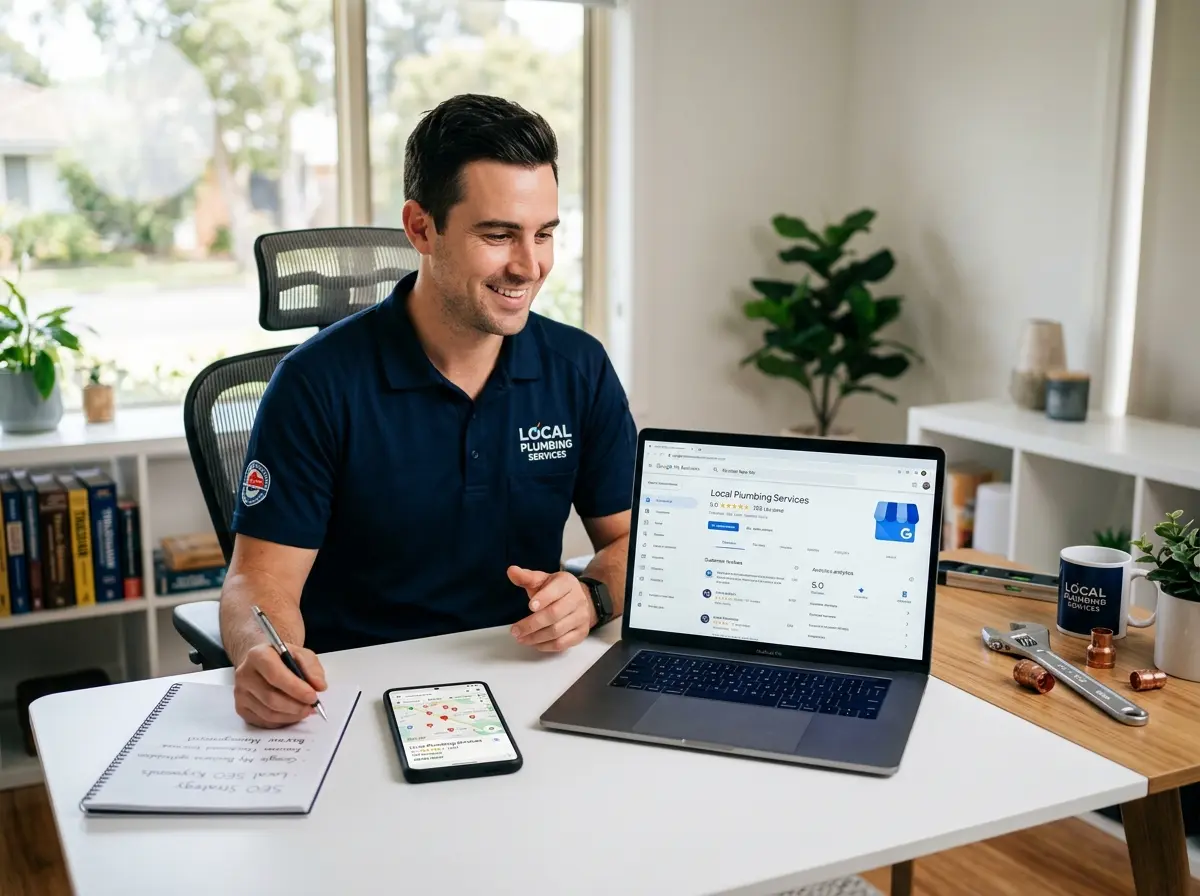
If Local SEO is a house, your Google Business Profile (GBP) is the foundation. Get it wrong, and everything else crumbles. Get it right, and you're the plumber who shows up in the coveted "Local Pack" — those three business listings that appear at the top of Google search results with a map. That real estate is prime, and it's free.
Claim, Verify, and Actually Fill It Out
First things first: claim your Google Business Profile at business.google.com if you haven't already. Then verify it — Google typically sends a postcard to your business address with a code, though some businesses can verify by phone or video. Once you're in, resist the urge to fill in the bare minimum and call it a day. Google rewards completeness.
Make sure your business name, address, and phone number (NAP) are accurate and match what's on your website exactly. Even small inconsistencies — like "St." vs. "Street" — can confuse Google and hurt your rankings. Add your service areas, business hours (including holiday hours), your website link, and a thorough business description packed with relevant keywords like "licensed plumber in [your city]" or "emergency drain cleaning in [your neighborhood]."
Photos, Posts, and the Details That Actually Matter
Here's something most plumbers skip entirely: photos. Businesses with photos on their GBP receive 42% more requests for directions and 35% more website clicks than those without. You don't need a professional photographer. Just snap some clean shots of your van, your team, before-and-after pipe repairs, or even your business cards. Anything that makes you look real and trustworthy.
Google also lets you publish Posts — short updates similar to social media — directly to your profile. Use these to announce seasonal promotions ("Winter pipe insulation special — book before December!"), share tips, or highlight completed projects. It signals to Google that you're an active, engaged business, which helps your rankings.
Categories, Attributes, and Services
Choose your primary category carefully — "Plumber" is the obvious choice, but if you also do HVAC or water heater installation, add those as secondary categories. Fill out the Services section in detail, listing everything from drain cleaning to sewer line repair. The more specific you are, the better Google understands what you offer — and the better it can match you to the right searches.
Reviews: The Word-of-Mouth You Can Actually Track
Reviews are the lifeblood of Local SEO for service businesses. According to BrightLocal's 2023 Consumer Review Survey, 98% of consumers read online reviews for local businesses. That's essentially everyone. And Google's algorithm factors in both the quantity and quality of your reviews when deciding where to rank you.
How to Actually Get More Reviews (Without Begging)
The easiest way to get reviews is simply to ask — but the timing and method matter. Ask right after the job is done, when the customer is happy and the experience is fresh. A simple text message with a direct link to your Google review page works remarkably well. You can also put a QR code on your invoice or business card that goes straight to your review page. Make it as frictionless as possible, because people's good intentions fade fast once they're back to their busy lives.
And please, respond to every review — positive and negative. Thanking happy customers shows you're engaged. Professionally addressing a bad review shows you're accountable. Both behaviors build trust with potential customers who are reading those exchanges before deciding whether to call you.
How Stella Can Help Your Plumbing Business Convert That Traffic
Local SEO gets people to call you. But what happens when they call and no one answers? Studies show that 85% of callers who can't reach a business won't call back. That's a brutal statistic for any plumber who's ever been elbow-deep in a crawl space during business hours.
This is where Stella steps in. Stella is an AI robot employee and phone receptionist that answers your calls 24/7 — nights, weekends, and yes, even that 7:45 PM pipe burst emergency. She handles incoming calls with genuine, conversational intelligence, answering questions about your services, availability, and pricing. She can collect customer information through conversational intake forms during the call, so by the time a job lands in your queue, you already have the name, address, issue description, and contact details ready to go. Stella's built-in CRM keeps all of that organized with custom fields, tags, and AI-generated customer profiles — no sticky notes required.
For plumbers with a physical office or showroom, Stella also operates as a human-sized in-store kiosk, greeting walk-in customers and answering questions without pulling your office staff away from other tasks. Whether someone calls at noon or midnight, Stella makes sure no lead slips through the cracks.
On-Page and Off-Page SEO: Making Your Website Work for You
Your Google Business Profile does a lot of heavy lifting, but your website still matters — especially for building authority and ranking for more specific search terms like "tankless water heater installation in [city]" or "emergency plumber open 24 hours [neighborhood]."
Build Location-Specific Service Pages
If you serve multiple cities or neighborhoods, create individual pages for each one. Don't just copy-paste the same content with the city name swapped out — Google sees through that immediately, and so do your customers. Instead, write genuinely useful, location-specific content. Mention local landmarks, common plumbing issues in that area (older housing stock, hard water problems, etc.), and customer testimonials from that community. These pages help you rank for hyper-local searches and signal to Google that you're genuinely present and relevant in those areas.
Nail the Technical Basics
You don't need to be a developer to cover the technical fundamentals. Make sure your website loads quickly — use Google's free PageSpeed Insights tool to check. Ensure your site is mobile-friendly, because the majority of "plumber near me" searches happen on smartphones. Display your NAP (name, address, phone number) consistently on every page, ideally in the footer. And add schema markup — a type of structured data code that helps Google understand your business type, service areas, and hours. Many website platforms like WordPress have free plugins that make this easy.
Build Citations and Local Links
A "citation" is any online mention of your business name, address, and phone number — on directories like Yelp, Angi, HomeAdvisor, the Better Business Bureau, and local Chamber of Commerce websites. Consistent citations across the web reinforce your legitimacy in Google's eyes. Aim to be listed on the top 15–20 directories in your industry and region. As a bonus, try to earn links from local websites — a mention from your city's local news site or a neighborhood blog carries more Local SEO weight than you might expect.
Quick Reminder About Stella
Stella is an AI robot employee and phone receptionist designed for businesses just like yours — service-based, customer-driven, and too busy to miss a single call. At just $99/month with no upfront hardware costs, she answers phones around the clock, manages customer contacts in her built-in CRM, and even promotes your current deals to callers. She's the team member who never calls in sick, never puts a customer on hold forever, and never forgets to ask for the job details.
Your Next Steps: Start Small, Stay Consistent
Local SEO isn't a one-time project — it's an ongoing practice. The good news is that you don't have to do everything at once. Start with the highest-impact actions and build from there.
Here's a practical action plan to get started:
- Claim and fully optimize your Google Business Profile this week. Add photos, fill in every field, and publish your first Post.
- Audit your NAP consistency across your website, GBP, and top directories. Fix any discrepancies.
- Set up a review request system — even just a text message template you can send after every completed job.
- Create or improve location-specific pages on your website for each city or neighborhood you serve.
- Submit your business to the top local directories — Yelp, Angi, BBB, and your local Chamber of Commerce are great starting points.
- Make sure you're actually reachable when those new leads start calling — because all this SEO work means nothing if calls go unanswered.
Local SEO levels the playing field for independent plumbers competing against big franchise operations. You have something they often don't: genuine local knowledge, real community relationships, and the ability to actually show up. Let Google help you prove it. Put in the work on your digital presence, keep your information accurate and up to date, and make sure that when someone's kitchen is flooding at 7:45 PM — you're the one who answers.