Introduction: The Shop That Runs Without You (Yes, Really)
Picture this: You're on a fishing trip, phone nowhere near you, completely at peace — and your auto shop is still running smoothly. No frantic calls from a tech who doesn't know where the torque wrench specs are stored. No confused service advisor improvising customer pricing. No chaos. Just clean, consistent operations humming along like a freshly tuned engine.
Now picture the current reality: you leave for two hours and come back to three problems that somehow all needed your personal intervention to solve. Sound familiar?
The difference between these two scenarios isn't luck — it's Standard Operating Procedures (SOPs). SOPs are documented, repeatable processes that tell your team exactly what to do, how to do it, and when. They're the backbone of every auto shop that successfully scales beyond its owner. And yet, most shop owners either don't have them, have them buried in someone's head, or wrote them once and stuffed them in a drawer somewhere around 2019.
This guide is going to change that. We'll walk through how to build SOPs that actually get used, how to train your team on them, and how to free yourself from being the indispensable human at the center of every single decision.
Building SOPs That Don't Collect Dust
Start With the Processes That Cost You the Most When They Go Wrong
Before you start documenting everything from how to make coffee to how to order brake pads, get strategic. The goal isn't to write an encyclopedia — it's to eliminate the bottlenecks that constantly drag you back into daily operations. Start by identifying the top five to ten processes in your shop that, when done inconsistently, cause customer complaints, revenue loss, or staff confusion.
For most auto shops, the usual suspects include: vehicle check-in and write-up procedures, repair order creation, customer communication during service, parts ordering, quality control inspections, and end-of-day closing procedures. These are your high-impact targets. Document these first, and you'll immediately feel the difference.
A good rule of thumb: if you've answered the same question from a staff member more than twice, that question needs an SOP. You shouldn't be a human FAQ machine.
Write SOPs That a New Hire Could Actually Follow
Here's where most shop owners go wrong — they write SOPs for themselves, using insider shorthand and assumed knowledge that only someone with ten years of experience would understand. Your SOP for a vehicle check-in process shouldn't assume the reader knows what a "full walkaround" means. Spell. It. Out.
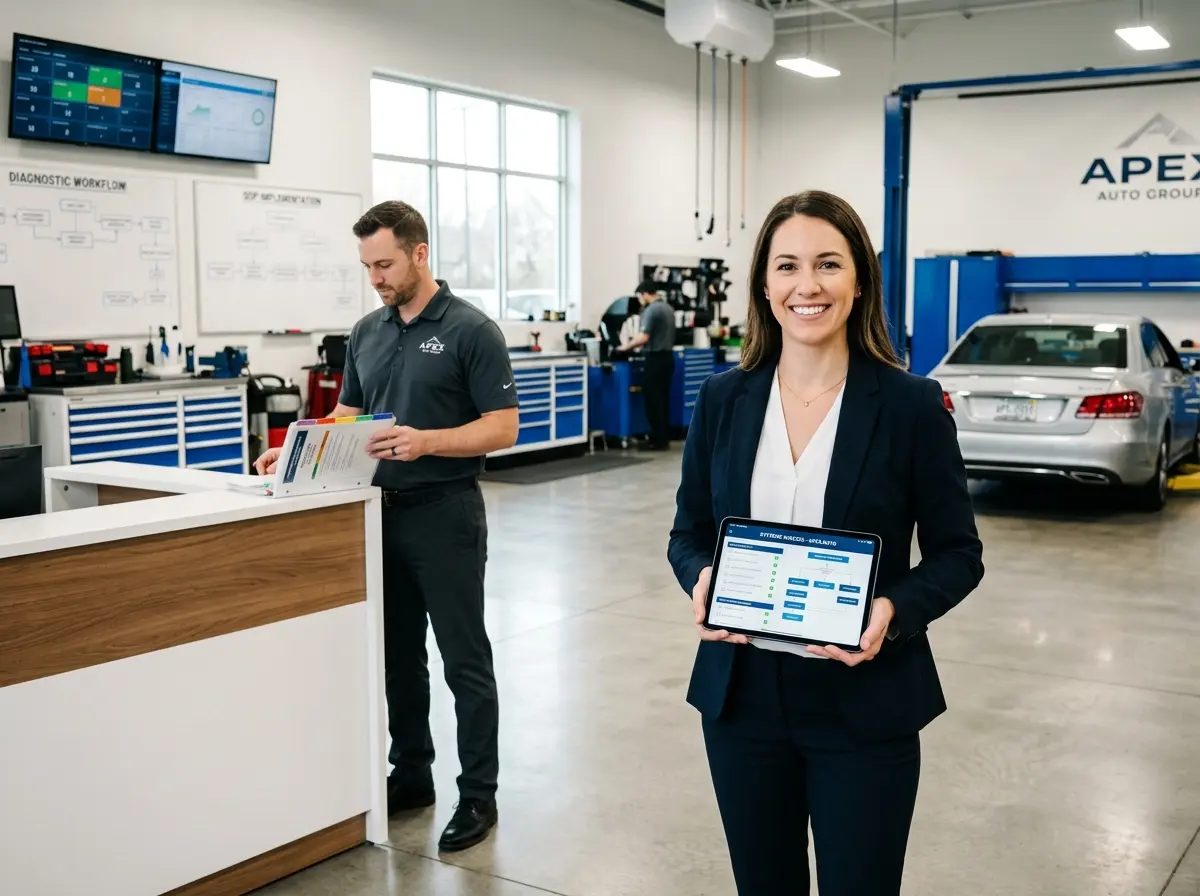
A strong SOP includes a clear title, a brief purpose statement, a list of required tools or resources, and a numbered step-by-step process. Use photos, screenshots, or short videos where possible. A photo of where the inspection forms are stored beats a paragraph describing it every single time. Keep each step short and action-oriented — "Open the repair order in the system and enter the customer's VIN" beats "Handle the repair order documentation."
According to a study by Trainual, businesses with documented processes onboard new employees 50% faster and see significantly fewer operational errors. That's not just good for efficiency — it's good for your sanity.
Store SOPs Where Your Team Will Actually Find Them
A binder in the break room is not a system. Your team needs SOPs accessible in the moment they're needed — not after a five-minute search. Consider using a simple cloud-based tool like Google Drive, Notion, or a dedicated platform like Trainual or Process Street. Organize documents by department or function, and make sure every employee knows exactly where to find them on day one.
Bonus points if you add QR codes at key stations around the shop linking directly to the relevant SOP. A QR code next to the alignment rack that opens the alignment checklist SOP? That's working smarter, not harder.
Let Technology Handle the Repetitive Stuff
Automate the Front-End So Your Team Can Focus on the Work
SOPs handle the human processes, but some tasks shouldn't require a human at all. Greeting every customer who walks in, answering the same ten phone questions you've heard a thousand times, explaining your oil change specials — these are time sinks that pull your service advisors away from billable work and meaningful customer interactions.
This is exactly where Stella earns her keep. She's an AI robot receptionist that stands inside your shop and greets every customer who walks in — proactively, professionally, and without ever being in a bad mood after a rough shift. She answers phone calls 24/7, explains your services, promotes your current deals, and collects customer information through conversational intake forms. She can forward calls to your staff when needed or handle everything herself. Your service advisors can stay focused on the customer in front of them instead of running back to grab a ringing phone. That's an SOP you don't have to write — it's already built in.
Training Your Team to Actually Use the SOPs
Make SOP Training Part of Onboarding — Not an Afterthought
Even the most beautifully written SOP is useless if your team never reads it. Training needs to be baked into your onboarding process from day one. New hires should spend dedicated time reviewing core SOPs before they ever touch a customer vehicle or answer a call. Shadow sessions, where a new employee watches an experienced one follow the SOP in real time, are particularly effective in auto shop environments where the work is hands-on.
Create a simple onboarding checklist that confirms each SOP has been reviewed and understood — and require a sign-off. This isn't about bureaucracy for its own sake; it's about accountability. When someone says "I didn't know we were supposed to do it that way," you want a paper trail that says otherwise.
Build a Culture of SOP Improvement, Not Just SOP Compliance
Your team members are on the floor every day. They see what works and what doesn't far better than you do from the owner's chair. Build a simple feedback loop — a monthly meeting, a shared document, a suggestion box — where staff can flag outdated steps or propose improvements to existing SOPs. When team members feel ownership over the processes, they're far more likely to follow them.
Set a calendar reminder to review and update your SOPs at least twice a year. Equipment changes, software updates, and new regulations all have a way of making last year's SOP quietly obsolete. Treat your SOP library like a living document, not a monument.
Measure Whether Your SOPs Are Actually Working
You wouldn't skip tracking your shop's revenue or car count, so don't skip tracking whether your SOPs are producing results. Identify a few simple metrics tied to your most important procedures — average check-in time, customer comeback rate, parts ordering errors, or phone-call response time. If the numbers improve after implementing an SOP, you know it's working. If they don't, you know where to dig.
Operational consistency is what allows you to confidently step back from daily management. And you can't confirm consistency without measuring it.
Quick Reminder About Stella
Stella is an AI robot employee and phone receptionist built for businesses like yours. She greets customers in person at her kiosk inside your shop, answers phone calls around the clock, promotes your services and specials, and collects customer information — all for just $99/month with no upfront hardware costs. Think of her as the one front-desk employee who never calls in sick, never forgets the script, and never has a bad day.
Conclusion: The Shop That Doesn't Need You to Survive
Building SOPs isn't glamorous work. It requires sitting down, thinking through every step of your operations, and writing it all out clearly enough that someone else can execute it without you. But the payoff — a shop that runs consistently, a team that operates confidently, and an owner who can finally take that fishing trip — is absolutely worth the upfront investment of time.
Here's your actionable game plan to get started:
- Identify your top five high-impact processes — the ones that go sideways most often when you're not watching.
- Draft your first SOP this week — pick the most painful process and document it step by step with photos or video where possible.
- Choose a central, accessible storage system — get your SOPs out of the binder and into the cloud.
- Build SOP review into your onboarding — make it official, make it documented, make it expected.
- Schedule a quarterly SOP review — set the calendar reminder now, before you forget.
- Let technology handle the repetitive front-end tasks — your service advisors' time is worth more than answering phone questions about your hours.
The goal isn't to remove yourself from your business entirely — it's to make your presence a choice rather than a necessity. Well-built SOPs make that possible. Start with one process, build the habit, and before long you'll have a shop that runs like the well-oiled machine your customers trust you to deliver.