When Your Waiting Room Is Full But Your Schedule Is a Mess
Picture this: your dermatology practice is technically booked solid for the next three weeks, but your front desk staff spend half their day on hold, playing phone tag, and manually entering appointment requests into a system that still somehow manages to double-book Dr. Martinez on Tuesdays. Patients are frustrated. Staff are exhausted. And somewhere in the chaos, a handful of appointment requests slipped through the cracks entirely — those patients have since moved on to a competitor who apparently figured out how to answer a phone in 2024.
This was the exact reality for a mid-sized dermatology practice we'll call Clearview Dermatology. They had strong demand, a competent team, and a scheduling backlog so thick you could use it as a doorstop. The problem wasn't a lack of patients — it was a deeply inefficient system for managing them. Within 90 days of implementing automated scheduling tools, they eliminated their three-week backlog, reduced no-show rates by 34%, and gave their front desk staff back roughly 15 hours per week. Not bad for a practice that previously considered "leaving a voicemail" a perfectly acceptable form of appointment confirmation.
If your practice is nodding along to any of this, keep reading. We're going to break down exactly how they did it — and how you can too.
The Real Cost of Scheduling Chaos
It's Not Just Annoying — It's Expensive
Scheduling inefficiency in medical practices is one of those problems that feels like a minor inconvenience right up until you actually run the numbers. According to the Medical Group Management Association (MGMA), the average no-show rate in dermatology practices hovers between 5% and 8%, and in some practices climbs well above 10%. At an average appointment value of $200–$350, even a conservative 6% no-show rate across 400 monthly appointments represents thousands of dollars in lost revenue every single month — revenue that simply evaporated because someone forgot, wasn't reminded, or never got a proper confirmation in the first place.
Then there's the staff time. When a front desk coordinator spends 20 minutes playing phone tag to confirm a single appointment, multiplied across dozens of bookings per day, you're essentially paying a skilled human being to perform a task that a well-configured automated system could handle in seconds. That's not a knock on your staff — it's a knock on the process that's forcing them to operate that way.
What Clearview's Backlog Was Actually Costing Them
Clearview's three-week backlog looked like a demand problem on the surface — hey, we're busy! — but it was masking a deeper inefficiency. New patients calling in were being quoted wait times that sent them straight to Google to find a competing practice. Existing patients needing follow-ups were slipping through without proper scheduling. And the staff were so consumed with managing the existing chaos that proactive outreach to lapsed patients wasn't even on the table.
When Clearview finally mapped out where their front desk time was actually going, the results were humbling: nearly 40% of staff hours were spent on scheduling-related tasks — confirmations, cancellations, rescheduling, and answering basic questions like "what do I need to bring?" and "where do you park?" These are important questions, but they are not exactly questions that require a trained medical receptionist to answer manually, 27 times per day.
The Backlog Wasn't a Capacity Problem — It Was a System Problem
This is the critical insight that changed everything for Clearview. They initially assumed they needed to hire more staff or expand their hours to address the backlog. What they actually needed was to stop manually processing every single patient interaction from scratch. Once they separated the high-touch interactions (clinical concerns, complex scheduling needs, insurance disputes) from the routine ones (initial booking, appointment reminders, intake forms, FAQs), a clear path forward emerged: automate the routine, elevate the complex.
How Automated Scheduling Actually Works in Practice
Letting Technology Handle the Repetitive Stuff
Clearview's transformation started with three core automations: online self-scheduling, automated appointment reminders, and digital intake forms. Patients could now book directly through the practice website at 11 PM on a Sunday without waiting to call during business hours — a capability that sounds obvious in 2024 but was genuinely revelatory for patients who'd previously been forced to call during a narrow window and hope someone picked up.
Automated reminder sequences — an email at 72 hours, a text at 24 hours, and a confirmation prompt that let patients cancel or reschedule with a single tap — brought their no-show rate from 9% down to just under 6% in the first month alone. That's a real, measurable revenue recovery with essentially zero ongoing staff effort.
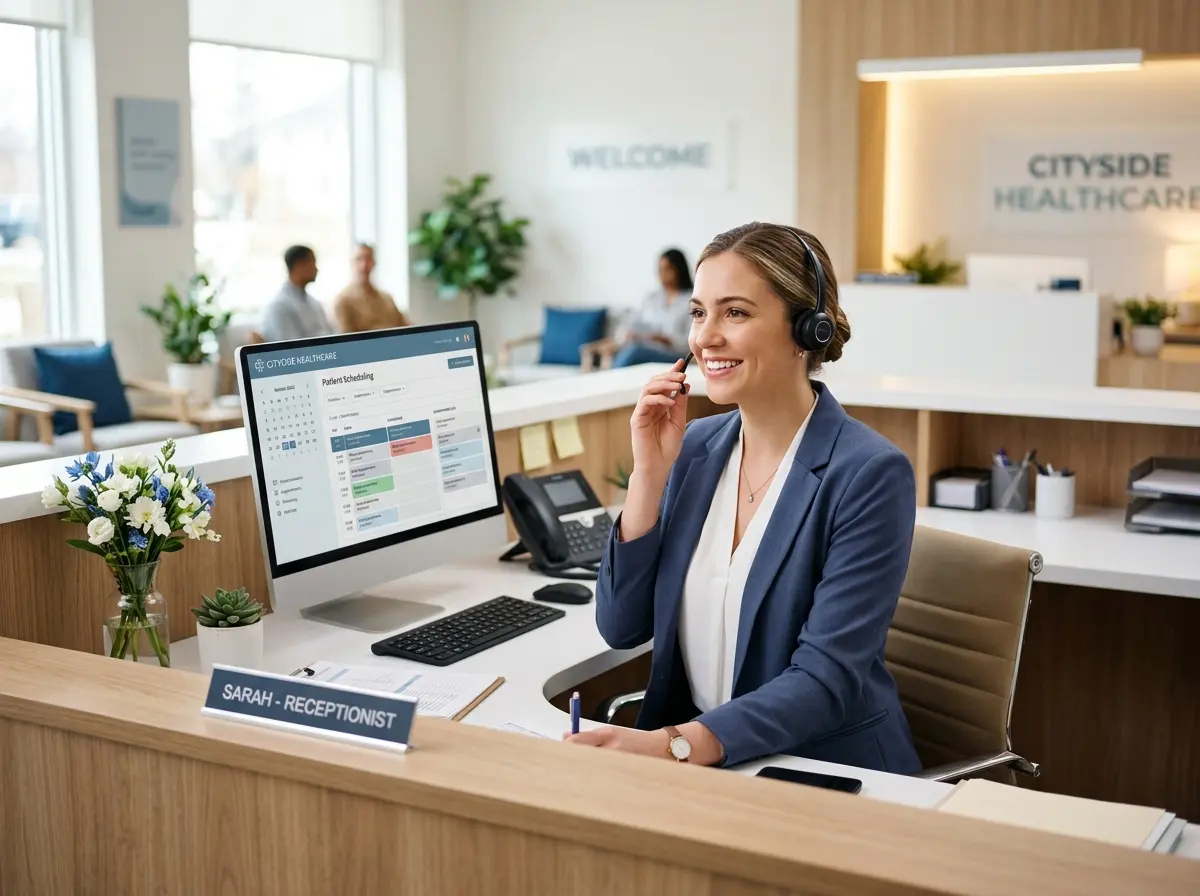
For tools like Stella, the AI robot employee and phone receptionist, this kind of patient-facing automation extends naturally to the phone channel — one of the most underestimated sources of scheduling inefficiency in any medical office. Stella answers incoming calls 24/7, collects patient information through conversational intake forms, and can handle the routine questions that eat up staff time, all while maintaining the same professional, knowledgeable presence your practice projects in person. Her built-in CRM also means that patient information gathered during a call doesn't vanish into a sticky note — it gets logged, tagged, and made available to your team with AI-generated summaries.
Quick Reminder About Stella
Stella is an AI robot employee and phone receptionist designed for businesses of all types — including medical practices, spas, law firms, and more. She greets patients at your front desk as a physical kiosk, answers phone calls around the clock, collects intake information, manages contacts through a built-in CRM, and keeps your team informed without burying them in busywork. All of this starts at just $99/month with no upfront hardware costs.
Rebuilding the Patient Experience From the Ground Up
Reducing Friction at Every Touchpoint
One of the most underappreciated dimensions of Clearview's turnaround was how dramatically the patient experience improved once the scheduling process stopped being a gauntlet. When patients can book online, receive clear confirmation, complete intake paperwork before they arrive, and get a reminder that actually tells them where to park and what to bring — they show up on time, prepared, and in a significantly better mood than patients who had to leave three voicemails and received zero communication until they were already sitting in the waiting room.
Patient satisfaction scores at Clearview increased meaningfully in the quarter following implementation, driven almost entirely by improvements in the pre-visit experience. The clinical care hadn't changed. The facility hadn't changed. The staff hadn't changed. The difference was that patients no longer felt like they were fighting the practice just to get an appointment.
Freeing Your Staff to Do Their Actual Jobs
Here's the part nobody talks about enough: when you automate the routine work, your human staff don't just get time back — they get energy back. Clearview's front desk team went from reactive and overwhelmed to proactive and engaged. They started making outreach calls to lapsed patients for annual skin checks. They had bandwidth to handle complex insurance questions properly instead of rushing through them. Staff turnover, which had been a persistent problem, stabilized noticeably in the months following implementation. Turns out people don't love spending their workday doing tasks that a well-configured piece of software could handle automatically. Who knew.
Measuring What Actually Matters
Clearview implemented a simple but effective dashboard tracking four metrics: no-show rate, average days to next available appointment, front desk call volume, and patient satisfaction scores. Within 90 days, the results were unambiguous. No-shows dropped by 34%. Average wait time fell from 21 days to 8 days — not because they added providers, but because fewer slots were being wasted on no-shows and scheduling errors. Inbound call volume dropped by nearly 30% as patients migrated to self-service booking. And satisfaction scores climbed to their highest point in three years.
The lesson here isn't that technology is magic. It's that measuring the right things forces you to confront the right problems — and then fix them systematically rather than heroically.
Time to Stop Scheduling Your Way Into Inefficiency
If Clearview's story sounds frustratingly familiar, the good news is that none of what they did required a massive overhaul, a large budget, or months of implementation pain. The tools exist, they're accessible, and the ROI in a medical practice context is genuinely fast to realize.
Here's where to start:
- Audit your front desk time. Track where staff hours actually go for one week. You may be surprised — and disturbed — by what you find.
- Enable online self-scheduling. If patients can't book without calling during business hours, you're turning away the growing segment of patients who simply won't make that call.
- Implement automated reminders. A three-message sequence (72 hours, 24 hours, day-of) with a simple confirm/reschedule option will meaningfully reduce no-shows within the first month.
- Digitize your intake process. Pre-visit forms collected online or via phone reduce check-in time and give your clinical staff better preparation before the patient walks in the door.
- Plug the after-hours gap. If your practice goes dark at 5 PM, you're missing booking requests, confirmation questions, and patient inquiries every single evening and weekend. An AI phone receptionist solves this without adding headcount.
A three-week booking backlog feels like a problem of abundance — too many patients, not enough time. But in most cases, it's a problem of process. Fix the process, and the backlog clears itself. Your patients will thank you. Your staff will thank you. And you'll finally be able to stop starting every Monday by triaging the voicemail inbox like it's an emergency room.