So You're Still Pricing Your Rooms Like It's 2005
Let's be honest. If you're running an independent hotel and you've been using the same flat rate structure since your last renovation, you're essentially leaving money on the table — sometimes a lot of it — while the big chain down the street algorithmically adjusts their prices every few hours like a caffeine-fueled stock trader. The good news is that revenue management and dynamic pricing aren't just for the Marriotts and Hiltons of the world anymore. With the right strategy, independent properties can compete smartly, price confidently, and actually capture the revenue their rooms deserve.
This guide is for the independent hotel owner or manager who knows their property inside and out but might need a little help translating that intuition into a systematic, data-driven pricing approach. No MBA required. Just a willingness to stop guessing and start managing.
Understanding Revenue Management: The Basics You Actually Need
Revenue management sounds intimidating, but at its core, it's about selling the right room to the right guest at the right price at the right time. That's it. The complexity comes in figuring out what "right" actually means in each situation — and that's where most independents stumble.
The Key Metrics That Actually Matter
Before you can manage revenue intelligently, you need to speak the language. Three metrics will form the backbone of your strategy:
- Occupancy Rate: The percentage of available rooms filled on a given night. High occupancy feels great but doesn't tell the whole story.
- ADR (Average Daily Rate): The average price paid per occupied room. This tells you how well you're pricing.
- RevPAR (Revenue Per Available Room): Occupancy multiplied by ADR. This is the number that actually matters, because a hotel at 100% occupancy with terrible rates is still underperforming.
Many independent operators obsess over occupancy while neglecting ADR — which is a trap. A 90% occupancy rate at $80/night is considerably less impressive than 75% occupancy at $130/night. Run the math for your property and let it inform how you think about success.
Segmentation: Know Who's Actually Booking
Not all guests are created equal, and a smart revenue strategy treats them accordingly. Business travelers typically book closer to the stay date and are less price-sensitive. Leisure travelers book further out and hunt for deals. Groups need volume discounts but guarantee block occupancy. Understanding your guest mix — and what motivates each segment — allows you to craft pricing and packages that appeal to the right people at the right moments. Pull your booking data and look for patterns. You might be surprised by what you find.
Dynamic Pricing: Stop Setting It and Forgetting It
Dynamic pricing means your room rates fluctuate based on real-time demand, competitive positioning, and market conditions — rather than sitting at a fixed number until someone remembers to change them. Hotels that adopt even basic dynamic pricing strategies typically see RevPAR improvements of 10–25%, according to industry research. That's not a rounding error. That's a real impact on your bottom line.
Building Your Pricing Triggers
You don't need a sophisticated revenue management system (RMS) on day one. Start by identifying the conditions that should prompt a rate adjustment. These typically include local events and festivals, competitor rate changes, your own occupancy thresholds (e.g., raise rates when you hit 70% booked), seasonality patterns, and day-of-week demand curves. Even a simple spreadsheet that tracks these signals and prompts weekly rate reviews is a massive improvement over a static pricing sheet. As your confidence grows, you can invest in dedicated RMS tools like Cloudbeds, Little Hotelier, or RoomPriceGenie, which automate much of this process.
Rate Fences: Protecting Your Pricing Strategy
Dynamic pricing only works if you protect your rate integrity with thoughtful restrictions — what the industry calls "rate fences." Non-refundable advance purchase rates incentivize early bookings at a slight discount, while flexible rates command a premium for guests who need the option to cancel. Minimum length-of-stay restrictions during peak periods prevent you from filling up with one-night bookings that block more valuable multi-night guests. These aren't arbitrary rules; they're strategic tools that shape the mix of business coming through your door.
A Smarter Front Desk Experience Can Support Your Revenue Goals
Revenue management doesn't stop at pricing — it extends to every guest touchpoint, including how inquiries are handled, how promotions are communicated, and whether potential guests get answers fast enough to actually book. This is where operational efficiency and guest experience intersect with your revenue strategy in very practical ways.
Where Stella Comes In
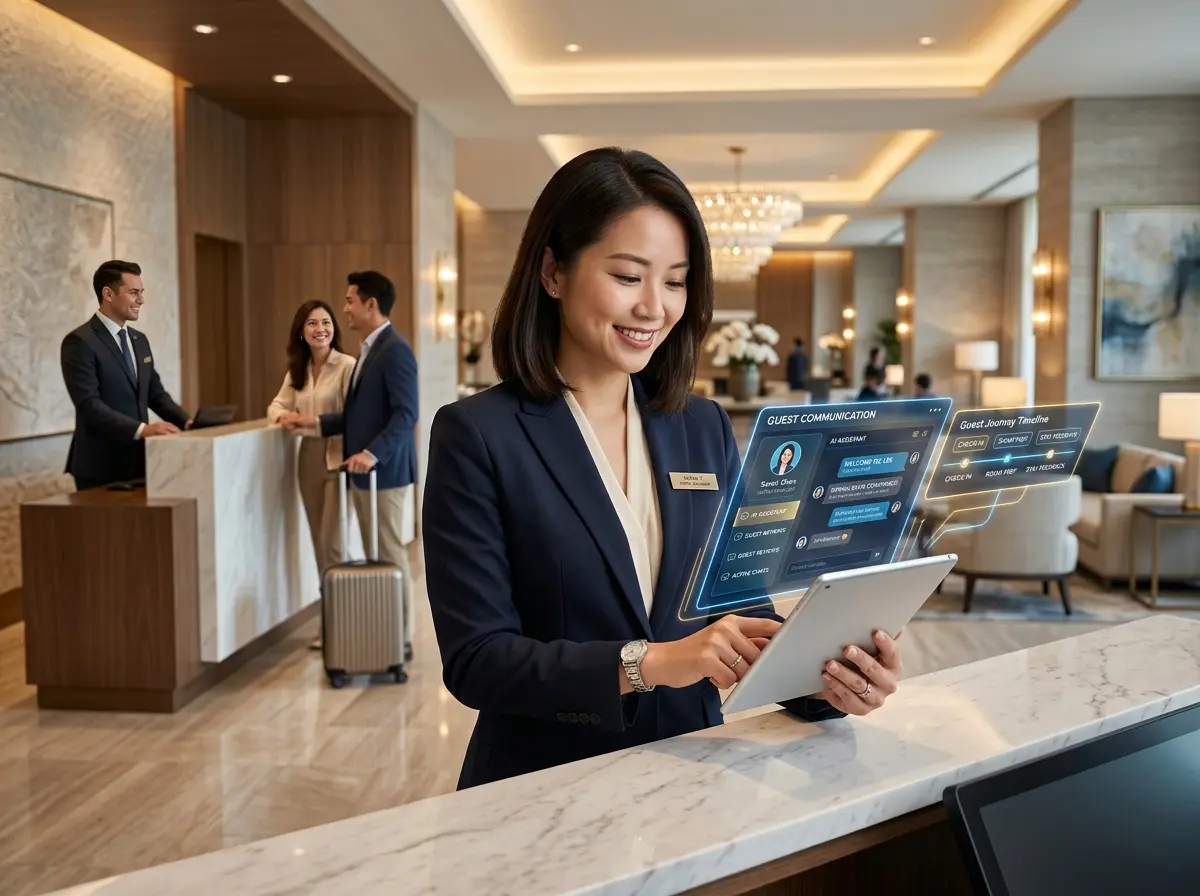
Independent hotels often run lean on staff, which means phone calls go unanswered after hours, promotional offers aren't consistently communicated, and the front desk team is too busy managing check-ins to upsell a room upgrade or a spa package. Stella, the AI robot employee and phone receptionist, can help close some of those gaps. She answers calls 24/7, communicates current promotions and package deals to callers, and handles routine inquiries — freeing up your human staff for the high-touch moments that actually require a human. For properties with a lobby kiosk, Stella can proactively engage guests and visitors, answer questions about amenities, and even collect guest information through conversational intake forms that feed directly into her built-in CRM. That means fewer missed calls, more consistent messaging, and a guest experience that doesn't fall apart the moment your best front desk employee takes a day off.
Putting It All Together: A Practical Revenue Management Routine
Strategy without execution is just daydreaming. Here's how to build a realistic revenue management rhythm that won't require you to hire a full-time analyst.
The Weekly Rate Review
Set aside 30–45 minutes every week — Monday mornings work well — to review your pickup pace (how many new bookings came in for each future date), compare your rates against two or three key competitors, check for any upcoming local events you may have missed, and adjust rates accordingly. This simple habit, done consistently, will outperform a "set it and forget it" pricing approach by a significant margin. Over time, you'll develop an intuitive feel for your market that no algorithm can fully replicate.
Leverage Your Direct Channel
Every booking that comes through an OTA (Online Travel Agency) like Booking.com or Expedia costs you a commission — typically 15–25%. Your direct booking channel (your own website and phone) is where your margins live. Invest in a clean, mobile-friendly booking engine, offer a "best rate guarantee" for direct bookings, and train your team to consistently mention the benefits of booking direct when speaking with guests. Even a modest shift in your OTA-to-direct booking ratio can meaningfully improve net revenue without changing a single room rate.
Packages and Ancillary Revenue
Room revenue is just the beginning. Romance packages, early check-in and late check-out fees, local experience bundles, and F&B add-ons can all increase the total revenue per guest without requiring additional occupancy. Consider what your guests actually want — and what your property or local area can uniquely offer — and build packages around those value drivers. A $199 "Romantic Getaway" package that bundles a $150 room with $30 in amenity costs and $20 in perceived-value extras is a much easier sell than a $150 room rate, and it generates more revenue per booking.
Quick Reminder About Stella
Stella is an AI robot employee and phone receptionist designed for businesses of all sizes — including independent hotels that need reliable, professional coverage without the overhead of additional staff. She greets guests in your lobby, answers calls around the clock, promotes your current packages, and collects guest information — all for just $99/month with no upfront hardware costs. If your front desk has ever missed a call during a busy check-in rush, Stella is worth a look.
Your Next Steps Toward Smarter Revenue Management
Revenue management isn't something you implement once and declare victory. It's a discipline — a set of habits, tools, and decisions that compound over time into meaningfully better financial performance. But you don't have to overhaul everything at once. Start small and build momentum.
This week, pull your RevPAR for the last 12 months and compare it against the same period from two years prior. Benchmark yourself against local competitors using a tool like OTA Insight or simply by checking their public rates regularly. Then set up your first weekly rate review — even if it's informal — and commit to it for 90 days.
From there, audit your direct booking experience. Is your website easy to book on? Do you have a compelling reason for guests to book direct? Are your packages and promotions clearly communicated across every channel — including by whoever answers your phone?
Independent hotels succeed not by out-spending the chains, but by out-thinking them. You know your guests, your market, and your property in ways no algorithm ever will. The goal of revenue management isn't to replace that instinct — it's to give it a framework that turns local expertise into measurable, sustainable revenue growth. And that's a competitive advantage worth investing in.