When Every Second Counts (And Your Inbox Doesn't Care)
Here's a fun little scenario: A homeowner finishes scrubbing their own floors at 11:47 PM, gives up forever, and submits an online quote request to three different cleaning companies. By morning, the first company to respond gets the job. The other two? They get to feel great about their "we'll get back to you within 24–48 hours" auto-reply.
Speed-to-lead is one of those concepts that sounds obvious until you realize how few businesses actually act on it. Studies have shown that responding to a lead within the first minute can increase conversion rates by up to 391% — and yet most small service businesses are still relying on someone to check the email between jobs, during lunch, or honestly, whenever they remember. That's not a workflow. That's a prayer.
This is the story of how one growing cleaning company stopped praying and started responding to every single online quote request within 60 seconds — automatically, professionally, and without hiring a single extra person.
The Speed-to-Lead Problem in Service Businesses
Why Fast Follow-Up Feels Impossible When You're Busy Doing the Actual Work
Cleaning companies — like most service businesses — live and die by their schedule. The owner is often in the field. The team is elbow-deep in someone's bathroom. Nobody is sitting at a desk refreshing a quote inbox. This is completely understandable and also, from a sales perspective, a bit of a catastrophe.
The brutal truth is that your prospects are not loyal. They're filling out forms on Google, Yelp, your website, and your competitors' websites — sometimes all in the same evening. The first business that responds with something helpful, specific, and professional immediately earns a massive psychological advantage. You seem organized. You seem like you actually want the business. You seem like the kind of company that shows up on time. First impressions are doing a lot of heavy lifting here.
The Real Cost of Slow Responses
Let's do a little math. If your average cleaning contract is worth $2,400 per year, and you're losing just five leads per month to faster competitors, that's $144,000 in annual revenue quietly walking out the door because nobody responded in time. And the maddening part? Those leads came to you. They already wanted to hire you. You just weren't there.
Hiring someone to monitor incoming leads around the clock isn't realistic for most small and mid-sized cleaning companies. A part-time admin might help during business hours, but quote requests don't arrive on a schedule. They come in at 6 AM, during dinner, and on Sunday afternoons. The problem isn't effort — it's availability.
How AI-Powered Tools Are Closing the Gap
Automation That Actually Sounds Human
The old approach to "automating" lead responses was the generic auto-reply: "Thanks for reaching out! Someone will contact you soon." Nobody was impressed. Nobody felt taken care of. It just confirmed that a human hadn't actually read anything yet.
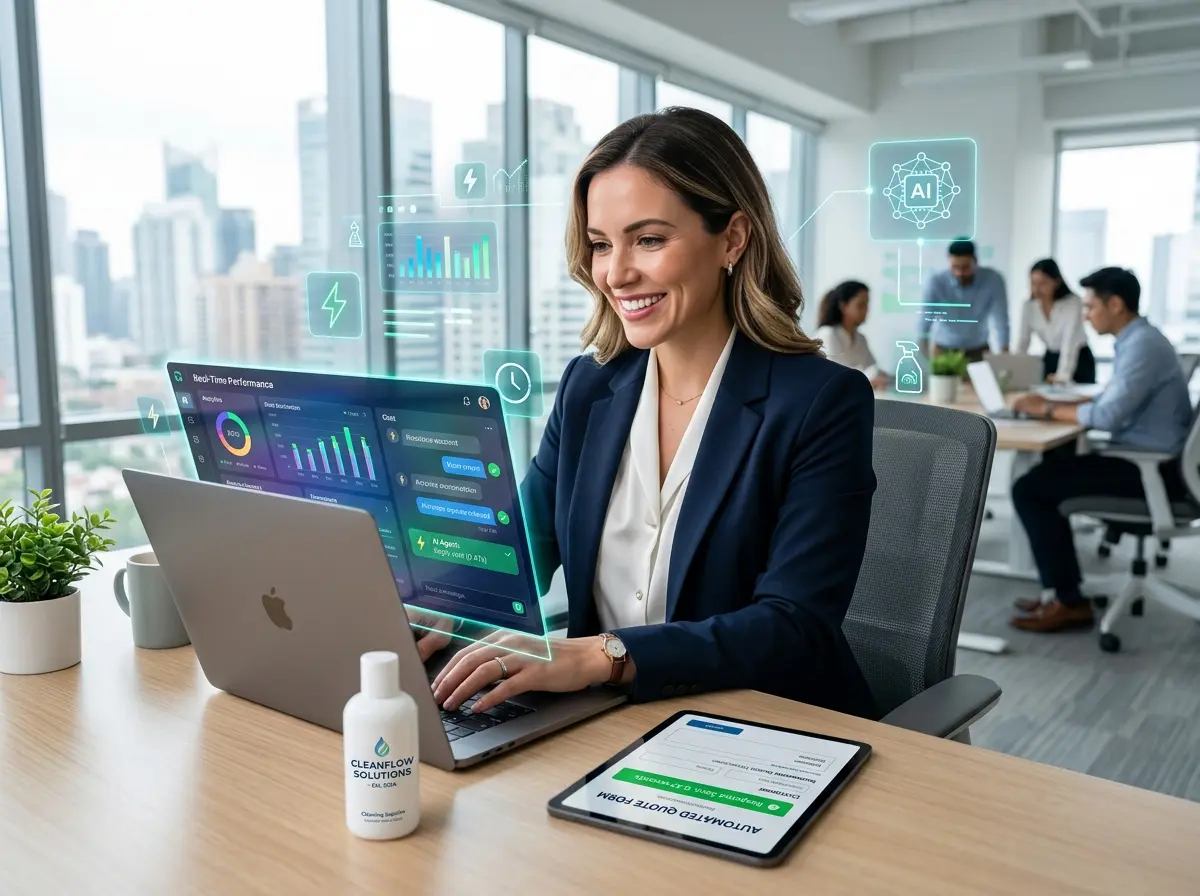
Modern AI tools can do something dramatically better. When a quote request comes in through a website form, AI can immediately parse the details — service type, home size, preferred dates, location — and craft a personalized response that acknowledges the specifics of what was submitted. It doesn't feel like a form letter because it isn't one. It feels like someone actually read the request and cared enough to respond thoughtfully. In under 60 seconds.
For the cleaning company in this story, implementing an AI-driven response workflow meant that every lead received a warm, detailed reply almost instantly — outlining next steps, asking any necessary follow-up questions, and setting the tone for a professional relationship. Booking rates climbed. Customer complaints about "never hearing back" disappeared entirely.
Intake Forms and CRM: Capturing the Right Information From the Start
Speed alone isn't enough if you're collecting bad data. A fast response that says "tell us more about your needs" is only marginally better than a slow one. What actually moves the needle is capturing structured, useful information upfront — and storing it somewhere it won't be forgotten.
Stella, the AI robot employee and phone receptionist, handles exactly this. Through conversational intake forms — available on the web, over the phone, or at an in-store kiosk — Stella collects customer information naturally, the way a real receptionist would during a conversation. That information flows directly into Stella's built-in CRM, where it's organized with custom fields, tags, AI-generated contact profiles, and notes. For a cleaning company, this means a new lead instantly becomes a structured contact with their address, service preferences, and scheduling needs already logged — before a human employee ever gets involved. Her phone answering capabilities also ensure that anyone who calls instead of submitting a form online gets the same thorough, consistent intake experience.
Building a 60-Second Response System That Scales
Step 1 — Design Your Quote Request Form With the End in Mind
The form someone fills out to request a quote is actually the beginning of your sales process, not just a data collection exercise. Design it to gather everything you need to send a meaningful, personalized first response. For a cleaning company, this typically means: type of service (residential, commercial, move-in/out), square footage or number of rooms, frequency preference, desired start date, and contact information.
The more specific the form, the more specific — and impressive — your automated response can be. An AI that references "your 3-bedroom home in the Riverside area" in its opening line is infinitely more compelling than one that says "your recent inquiry."
Step 2 — Connect Your Form to an AI Response Workflow
Once your form is capturing the right data, the next step is connecting it to an AI engine that can generate and send a personalized response within seconds. Tools like Zapier, Make, or native integrations within your CRM can trigger an AI-composed message the moment a form submission lands. The response should acknowledge the specifics of the request, provide a rough pricing range or next steps, and invite the prospect to schedule a call or confirm a booking.
The goal is to make the lead feel like a human picked up their request immediately — even if it's 2 AM on a Tuesday and your team is nowhere near a phone.
Step 3 — Follow Up Intelligently, Not Just Frequently
The 60-second response is your opening move, not your entire strategy. After the initial reply, build a short follow-up sequence that checks in if the prospect hasn't booked within 24 hours, then again at 72 hours. Keep the tone helpful and low-pressure. Something like, "Just wanted to make sure your questions got answered — we'd love to get you on the schedule!" goes a long way.
The key is making sure these follow-ups are triggered automatically and logged in your CRM so nothing falls through the cracks. When your AI handles intake and your CRM tracks the conversation history, your human team can step in at exactly the right moment — informed, prepared, and not starting from scratch.
Quick Reminder About Stella
Stella is an AI robot employee and phone receptionist built for businesses of all sizes — including cleaning companies that are tired of losing leads to faster competitors. She answers phones 24/7, handles conversational intake forms, manages a built-in CRM, and for businesses with a physical location, she even greets customers in person as a human-sized kiosk. All of this runs on a straightforward $99/month subscription with no upfront hardware costs and no complicated setup.
Your Next Steps Toward Never Missing a Lead Again
The cleaning company at the center of this story didn't have a bigger team, a bigger budget, or some secret advantage. They just stopped accepting "we'll get back to you soon" as a viable business strategy. They set up a system that responded instantly, collected the right information, and handed off warm leads to their human team at exactly the right moment.
Here's what you can do starting this week:
- Audit your current quote request process. Time how long it actually takes for a lead to receive a meaningful response. Be honest. It might be uncomfortable.
- Rebuild your intake form to collect the specific information needed to personalize your first response.
- Connect your form to an AI workflow that generates and sends a customized reply within 60 seconds of submission.
- Set up a CRM that automatically logs every new lead with their intake details, so your team always has context before they make contact.
- Build a short follow-up sequence for leads who don't book immediately — and let automation handle the timing.
The leads are out there. They're actively looking for someone to clean their homes, their offices, and their lives. The question is whether you're going to be the company that responds before they've even had a chance to reconsider — or the one sending a "Sorry for the delay!" email two days later.
Speed is a competitive advantage hiding in plain sight. Time to use it.