Are You Leaving Money on the Table — One Lens at a Time?
Let's be honest: most optical patients walk in thinking they just need a new prescription and walk out spending exactly what they planned. Meanwhile, you know — you know — that the patient squinting at their phone under fluorescent lighting could absolutely benefit from blue light filtering. The person who mentioned they spend every weekend on the golf course? Progressive lenses with an anti-reflective coating would change their life. But somehow, between checking insurance, verifying prescriptions, and managing a full waiting room, the upsell conversation gets lost in the shuffle.
The good news is that upselling lens upgrades isn't about being pushy — it's about being helpful. Patients trust their optometrists and opticians implicitly. When you confidently recommend the right lens upgrade for their lifestyle, you're not selling; you're practicing good patient care. And as a bonus, your revenue goes up. Win-win.
This guide breaks down exactly how to build a consistent, comfortable upselling culture in your optical practice — from the moment a patient books to the moment they walk out the door with their new frames.
Building the Foundation: Creating a Culture of Proactive Recommendations
Know Your Upgrades Cold — So Your Team Does Too
Before you can upsell anything, your entire team needs to understand what they're selling and why it matters. This sounds obvious, but you'd be surprised how many optical staff members can recite a lens upgrade's name without being able to explain what it actually does for the patient's daily life. Anti-reflective coatings, photochromic lenses, high-index materials, blue light filters, polarized options — each one solves a real problem for a specific type of patient.
Invest in regular product training. Hold short monthly team huddles where you role-play patient conversations. Create simple reference cards for staff that map patient lifestyle cues to specific upgrade recommendations. For example: patient mentions night driving difficulty → AR coating conversation. Patient describes outdoor lifestyle → photochromic or polarized lenses. Once your team internalizes these connections, recommendations become natural rather than scripted.
Start the Conversation Before the Appointment Even Happens
The upsell journey doesn't begin in the exam chair — it begins at booking. When patients call to schedule or fill out intake forms, that's your first opportunity to plant seeds. A simple question like "Do you spend a lot of time on screens or outdoors?" during intake primes patients to think about their vision in lifestyle terms, not just prescription terms. By the time they sit down with your optician, they've already been thinking about it.
Consider adding lifestyle questions to your new patient forms. Time spent on digital devices, occupational demands, hobbies, and driving habits can all inform upgrade recommendations — and when your staff already has that information, the conversation flows naturally rather than feeling like an interrogation mid-appointment.
Set Team Incentives That Align With Patient Outcomes
People do what they're rewarded for — that's not cynicism, that's just management reality. If your team has no incentive to recommend lens upgrades, many of them won't push past patient hesitation. Consider introducing a modest performance bonus tied to lens upgrade attachment rates, or recognize top performers in team meetings. Keep it balanced: the goal is genuinely improved patient experience, not pressure tactics that send patients running to Costco's optical department.
Streamlining the Upsell: Let Technology Do Some of the Heavy Lifting
How Stella Can Support Your Optical Practice
Running an optical shop means your staff is almost constantly pulled in multiple directions — managing walk-ins, handling the phone, dealing with insurance verifications, and actually helping patients pick frames they won't regret in six months. That's a lot of ground to cover, and upselling is often the first casualty of a busy afternoon.
This is where Stella, the AI robot employee and phone receptionist, can genuinely lighten the load. In-store, Stella functions as a friendly, human-sized kiosk presence that proactively greets patients, answers questions about your current lens promotions, and keeps people engaged while they wait — which, in an optical setting, is almost always. She can promote seasonal deals on lens upgrades, highlight package options, and answer common questions about the difference between lens types, all without pulling your licensed staff away from patients who need them most.
On the phone side, Stella answers calls 24/7 with the same knowledge she uses in the store — so a patient calling after hours to ask whether blue light lenses are worth it gets a helpful, informed answer rather than a voicemail. Her built-in CRM and conversational intake forms also allow you to capture patient lifestyle information before appointments, giving your team a head start on personalized upgrade recommendations. At just $99/month, she's considerably cheaper than the cost of a missed upsell on a pair of premium progressive lenses.
The Appointment Itself: Making Upgrade Conversations Feel Natural
Frame the Conversation Around Lifestyle, Not Features
Nobody wakes up excited to buy an anti-reflective coating. But plenty of people are frustrated by glare on their evening commute, or annoyed by the digital eye strain that hits them at 3pm every day. The key to a successful lens upgrade conversation is leading with the patient's problem, not the product's specification.
Train your opticians to listen actively during the exam and frame summary portion of the visit. When a patient mentions headaches after long computer sessions, that's an opening — not an interruption. A simple transition like "Based on what you've told me about your workday, I'd actually recommend we look at a blue light filtering lens — here's why that might make a real difference for you" is informative, helpful, and positions the upgrade as a natural extension of their care rather than a sales pitch.
Avoid feature-dumping. Patients don't need a technical lecture on refractive index — they need to understand that thinner, lighter lenses mean their new frames won't slide down their nose every ten minutes. Translate features into tangible, personal benefits every time.
Use Visual Aids and Demos Strategically
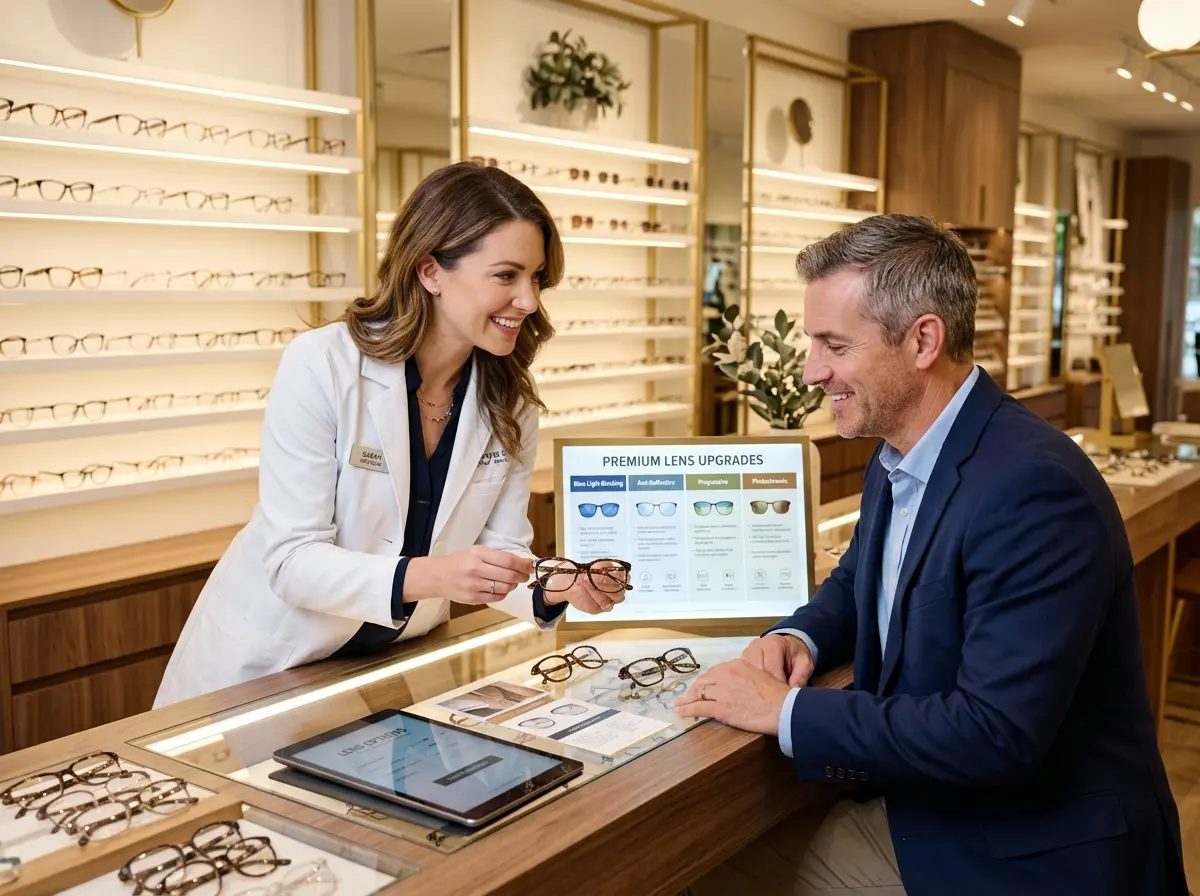
Seeing is believing — which is convenient, given your industry. If you have demo lenses, AR coating comparisons, or scratch-resistance demonstrations available, use them. Patients who can see the difference between a standard lens and a premium coating are far more likely to invest in the upgrade than patients who are simply told about it.
Consider setting up a small display area in your optical dispensary that lets patients interact with lens upgrade samples on their own while they wait. Pair it with clear, simple signage that explains the benefits in plain language, and you've got a passive upselling tool working for you around the clock — no staff required.
Overcome Price Objections With Value Framing
Price objections are inevitable, and they're not automatically a "no" — they're often a request for more justification. When a patient balks at the cost of a premium lens package, resist the urge to immediately discount. Instead, reframe the investment: "These lenses are designed to last two or more years. When you break it down, you're looking at pennies a day for significantly better vision comfort."
It also helps to offer tiered options rather than a binary choice between the base lens and the top-tier package. Give patients a "good, better, best" framework with clear explanations of what each tier adds to their experience. Most patients will land somewhere in the middle — which is still a meaningful upgrade from where you started.
Quick Reminder About Stella
Stella is an AI robot employee and phone receptionist designed to help businesses like yours run more smoothly — greeting patients in-store, answering calls 24/7, promoting specials, managing intake, and supporting your team without adding to your payroll headaches. She's ready to work from day one, never calls in sick, and costs $99/month with no upfront hardware investment.
Turning Upgrades Into a Consistent Revenue Stream
Upselling lens upgrades isn't a one-time initiative — it's a system. The practices that consistently outperform on optical revenue aren't doing anything magical; they've simply built repeatable processes that make upgrade conversations happen at every single appointment, not just when a staff member happens to remember.
Start by auditing your current attachment rate for the top three lens upgrades you offer. If you don't know that number, find it — because you can't improve what you're not measuring. Set a realistic target for improvement over the next 90 days and implement the strategies in this guide one at a time. Don't try to overhaul everything at once, or you'll overwhelm your team and nothing will stick.
Then, revisit and refine. What upgrade conversations are landing? Which ones are falling flat? Where in the appointment is the momentum being lost? Use that data to coach your team, adjust your approach, and keep improving. The optical practices doing this well aren't doing it perfectly — they're just doing it consistently, and consistency compounds over time.
Your patients trust you with their vision. Recommending the right lens upgrades isn't a sales tactic — it's part of that trust. Start treating it that way, and both your patients and your revenue will thank you for it.