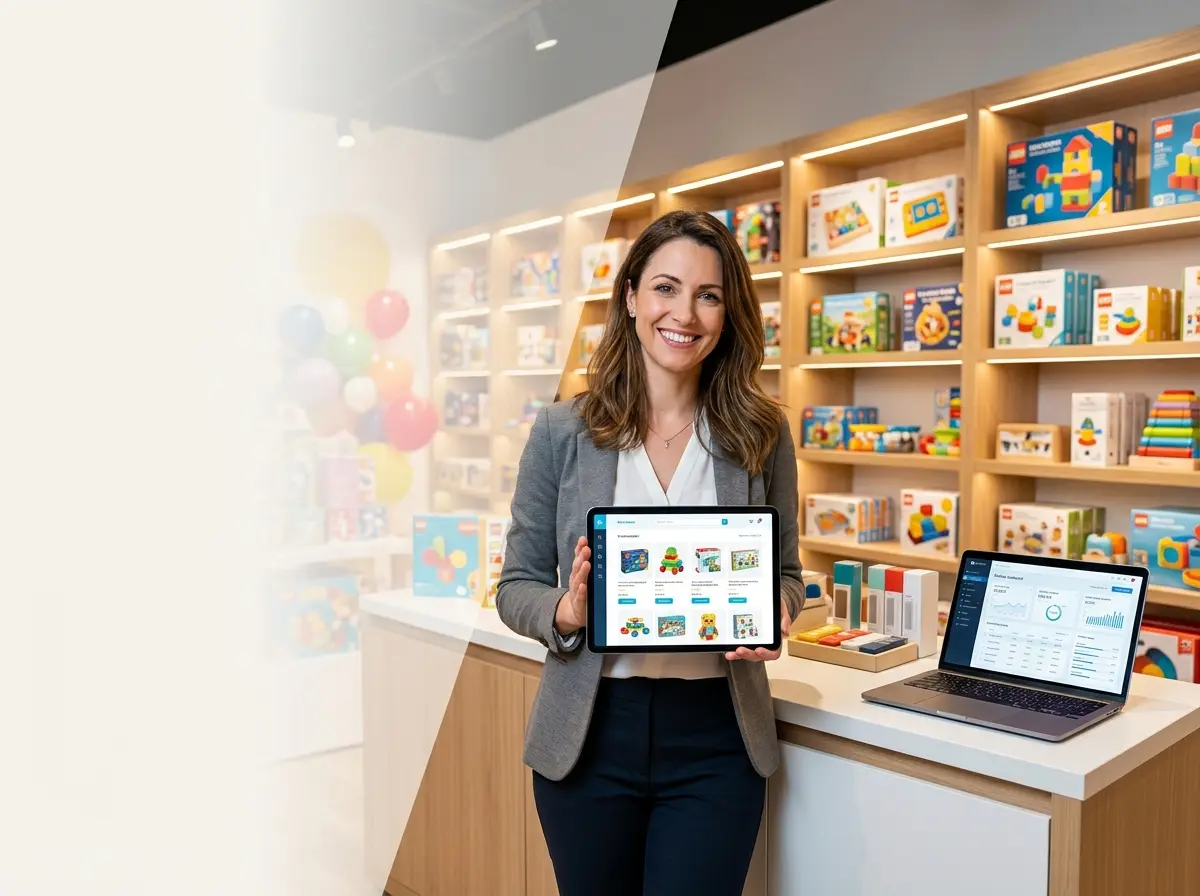
Your Toy Store Deserves More Than a Dusty "Under Construction" Page
Let's be honest — if your toy store's website looks like it was built in 2009 and hasn't been touched since, you're leaving real money on the table. In an age where parents Google "best toy stores near me" while standing in a competitor's parking lot, your e-commerce site isn't just a nice-to-have. It's the digital storefront that either pulls customers in or sends them straight to Amazon with zero guilt.
But here's the good news: building an engaging e-commerce site that complements your physical store doesn't mean you need to become a tech wizard overnight. It means being smart, strategic, and a little playful — which, if you run a toy store, should already be in your DNA. According to the U.S. Census Bureau, e-commerce sales continue to grow year over year, and toy and hobby categories consistently rank among the top-performing segments. Your customers are already shopping online. The question is whether they're shopping with you.
This guide walks you through the practical steps to build a site that drives traffic, converts browsers into buyers, and — crucially — makes your in-store experience even more irresistible in the process.
Building a Site That Actually Works for Toy Retailers
Design for the Real Decision-Makers (Hint: It's the Parents)
Children may be the ones tugging on sleeves and circling items in catalogs, but parents are the ones with the credit cards. Your website needs to speak to both audiences simultaneously — visually fun and exciting enough to keep kids engaged, but organized, trustworthy, and informative enough to give parents the confidence to hit "Add to Cart."
This means clean navigation by age group, category, or occasion (birthday gifts, holiday picks, educational toys), high-quality product photography, and clear descriptions that include age recommendations, safety certifications, and skill-building benefits. Parents aren't just buying toys — they're buying experiences, developmental value, and peace of mind. Give them the information they need without making them scroll through a wall of text to find it.
Also, don't underestimate the power of a well-placed "Staff Picks" or "Best Sellers" section. These social proof elements do the selling for you, and they create a natural bridge between your online presence and the expertise your in-store team already provides.
Sync Your Online Inventory With Your In-Store Reality
Nothing destroys customer trust faster than ordering something online, getting excited about it, and then receiving an apologetic "out of stock" email three days later. If your e-commerce platform isn't connected to your physical inventory system, fix that first — before you do anything else.
Modern point-of-sale systems like Shopify, Square, or Lightspeed all offer real-time inventory syncing between your online store and your brick-and-mortar location. This prevents overselling, reduces customer service headaches, and allows you to offer genuinely useful features like "Buy Online, Pick Up In Store" (BOPIS) — a feature that, according to Adobe Analytics, saw a 208% surge in popularity during the pandemic and has remained a customer favorite ever since. BOPIS is particularly powerful for toy stores because it lets parents confirm the item is available without making a wasted trip, and it almost always results in an upsell when they walk through your door to pick it up.
Create Content That Earns Traffic and Builds Community
Your competitors are running ads. You should be building something more valuable: content. A blog or resource section featuring gift guides by age, toy reviews, and "how to play" videos positions your store as the local expert — not just another retailer. Parents searching for "best STEM toys for 7-year-olds" or "open-ended toys for toddlers" are already primed to buy. If your content answers their questions, they're far more likely to buy from you.
Seasonal gift guides are especially effective and surprisingly easy to produce. A well-structured "Holiday Gift Guide for Kids Under 10" published in early November can drive organic search traffic for years with minimal updates. Pair this with an email newsletter and a lively social media presence, and you've built a community around your store — one that keeps customers coming back long after the initial purchase.
Bridging the Gap Between Your Website and Your Front Door
Use Technology to Keep the In-Store Experience Consistent
Here's where a lot of toy store owners miss a trick: they build a decent website and then treat it as completely separate from what happens in-store. The magic is in the integration. If a customer browses your site, adds items to a wishlist, and then walks into your store, your staff should ideally be able to reference that wishlist and help them find what they're looking for. Some POS systems allow for customer accounts that span both channels — worth exploring if you haven't already.
On the in-store side, Stella — an AI robot employee and phone receptionist — is worth a look for toy retailers who want to create a consistently engaging experience without burning out their human staff. Stella greets customers as they walk in, promotes current deals, answers product questions, and can even collect customer information for your CRM. She also handles phone calls 24/7, so when a parent calls at 9pm wondering if you carry a specific board game, someone (something?) picks up. Her built-in CRM and intake forms mean you're capturing customer data whether the interaction happens in person, on the phone, or online — all in one place.
Driving Online Traffic That Converts to In-Store Visits
Local SEO Is Your Secret Weapon
National toy chains have massive advertising budgets. You have something they don't: a real local presence that people genuinely want to support. Local SEO helps you capitalize on that. Start by claiming and fully optimizing your Google Business Profile — complete with accurate hours, photos, a link to your website, and regular posts about new arrivals or upcoming events. Reviews matter enormously here, so don't be shy about asking satisfied customers to leave one.
On your website, make sure your city and neighborhood appear naturally throughout your content — in page titles, meta descriptions, and in the copy itself. "The best toy store in [Your City]" isn't just a tagline; it's a search term real people use. Local landing pages, if you have multiple locations, can further reinforce your geographic relevance in search results.
Turn Online Browsers Into In-Store Visitors With Events and Exclusives
One of the most effective strategies for driving foot traffic through your website is promoting in-store exclusives and events that can't be replicated online. Think Saturday morning story hours, LEGO building competitions, themed holiday events, or exclusive first-access sales for loyalty members. Announce these prominently on your website, promote them via your email list, and make registration easy.
When customers feel like your store offers experiences — not just products — they'll drive past three other toy stores to visit you. Your website becomes the marketing engine for that experience, capturing interest online and converting it into real, in-store visits. A simple event calendar plugin on your site is a low-effort, high-return addition that many independent toy stores overlook entirely.
Leverage Data to Understand What's Actually Working
You don't need a data science degree to make smart decisions — you just need to pay attention to the right numbers. Google Analytics (specifically GA4) is free and will show you which pages are getting traffic, where visitors drop off, and which products people are viewing without buying. If a product page has high traffic and low conversions, something is wrong — maybe the photos are poor, the price seems high, or the description isn't compelling enough.
Similarly, track which online promotions are driving in-store visits by using unique discount codes that are only available on your website. When a customer redeems one in-store, you have a direct, measurable connection between your digital marketing and physical foot traffic. This kind of closed-loop tracking is what separates retailers who grow intentionally from those who just hope for the best.
Quick Reminder About Stella
Stella is an AI robot employee and phone receptionist designed for businesses just like yours — she stands in-store as a friendly, human-sized kiosk that engages customers, promotes deals, and answers questions, while simultaneously handling phone calls around the clock. At $99/month with no upfront hardware costs, she's one of the easiest ways to add a consistent, professional presence to both your physical and phone-based customer interactions without adding headcount.
Your Next Steps Start Today
Building an e-commerce site that genuinely complements your in-store toy business isn't a one-day project — but it doesn't have to be overwhelming either. Start with the fundamentals: sync your inventory, optimize for local search, and make sure your website reflects the warmth and expertise that makes your store worth visiting in the first place.
From there, layer in content marketing, in-store events, and data tracking to create a virtuous cycle where your online presence drives foot traffic, and your in-store experience builds the loyalty that keeps customers coming back online. The toy retailers who thrive in the next decade won't be the ones who chose between a great store and a great website — they'll be the ones who figured out how to make both work together seamlessly.
So dust off that website, sync up your inventory, write that gift guide you've been putting off, and maybe — just maybe — let an AI robot handle the phones while you focus on what you do best: creating the kind of magical in-store experience that no Amazon algorithm can replicate.