Returns Are Inevitable — How You Handle Them Isn't
Let's be honest: no one opens a retail business dreaming about the day a customer walks back through the door holding a crumpled receipt and a look of mild disappointment. And yet, here we are. Returns happen. They happen to the best products, the best stores, and yes, even to that item you were absolutely certain nobody could possibly want to return.
Here's the thing — a clunky, confusing, or confrontational return policy doesn't just cost you the original sale. It costs you the customer. According to a study by Narvar, 96% of consumers say they would shop with a retailer again if the return experience was easy. Flip that around, and you quickly realize that a painful return process is essentially a loyalty-destruction machine. Efficient, reliable, and almost impressively counterproductive.
The good news? A well-crafted return policy isn't just damage control — it's a genuine competitive advantage. When customers trust that they won't be trapped in a bureaucratic nightmare if something goes wrong, they shop with more confidence, spend more freely, and come back more often. This post is your practical guide to building a return policy that reduces friction, retains customers, and maybe — just maybe — turns a refund into a repeat sale.
Building a Return Policy That Actually Works
Keep It Clear, Simple, and Findable
The single most common return-related frustration isn't the policy itself — it's customers not being able to find or understand it. If your return policy is buried three clicks deep on your website, printed in 6-point font on the back of a receipt, or explained exclusively by the one staff member who works Tuesday mornings, you have a problem. Clarity and accessibility are non-negotiable.
Your policy should be written in plain language. Not legal-ese. Not corporate-speak. Just honest, straightforward sentences that tell customers exactly what they need to know: what can be returned, within what timeframe, in what condition, and what they'll receive in exchange (refund, store credit, exchange, etc.). If there are exceptions — and there usually are — list them explicitly rather than hiding behind vague language like "select items may not qualify."
Place your policy prominently. That means on your website's homepage footer, on your product pages, at your physical checkout counter, and ideally communicated verbally at the point of sale for higher-ticket items. The goal is to make sure customers never have to hunt for this information. The easier it is to find, the more trust it builds — even before a return is ever needed.
Generous Doesn't Mean Reckless — Find the Right Balance
There's a common fear among retailers that a lenient return policy will be exploited. And while return fraud is a real issue (the National Retail Federation estimates it costs retailers billions annually), the data consistently shows that most customers are honest, and overly restrictive policies punish the majority for the behavior of a small minority.
The sweet spot is a policy that feels genuinely customer-friendly without leaving you financially vulnerable. A few principles worth adopting: offer a reasonable time window (30–60 days is standard; 90 days signals real confidence in your product), require proof of purchase without making it an interrogation, and offer store credit as a default option where full refunds aren't feasible. You'd be surprised how often customers will happily accept store credit — especially if it's positioned as a benefit rather than a consolation prize.
The psychology here matters enormously. A customer who leaves with store credit is still a customer. A customer who leaves feeling accused of something is not coming back.
Train Your Team to Handle Returns Like Pros
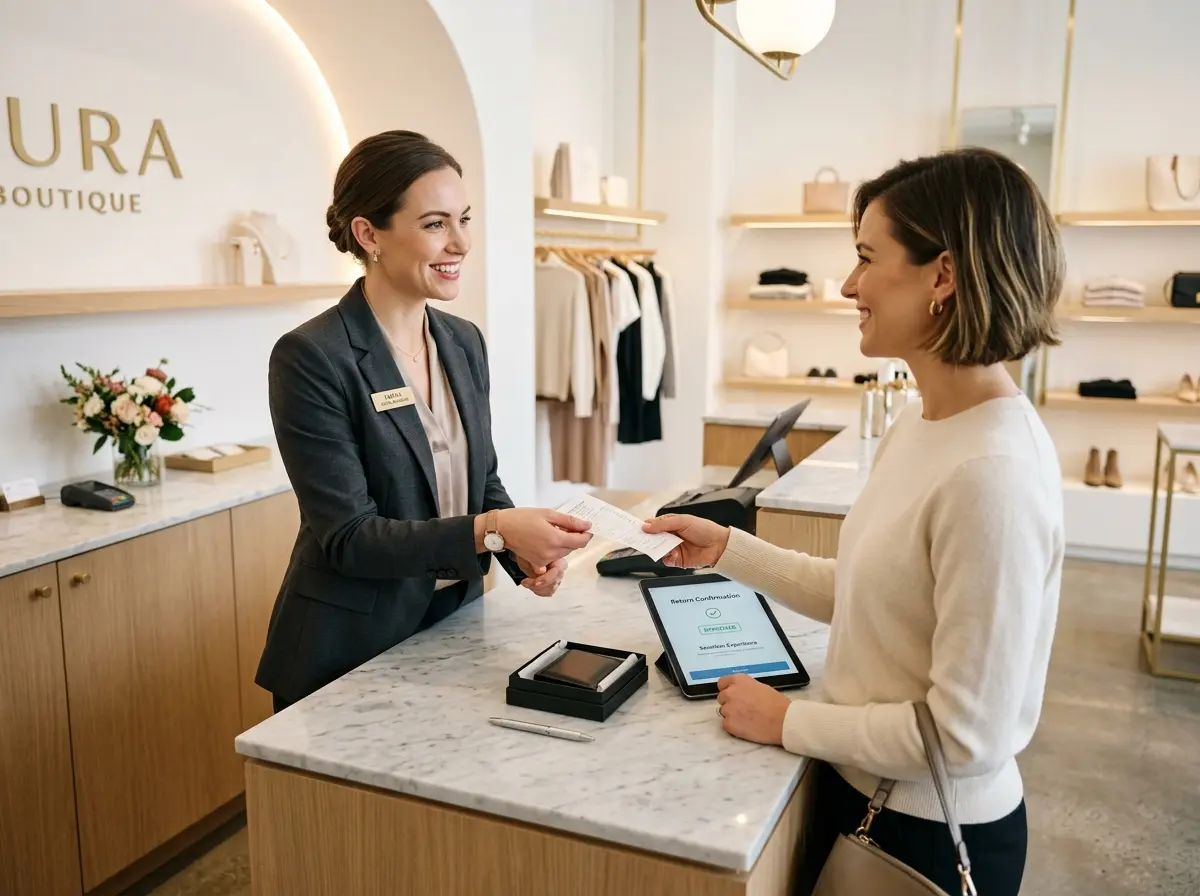
A policy is only as good as the people executing it. Staff who seem annoyed, skeptical, or robotic during the return process can undermine even the most generous policy you've written. Return interactions are, oddly enough, some of the highest-stakes moments in customer service — because the customer is already slightly vulnerable, slightly frustrated, and watching very carefully to see how you treat them.
Train your team to approach returns with empathy first, process second. A simple acknowledgment — "I'm sorry that didn't work out for you" — goes a long way before diving into receipt verification. Empower staff to resolve issues without needing manager approval for routine situations. Long approval chains are a friction generator. The faster and more smoothly a return is processed, the more impressed the customer will be, and the more likely they are to immediately start browsing for a replacement purchase.
How Technology Can Smooth the Entire Process
Let Tools Handle the Repetitive Questions So Your Team Can Focus on People
One underappreciated source of return friction has nothing to do with the return itself — it's the lead-up. Customers call to ask about the policy. They walk in unsure if their item qualifies. They stand at the counter while a staff member tries to remember whether the 30-day window starts from purchase or delivery. These moments add up, and they quietly erode the experience before it even begins.
This is exactly where Stella, the AI robot employee and phone receptionist, quietly earns her keep. Stella can answer questions about your return policy — and virtually anything else about your store — both in person at her kiosk inside your location and over the phone, 24/7. A customer calling after hours to ask whether they can return an opened item doesn't need to wait until tomorrow morning. Stella handles it instantly, accurately, and with the same friendly tone every single time. Fewer interruptions for your staff, faster answers for your customers, and a noticeably smoother pre-return experience overall.
Turning Returns Into Retention Opportunities
The Exchange Conversation: Your Hidden Revenue Moment
Here's a perspective shift worth adopting: a customer who is returning something is a customer who is already in your store, already engaged with your brand, and often already looking for a solution to a problem your product didn't solve. That is a sales opportunity dressed in disappointment clothing.
Train your team (or your signage, or your kiosk) to gently guide return conversations toward exchanges and alternatives. Ask open-ended questions: "What wasn't quite right about it?" or "Were you looking for something with a bit more [X]?" Sometimes the customer didn't need a refund at all — they needed a different size, a different color, or a different product entirely. Solving their underlying problem keeps the revenue in your register and sends them home actually satisfied this time.
Follow Up After the Return — Yes, Really
Most retailers treat a completed return as a closed file. The smart ones treat it as an opening. A simple follow-up — whether by email, text, or even a brief personal note — that acknowledges the return and offers a small gesture (a discount on the next purchase, a recommendation for an alternative product, or even just a sincere "We hope to see you again") can be remarkably effective at rebuilding goodwill.
Customers don't expect to be followed up with after a return. The bar is low. When you clear it, you stand out. And standing out positively in a moment when a customer was slightly disappointed is one of the most powerful loyalty moves available to a retailer.
Use Return Data to Improve, Not Just to Report
Your return patterns are telling you something. High return rates on a specific product? That's either a quality issue, a description mismatch, or a customer expectation problem — all of which are fixable. Returns clustered around certain staff members? That's a training opportunity. Returns spiking after a particular promotion? That promotion may be attracting the wrong buyers.
Treat return data as business intelligence, not just accounting. Review it monthly, look for patterns, and act on what you find. A 10% reduction in your return rate through product improvements or better pre-sale communication can have a meaningful impact on both your bottom line and your customer satisfaction scores.
Quick Reminder About Stella
Stella is an AI robot employee and phone receptionist that greets customers in your store, answers questions about your products and policies, and handles phone calls around the clock — all for $99/month with no upfront hardware costs. She's always on, always consistent, and never needs a coffee break. If you haven't explored what she can do for your retail operation, it's worth a look.
Your Next Steps Toward a Frictionless Return Experience
A graceful return policy isn't a concession to demanding customers — it's a strategic investment in long-term loyalty. The retailers who win aren't necessarily the ones with the lowest prices or the flashiest products. They're often the ones who made every interaction, including the disappointing ones, feel easy and human.
Here's where to start:
- Audit your current policy for clarity, accessibility, and tone. Read it as a first-time customer would.
- Review your return data from the last six months and identify any patterns worth addressing.
- Train your team on the empathy-first approach and empower them to resolve routine returns without escalation.
- Build in a follow-up mechanism for returned purchases — even a simple automated email can make a difference.
- Consider tools like Stella to handle policy questions consistently and free your staff to focus on higher-value customer interactions.
Returns will never be the highlight of your business day. But with the right policy, the right team behavior, and the right tools in place, they can stop being a liability and start being a quiet, steady engine for customer retention. And in retail, that's not a small thing — that's the whole game.