Your Waiting Room Is Quietly Killing Your Customer Retention
Let's be honest — nobody walks into an auto shop thinking, "I can't wait to spend the next two hours staring at a flickering TV playing a news channel from 2019." And yet, here we are. The waiting room experience at most auto shops is the kind of thing that makes people reconsider whether they actually need their oil changed at all. Spoiler: they do. But they might find someone else to do it.
Here's the uncomfortable truth: perceived wait time is often more damaging to customer satisfaction than actual wait time. Research from the Journal of Consumer Research has shown that an unoccupied minute feels significantly longer than a minute spent doing something — anything — engaging. A customer who waits 45 minutes and feels informed, entertained, and valued will rate their experience higher than a customer who waited 30 minutes staring at a blank wall. Your shop's reputation isn't just built in the service bay. It's built in that waiting room, one agonizing minute at a time.
The good news? Creating a digital customer waiting room experience that actively reduces perceived wait time isn't rocket science — it's just smart business. And it's more achievable than you might think, even for smaller independent shops. Let's break it down.
Understanding Why Wait Time Feels So Long (And What You Can Do About It)
The Psychology of Waiting
Psychologists have been studying wait time for decades, and the findings are consistent: unoccupied time drags, uncertainty makes it worse, and feeling ignored makes it unbearable. In a service environment like an auto shop, all three of these factors are working against you simultaneously. Your customer doesn't know when their car will be done, no one has checked in with them, and they've already read every magazine from 2021 in the rack by the door.
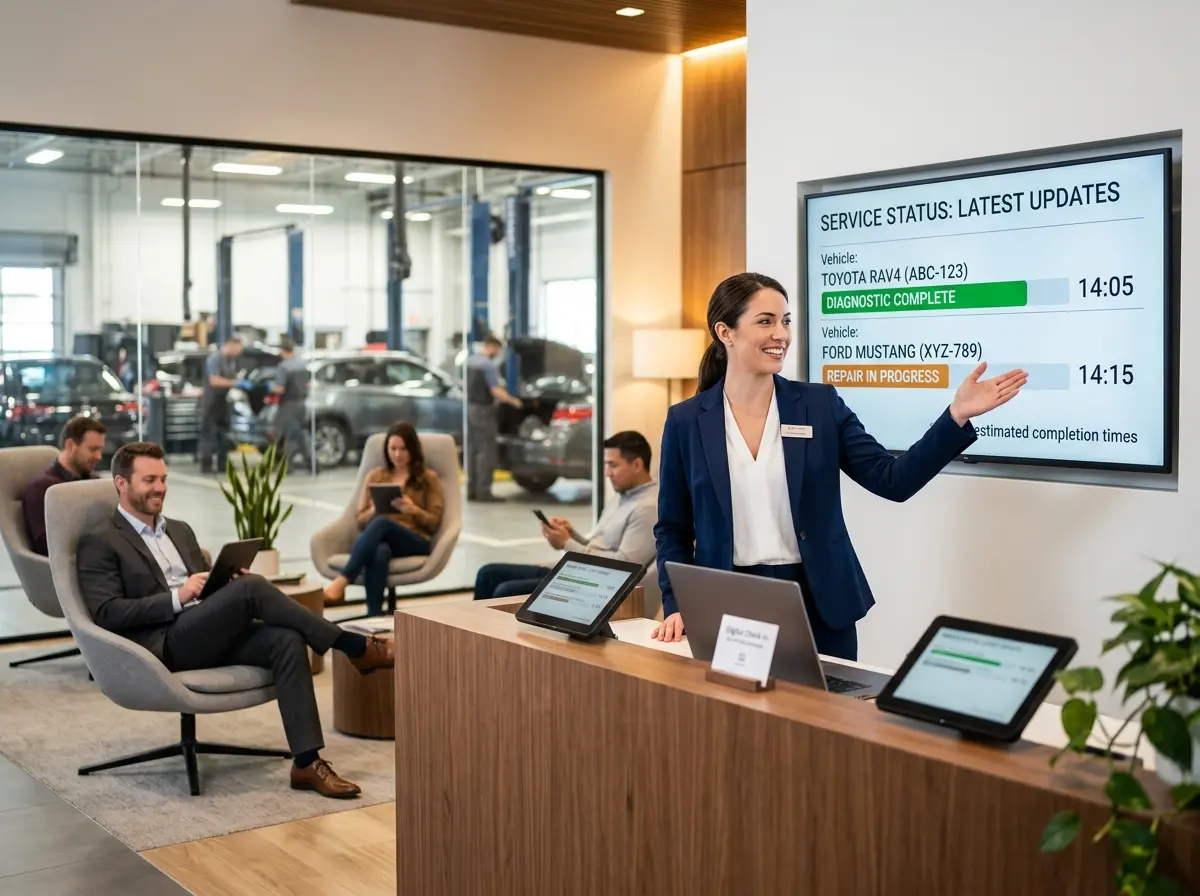
David Maister, a Harvard Business School researcher, famously outlined eight principles of waiting, including the idea that unexplained waits feel longer than explained ones, and that uncertain waits are more tolerable when an end point is known. Translation: your customers aren't just frustrated by the wait — they're frustrated by the silence. A simple digital display showing estimated completion times, live service updates, or even a queue status board can dramatically shift how long that wait feels, even when nothing about the actual time has changed.
The Hidden Cost of a Bad Waiting Experience
You might be thinking, "People understand that car repairs take time." And you're right — they do. But understanding something intellectually and experiencing it comfortably are two very different things. A customer who felt ignored or bored during their wait is significantly less likely to return, less likely to leave a positive review, and more likely to mention the experience to their friends — not in a flattering way.
According to a study by Waitwhile, 75% of customers say they've left a business due to a long or poorly managed wait. For an auto shop where repeat business and word-of-mouth referrals are the lifeblood of revenue, that number should get your attention. Every customer who leaves your waiting room with a bad taste in their mouth is a potential Yelp review you didn't want and a referral you'll never get.
Building a Digital Waiting Room That Actually Works
How Technology Can Help — Including Stella
This is where the modern auto shop owner has a genuine advantage over the old-school "just put on the local news" approach. Stella, the AI robot employee and kiosk receptionist, is one of the most practical tools you can deploy in your waiting area. Rather than leaving customers to sit in silence or awkwardly flip through their phones, Stella stands in your lobby and proactively engages them — answering questions about services, explaining what's being done to their vehicle, highlighting current promotions, and generally being the attentive presence your front desk staff doesn't always have time to be.
Beyond the in-person kiosk experience, Stella also handles phone calls 24/7, which means customers who call ahead to check on their vehicle status or ask about services get an immediate, knowledgeable response rather than being put on hold or sent to voicemail. For auto shops that deal with high call volumes during peak hours, this alone can be a game-changer for customer satisfaction.
Digital Content Strategies That Reduce Perceived Wait Time
Use Screens Strategically — Not Just for Background Noise
If you have a TV in your waiting room (and you probably do), ask yourself honestly: is it working for your business, or is it just filling space? A random cable news channel isn't engaging your customers in any meaningful way. What would engage them is content that's relevant, informative, and subtly promotional without feeling like an infomercial.
Consider running a digital signage loop that includes real estimated wait times or a service queue board, short educational videos about vehicle maintenance (why tire rotation matters, what that dashboard light actually means), current promotions and service specials, customer reviews and testimonials displayed in rotation, and behind-the-scenes content showing your team's expertise and shop culture. This kind of content does double duty: it occupies the customer's attention and it builds trust and familiarity with your brand. A customer who watches a 90-second video explaining why synthetic oil is worth the upgrade is a customer who's more likely to say yes when your service advisor recommends it.
Create a Comfortable, Connected Environment
Digital experiences don't stop at screens. The physical comfort of your waiting room directly influences how long a wait feels. Fast, reliable Wi-Fi is now a baseline expectation, not a luxury — display the network and password prominently. Consider adding charging stations for phones and laptops. If your waiting room looks like it hasn't been updated since the shop opened in 1994, a modest refresh with comfortable seating, good lighting, and a clean environment will do more for your customer satisfaction scores than almost anything else.
You can also implement text or app-based status updates so customers don't have to wonder if their car is done — they get a notification. This removes one of the most anxiety-inducing aspects of waiting: the unknown endpoint. When customers know they'll be notified, they stop watching the clock and start actually relaxing.
Leverage the Wait Time as a Revenue Opportunity
Here's a reframe that might change how you think about your waiting room entirely: your waiting customers are a captive audience. Not in a sinister way — in an opportunity way. These are people who are already financially committed to your shop today. They're in the right mindset, they're on-site, and they have time on their hands. That's actually a remarkably receptive customer to be talking to.
Use digital signage, in-person engagement, and even printed materials strategically placed around the room to introduce customers to services they might not have known you offer. Seasonal promotions, maintenance packages, fleet services, referral programs — all of it can be surfaced naturally in the waiting room environment. Shops that approach the waiting room as a marketing channel, rather than just a holding area, consistently report higher upsell conversion rates and stronger customer loyalty.
Quick Reminder About Stella
Stella is a friendly, human-sized AI robot kiosk and phone receptionist built for businesses like yours — she greets customers, answers questions, promotes specials, and handles phone calls 24/7, all for just $99/month with no upfront hardware costs. For auto shops specifically, she's the kind of always-on, never-distracted front-of-house presence that keeps customers informed and engaged whether they're sitting in your waiting room or calling in from their driveway. Setup is easy, and she's ready to work from day one.
Turn Your Waiting Room Into a Competitive Advantage
Here's what your action plan looks like if you're serious about improving the waiting experience at your auto shop:
- Audit your current waiting room — sit in it yourself for 20 minutes and take notes on what the experience actually feels like as a customer.
- Upgrade your screens — replace passive cable TV with intentional digital signage that includes wait time updates, educational content, and current promotions.
- Add reliable Wi-Fi and charging stations — these are low-cost, high-impact improvements that customers notice immediately.
- Implement status update notifications — text-based updates so customers know when their vehicle is ready without having to ask.
- Consider an in-lobby engagement tool like Stella to proactively interact with waiting customers and answer questions without pulling your staff away from other work.
- Treat the waiting room as a marketing channel — surface your service offerings, promotions, and customer reviews in the places where captive eyes will see them.
The auto shops that are winning right now aren't necessarily the ones with the fastest turnaround times or the lowest prices. They're the ones that make the entire experience — including the waiting — feel professional, modern, and respectful of the customer's time. That's not a small thing. In a competitive market where customers have options, the shop that makes waiting feel like less of a burden is the shop that earns the second visit, the five-star review, and the referral to a neighbor.
Your service bay is where you fix cars. Your waiting room is where you keep customers. It's time to invest in both.