Your Website Is Beautiful. Too Bad Nobody's Seeing It.
Let's set the scene: you've just spent three months (and probably more money than you'd like to admit) getting your catering company's website looking absolutely stunning. The hero image is gorgeous. The menu PDFs are perfectly formatted. The "About Us" page tells your origin story with just the right amount of warmth. You hit publish, lean back in your chair, and wait for the inquiries to roll in.
Then... crickets.
Here's the uncomfortable truth that nobody tells catering business owners: a beautiful website doesn't generate business on its own. It's a destination, not a discovery tool. People have to find you before they can admire your design choices. And in the catering world — where contracts are won on relationships, referrals, and reputation — one platform is quietly doing more heavy lifting than most owners realize: LinkedIn.
Before you invest another dollar in website redesigns, SEO plugins, or a new logo, let's talk about why LinkedIn deserves your attention first, and how to actually use it to grow your catering business.
Why LinkedIn Is a Goldmine for Catering Companies
Your Best Clients Are Already There
Think about who hires catering companies most consistently: corporate event planners, HR managers organizing company retreats, office managers coordinating quarterly team lunches, executives planning client appreciation dinners. These people aren't scrolling Instagram hoping to stumble across your risotto. They're on LinkedIn — every single workday — and they're the exact decision-makers who control catering budgets that dwarf anything your average wedding client will spend.
LinkedIn boasts over 1 billion members worldwide, with a significant concentration of business professionals, managers, and executives. More importantly, according to LinkedIn's own data, four out of five LinkedIn members drive business decisions at their companies. That's not a vanity metric — that's your ideal client base in digital form, and they're actively looking for service providers they can trust.
Catering Is Inherently Visual and Story-Driven — Use That
One of the best-kept secrets of LinkedIn is that it rewards good content more generously than almost any other platform. Unlike Instagram, where you're fighting algorithm changes and fleeting attention spans, LinkedIn's feed is less saturated with catering content, which means a well-placed post actually gets seen. Behind-the-scenes content from a corporate gala setup, a short video of your team plating a 200-person luncheon, or even a simple post about a challenge you solved on a complex event — these perform remarkably well because they demonstrate competence and build trust simultaneously.
The catering industry is full of stories. A last-minute venue change you navigated seamlessly. A client's dietary restriction you turned into the most-complimented dish of the night. These are the narratives that make corporate buyers feel confident handing you their budget and their reputation.
LinkedIn Builds the Referral Engine Your Business Runs On
Catering is a referral business. Full stop. A satisfied corporate client who moves to a new company doesn't just become a repeat customer — they become a walking endorsement in a new organization with a new budget. LinkedIn is where those connections live and breathe. When you're consistently visible on the platform, posting valuable content and engaging with your network, you stay top-of-mind when someone at a networking event asks, "Do you know a good caterer for our annual conference?"
Your website can't do that. A LinkedIn presence, maintained consistently, absolutely can.
While You're Building Your Brand Online, Don't Drop the Ball Offline
Your Phone and Front Door Still Matter — A Lot
Here's the irony of investing in your digital presence: the better your LinkedIn strategy works, the more inquiries you'll start fielding — and those inquiries often come as phone calls or walk-ins, especially from local corporate clients who want to talk to a real person before signing a catering contract. If you're busy running an event and your phone goes to voicemail, or a potential client walks into your commissary and nobody greets them promptly, you've done all that LinkedIn work for nothing.
This is where Stella comes in. Stella is an AI robot employee and phone receptionist that greets customers in-person at your physical location and answers your phone calls 24/7 — with the same business knowledge, the same professionalism, and zero bad days. For a catering company generating new inbound interest, Stella can handle initial inquiries, share information about your services and current promotions, collect client details through conversational intake forms, and even forward calls to your human team when the situation calls for it. At just $99/month, she's considerably less expensive than a missed corporate contract.
How to Actually Build a LinkedIn Presence That Works for Your Catering Business
Start With a Profile That Does the Selling for You
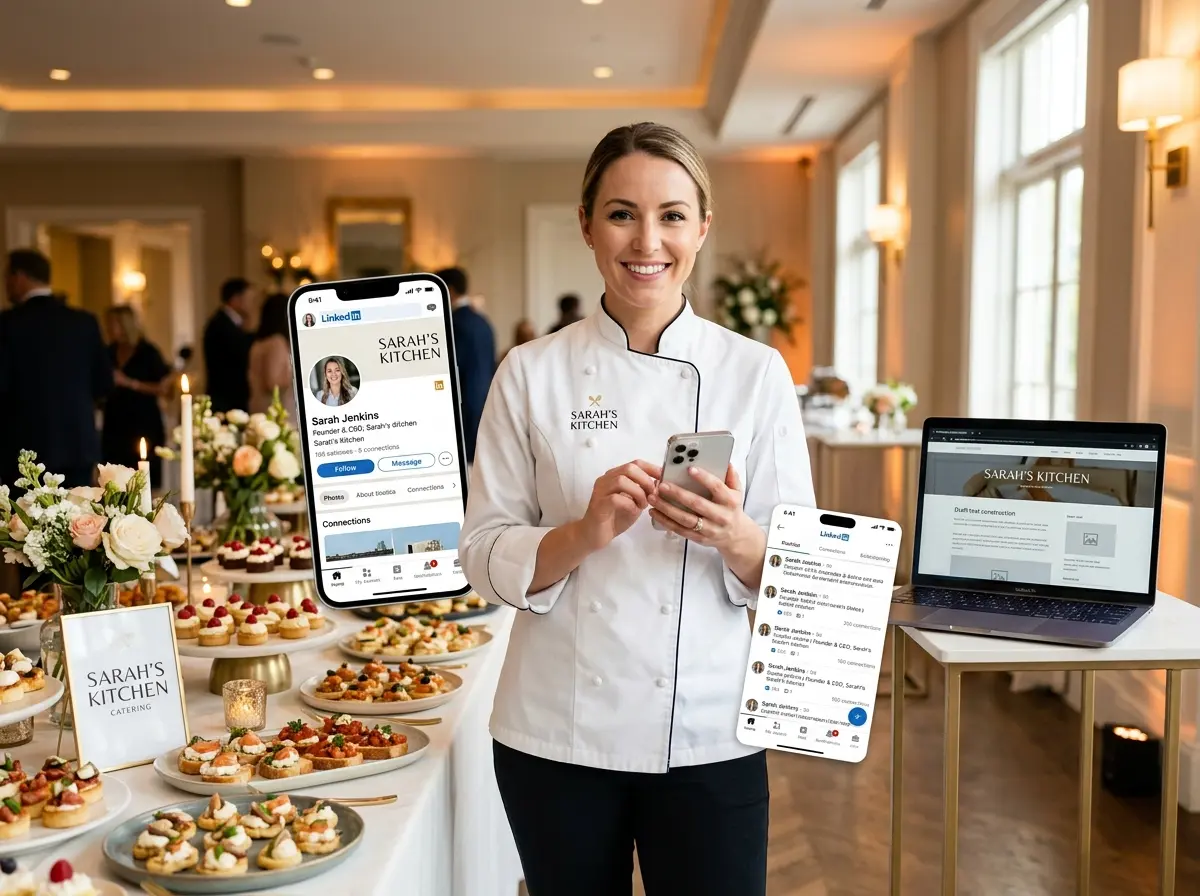
Your LinkedIn company page and personal profile are your digital handshake. Before you post a single piece of content, make sure the foundation is solid. Your company page should have a clear, compelling description that speaks directly to your target client — corporate event planners, not wedding guests. Use industry-specific language like "corporate catering," "executive dining," "large-scale event logistics," and "dietary accommodation management." These are the phrases that show up in searches and signal credibility to buyers who've been burned by disorganized caterers before.
Your banner image should show your team in action at a real event — not a stock photo of a cheese board. Your contact information should be complete, your service offerings clearly listed, and your location accurate. It sounds basic because it is, but you'd be surprised how many catering companies skip these fundamentals and then wonder why LinkedIn "doesn't work" for them.
Build a Content Rhythm You Can Actually Sustain
Consistency beats brilliance on LinkedIn. Posting three times a week for six weeks will outperform one viral post followed by three months of silence. The good news is that catering companies have a natural content calendar built into their operations — every event is a content opportunity. A quick photo post after a corporate lunch, a short reflection on what made a recent wedding coordination challenging, a tip on how to plan a menu for a mixed-dietary group of 150 people — all of this is genuinely useful to your audience and positions you as an expert, not just a vendor.
Aim for a mix of content types: educational posts that showcase your expertise, behind-the-scenes glimpses that build trust, client success stories (with permission), and occasional promotional announcements about availability or seasonal menus. Engage with comments, respond to messages promptly, and comment meaningfully on posts from event planners and corporate clients in your network. Relationships are built in the comments section just as much as in the feed.
Use LinkedIn's Tools Strategically, Not Just Casually
LinkedIn offers several underutilized features that catering companies can leverage for real business development. LinkedIn Events lets you promote open houses, tasting events, or vendor showcases directly to a professional audience. LinkedIn Articles allow you to publish longer-form content — like a guide to planning a corporate holiday party — that demonstrates deep expertise and gets indexed by search engines. LinkedIn Newsletters are an increasingly powerful tool for building a subscriber base of event planners who receive your content directly in their inbox, bypassing the algorithm entirely.
Additionally, don't underestimate the power of personal profiles alongside your company page. If you're the founder or head chef, your personal profile likely has more reach than your company page initially. Use both, cross-promote between them, and encourage any team members who are comfortable doing so to share company content from their own profiles.
Quick Reminder About Stella
Stella is the AI robot employee and phone receptionist that keeps your business running professionally while you're busy running events, building your LinkedIn presence, or simply sleeping. She greets walk-in customers, answers calls around the clock, promotes your offerings, and collects client information — all for $99/month with no upfront hardware costs. For catering companies scaling their inbound inquiries, she's the kind of support that pays for itself the first time she converts a late-night call into a booked contract.
Your Next Moves — Start This Week, Not Next Quarter
Building a LinkedIn presence isn't a six-month project — it's a series of small, consistent actions that compound over time. Here's how to get started without getting overwhelmed:
- Audit your existing presence. Search your catering company on LinkedIn. What comes up? Is your company page complete, accurate, and professional? Fix this first.
- Optimize your personal profile and company page using the guidelines above. Spend one solid afternoon on this and it's done.
- Commit to posting twice a week for 60 days. Take photos at your next event. Write a short post about something you learned recently. Document a challenge and how you solved it. Just start.
- Connect intentionally. Search for corporate event planners, HR directors, and office managers in your local area. Send personalized connection requests. Engage with their content before you ever try to sell anything.
- Track what's working. LinkedIn provides basic analytics on your posts and page. After 30 days, look at what content got the most engagement and make more of that.
Your website is a wonderful thing, and eventually, it'll earn its keep. But right now, LinkedIn is where your next corporate client is spending their Tuesday afternoon, and you want to be the caterer they're already familiar with when they start searching. A new website redesign can wait. Your LinkedIn presence cannot.
Get visible. Build relationships. Feed people. In that order.