When "You Might Also Like" Actually Works
Let's be honest — most small food retailers are not exactly rolling in data science budgets. You're too busy managing inventory, keeping cheese at the right temperature, and explaining to customers for the fourteenth time today what the difference between prosciutto and coppa is. Building a personalized product recommendation engine probably sounds like something reserved for Amazon or a startup with a ping-pong table and too much venture capital.
But here's the thing: specialty food retail is uniquely positioned to benefit from personalization. Your customers are passionate, opinionated, and often loyal — the kind of people who will drive 25 minutes out of their way for the right olive oil. They don't want to be sold to. They want to be understood. And when you recommend the exact aged manchego that pairs perfectly with the fig jam they just bought, you're not upselling — you're being their favorite food person.
This post walks through how a specialty food retailer built a practical, affordable personalized recommendation engine that increased average order value, deepened customer relationships, and — yes — actually got used. No data science degree required.
Building the Foundation: Data You Already Have (But Aren't Using)
Before you can recommend anything to anyone, you need to know who they are and what they care about. The good news is that most specialty food retailers are already sitting on a goldmine of useful data. The bad news is that it's usually scattered across a POS system, a paper loyalty card, a sticky note on the register, and someone's memory.
Understanding Your Customer Segments
Start by thinking about your customers in broad strokes before getting granular. Specialty food customers tend to cluster into recognizable types: the adventurous explorer who wants whatever is weird and new, the loyalist who buys the same three things every visit, the gift buyer who shows up four times a year with a budget and a mild panic, and the entertainer who needs everything to look impressive on a charcuterie board.
These aren't just personas for a marketing deck — they're actually useful for structuring recommendations. The explorer gets your new arrivals and limited-edition imports. The loyalist gets a heads-up when their favorite is back in stock. The gift buyer gets curated bundles. Each segment needs a different recommendation strategy, and the first step is simply deciding which segments exist in your world.
Collecting the Right Data Points
You don't need to track everything. You need to track the right things. For a specialty food retailer, the most actionable data points include purchase history (obviously), dietary preferences or restrictions, flavor profile preferences (savory vs. sweet, mild vs. bold), interest categories (wine, charcuterie, pantry staples, gifts), and purchase occasion (everyday vs. entertaining vs. gifting).
Collecting this doesn't have to be a whole production. A short intake form during a loyalty program signup, a brief conversational question at checkout, or a simple preference survey sent via email after a first purchase can give you enough to start making meaningful recommendations. The key is consistency — capturing the same types of information across customers so you can actually use it.
Organizing It All in One Place
Scattered data is just noise. Once you've identified what you want to collect, it needs to live somewhere structured — ideally a CRM that allows for custom fields and tags. Tag customers with flavor preferences, dietary flags, purchase categories, and visit frequency. Add notes from meaningful conversations. Over time, these profiles become genuinely useful, not just decorative.
According to a McKinsey report, companies that excel at personalization generate 40% more revenue from those activities than average players. That gap isn't explained by technology alone — it's explained by organized, actionable data.
How AI-Powered Tools Like Stella Fit Into This Picture
Here's where things get interesting for specialty food retailers, especially those with a physical storefront. You can build the most sophisticated recommendation logic in the world, but if it only lives in your email platform, you're missing half the conversation — the one that happens in your store, in real time, with a customer standing in front of your cheese case.
In-Store Personalization and Phone Engagement
Stella — an AI robot employee and phone receptionist — is designed to close exactly that gap. In-store, she operates as a human-sized kiosk that proactively greets customers, answers questions about products, and makes recommendations based on what a customer is looking for. She can highlight current specials, suggest pairings, and guide customers toward products that match their stated preferences — all without pulling your staff away from what they're doing.
On the phone side, Stella answers calls 24/7, handles common questions about hours, availability, and promotions, and can collect customer information through conversational intake forms — feeding directly into a built-in CRM with custom fields, tags, and AI-generated profiles. For a specialty food retailer building a recommendation engine, that CRM is not a side feature. It's the backbone of the whole operation. At $99/month with no upfront hardware costs, it's the kind of tool that actually makes sense for an independent retailer's budget.
Building the Recommendation Logic: Practical Approaches That Work
Now for the part that actually sounds technical but genuinely isn't. Building a recommendation engine for a specialty food retailer doesn't require algorithms or engineers. It requires thoughtful rules, good product taxonomy, and a bit of creativity.
Product Tagging and Pairing Maps
The foundation of any food recommendation system is understanding how your products relate to each other. Start by tagging every product in your inventory with relevant attributes: flavor profile, category, dietary compatibility, and natural pairings. Then build pairing maps — essentially a structured list of "if someone buys X, suggest Y and Z."
A customer who buys a raw-milk aged cheddar probably wants a chutney and a honey to go with it. Someone buying imported pasta likely wants an artisan sauce or a finishing olive oil. These relationships exist in your staff's heads already. The exercise here is just making them explicit and systematic so they can be applied consistently — through email, through your kiosk, through your phone interactions, through your website.
Using Purchase History to Trigger Recommendations
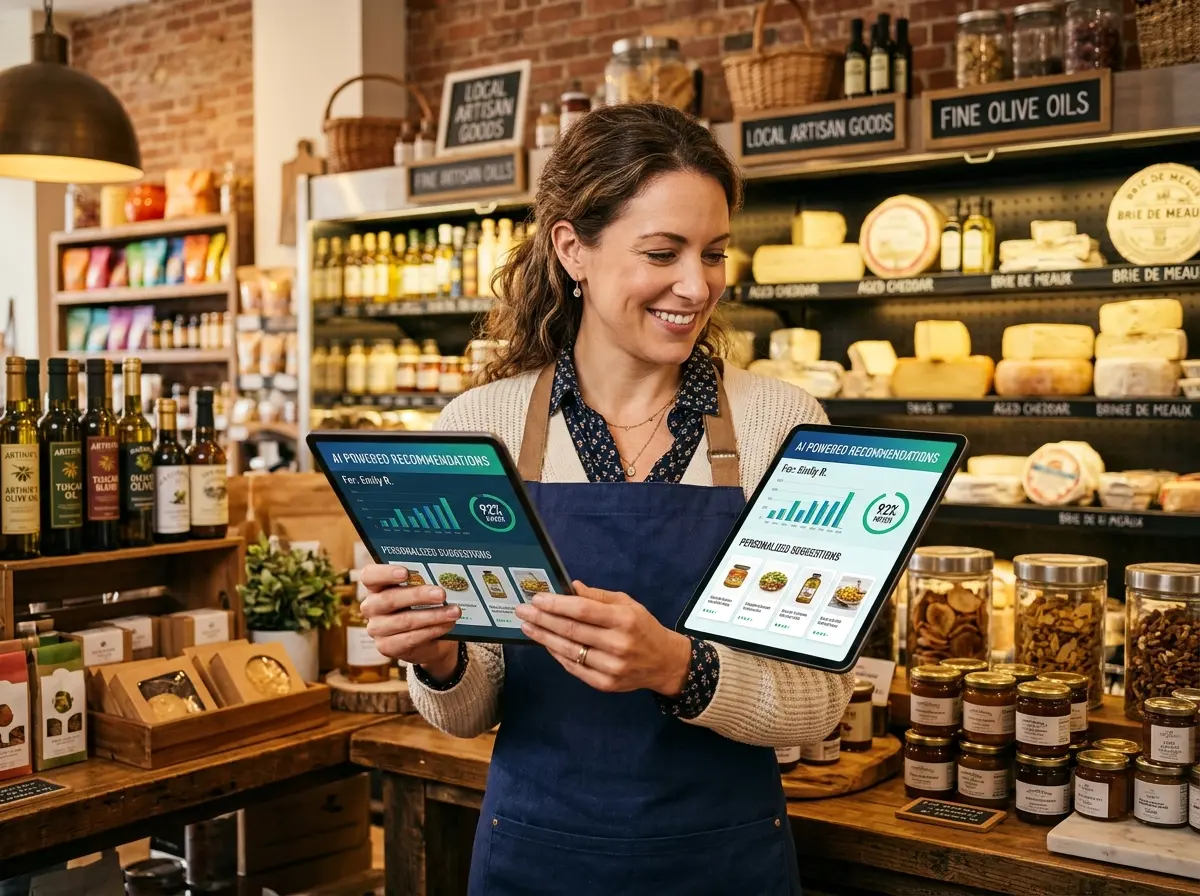
Once your CRM is capturing purchase data and your products are properly tagged, you can start automating simple recommendation triggers. A customer who bought smoked salmon twice in the last three months gets a "you might love this" email when you bring in a new cured fish. A customer tagged as a "gift buyer" gets a curated gift box suggestion in October before the holiday rush. A loyalist who hasn't visited in six weeks gets a "we miss you" message featuring their usual favorites.
None of this requires a sophisticated AI model. A well-configured email platform connected to your CRM, with simple rules and segments, can execute all of this reliably. The "intelligence" isn't in the technology — it's in the thoughtfulness of the rules you build.
Testing, Measuring, and Refining
The biggest mistake specialty retailers make with personalization is treating it as a set-it-and-forget-it project. It isn't. Recommendation effectiveness needs to be measured. Track click-through rates on recommendation emails, conversion rates on suggested add-ons at checkout, and changes in average order value by customer segment.
Run simple A/B tests: does recommending a pairing item at the point of sale increase attachment rate? Does a "customers like you also bought" email perform better than a "new arrival" email for your adventurous segment? These answers will be specific to your store and your customers. The only way to find them is to measure consistently and iterate honestly. Plan for a 90-day cycle of testing and refinement before drawing meaningful conclusions.
Quick Reminder About Stella
Stella is an AI robot employee and phone receptionist that works both as an in-store kiosk and a 24/7 phone answering solution for businesses of all sizes. She greets customers, answers questions, promotes specials, upsells and cross-sells, collects customer information, and manages contacts through a built-in CRM — all for $99/month with no upfront hardware costs. For a specialty food retailer building a personalized recommendation engine, she's worth a serious look.
Conclusion: Start Small, Think Long-Term
Building a personalized product recommendation engine for a specialty food retailer doesn't require a six-figure technology investment or a team of data analysts. It requires clarity about your customers, discipline in your data collection, thoughtfulness in your recommendation logic, and a willingness to measure what's working.
Here's a practical starting point for this week:
- Audit your current data: What do you actually know about your customers right now, and where does it live?
- Tag your top 50 products with flavor profiles, categories, and natural pairings.
- Define three customer segments that exist in your store and describe what a good recommendation looks like for each.
- Set up one automated trigger — a follow-up email, a loyalty touchpoint, or a restock alert — and measure the response rate.
- Evaluate your in-store and phone touchpoints to identify where recommendations are currently falling through the cracks.
Your customers already trust you with their tastebuds. A little bit of personalization infrastructure just helps you prove — consistently and at scale — that the trust is well placed. And if you can get a robot to help you do it, even better.