From Invisible to Unmissable: How One PT Practice Won the Local Search Game
Picture this: a physical therapy practice with excellent clinicians, glowing patient outcomes, and a waiting room that could comfortably seat a small village — yet somehow, when people in the neighborhood searched "physical therapy near me," this clinic wasn't showing up. Not on page one. Not even on page two. Somewhere in the digital equivalent of a back alley. Meanwhile, a competitor with suspiciously generic stock photos was ranking at the top of Google. Infuriating, right?
This is the reality for thousands of local businesses. You can be genuinely great at what you do and still lose to someone who simply knows how to be found. Local SEO — search engine optimization specifically targeted at geographic search results — is the difference between a packed schedule and tumbleweeds rolling through your front door. The good news? It's not magic. It's a repeatable process, and this blueprint breaks it down step by step using a real physical therapy practice as the case study.
Building the Foundation: Google Business Profile and Local Citations
If local SEO were a house, your Google Business Profile (GBP) would be the foundation. Not the curb appeal, not the fancy kitchen island — the foundation. Everything else sits on top of it. And yet, a staggering number of businesses treat their GBP like a forgotten MySpace page: set up once, never touched again, probably missing half the information.
Optimizing Your Google Business Profile the Right Way
The physical therapy practice in our case study — let's call them Peak Motion PT — started by doing a full audit of their GBP. What they found was not pretty: inconsistent hours, no photos, a business description that read like it was written by someone who had heard of physical therapy but never actually experienced it, and zero responses to their reviews (both good and bad). Google pays attention to all of this.
Here's what they fixed and what you should too:
- Business name, address, and phone (NAP): Make sure these match exactly across every platform on the internet. Exactly. Not "St." in one place and "Street" in another.
- Categories: They added a primary category of "Physical Therapist" and relevant secondary categories. Google uses these to decide when to show you.
- Business description: Written with natural language that included their target neighborhood and key services — without reading like a keyword-stuffed ransom note.
- Photos: Real photos of real staff and the actual clinic. Businesses with photos receive 42% more requests for directions and 35% more website clicks according to Google.
- Weekly Google Posts: Short updates about new services, patient tips, and promotions — treated like a mini social feed directly in search results.
Citations: The Unsexy but Essential Work
A "citation" is simply any online mention of your business name, address, and phone number. Directories like Yelp, Healthgrades, Zocdoc, and dozens of others are citation sources. Search engines cross-reference these to verify that your business is legitimate and located where you claim to be. Peak Motion PT had citations scattered across the web with three different phone numbers and two different addresses — the result of a mid-pandemic office move nobody fully cleaned up online.
They used a citation management tool to audit and correct every listing. It took about two weeks of unglamorous work. Within 60 days, their local pack rankings (those coveted top-three map results) improved noticeably. Not because of any clever trick, but because they gave Google consistent, trustworthy information. Groundbreaking, honestly.
Reviews, Reputation, and the Trust Economy
Why Reviews Are Your Most Powerful Local Ranking Signal
Reviews are not just for making you feel warm and fuzzy (or defensive and grumpy). They are an active ranking factor in local search. Google's algorithm weighs review quantity, recency, rating, and — critically — whether the business responds to them. Peak Motion PT had 11 reviews, most of them two years old. Their competitor down the street had 147 reviews with an average of 4.8 stars and personalized responses to every single one. The ranking gap suddenly made a lot of sense.
The fix was embarrassingly simple: they started asking. After each session, staff sent a brief follow-up text with a direct link to leave a Google review. Within three months, they had 64 new reviews. They responded to every one — thanking positive reviewers by name and professionally addressing the rare negative feedback. Their average rating climbed to 4.9 stars, and their Google Business Profile views increased by over 200%.
Let Technology Handle the Grunt Work While You Focus on Patients
Here's where we talk about working smarter, because manually handling every incoming call, greeting every walk-in, and chasing down every intake form is a fast track to burnout — especially for a healthcare practice where staff time is precious and front-desk attention needs to be laser-focused.
Stella, the AI robot employee and phone receptionist, is genuinely useful for physical therapy practices and similar businesses investing in local visibility. When someone finds your clinic through a hard-won Google search, the last thing you want is for that call to go to voicemail or for a walk-in patient to stand at the front desk waiting while staff are occupied. Stella answers the phone 24/7, handles intake questions, and greets patients in-person at the kiosk — making sure that expensive local SEO traffic actually converts into booked appointments instead of bouncing to a competitor who picked up the phone. Her built-in CRM also captures caller information and generates AI-powered contact profiles, so your team always has context before a follow-up conversation even begins.
On-Page Local SEO: Your Website Needs to Do Its Part
Your Google Business Profile and citations are doing the heavy lifting in local pack rankings, but your website still matters — especially for organic local search results that appear below the map. Peak Motion PT's website was well-designed but essentially invisible to search engines because it had never been optimized for local intent.
Location Pages and Neighborhood Targeting
One of the highest-impact changes they made was creating a dedicated location page that mentioned their specific neighborhood, nearby landmarks, and the communities they serve. This wasn't keyword stuffing — it was contextually natural content that helped Google understand where the practice was and who it served. If you operate in multiple neighborhoods or serve patients from several zip codes, a separate page for each area is worth the investment.
They also embedded a Google Map on their contact page, added local schema markup (structured data that explicitly tells search engines your business name, address, phone, and hours), and made sure their NAP information in the website footer matched their GBP exactly. These are not glamorous tasks. Neither is flossing, and yet here we are recommending both.
Content That Answers Local Questions
Peak Motion PT started publishing short blog posts targeting questions their patients actually asked — things like "how long does PT take for a rotator cuff injury in [neighborhood]" or "what to expect at your first physical therapy visit." These weren't viral content pieces. They were practical, locally relevant answers that attracted exactly the kind of search traffic that converts. Within six months, organic search traffic from their target neighborhoods had doubled, and new patient inquiries attributed to organic search increased by 78%.
The lesson here is that local content doesn't need to be ambitious — it needs to be relevant. Answer the questions your customers are already typing into Google, and do it better than your competitors.
A Quick Word About Stella
Stella is an AI robot employee that works as both an in-store kiosk and a 24/7 phone receptionist for businesses of all kinds — from physical therapy clinics to retail shops to law firms. At $99/month with no upfront hardware costs, she greets customers, answers questions, promotes services, handles calls, and keeps your team free to do what they're actually trained to do. She doesn't call in sick, doesn't need a lunch break, and never puts a potential patient on hold to deal with something else.
Your Next Steps: Turning This Blueprint Into Results
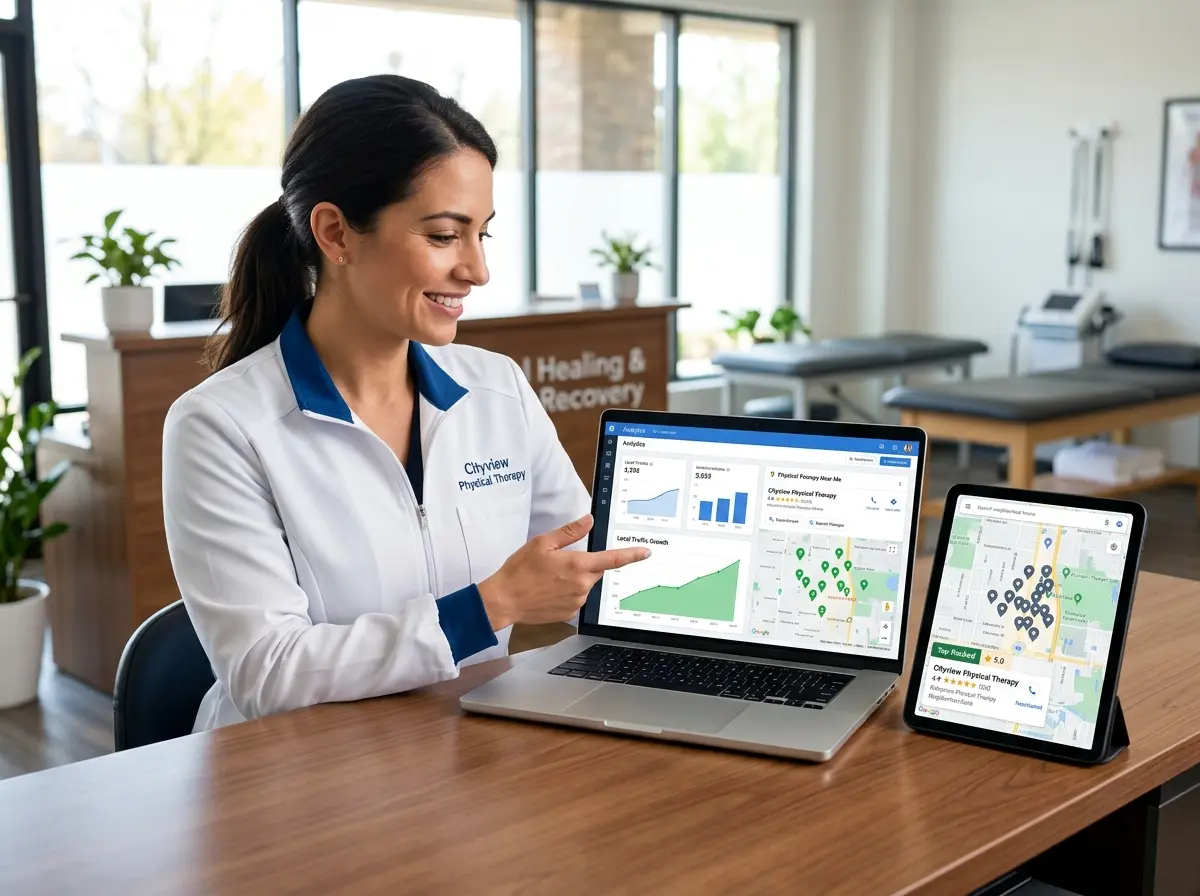
The story of Peak Motion PT isn't exceptional — it's repeatable. Within eight months of implementing this local SEO blueprint, they went from virtually invisible in local search to holding a consistent top-three position in the local map pack for their primary service keywords. New patient bookings increased by over 40%, and they credited the majority of that growth to organic and local search traffic that previously didn't exist.
Here's your action checklist to get started this week:
- Audit your Google Business Profile — fix your NAP, add real photos, update your description, and start posting weekly.
- Clean up your citations — use a tool like BrightLocal or Whitespark to find and fix inconsistencies across directories.
- Build a review generation system — make asking for reviews a standard part of your patient or customer follow-up process.
- Respond to every review — yes, every one. It signals to Google (and to humans) that you're engaged and professional.
- Optimize your website for local search — create a strong location page, add schema markup, and start answering the questions your local customers are searching for.
- Make sure your phone and front desk experience matches the quality of your online presence — all that SEO work means nothing if the experience falls apart at first contact.
Local SEO is not a one-time project. It's an ongoing commitment to showing up — consistently, accurately, and helpfully — in the places where your future customers are already looking for you. The businesses that win in local search aren't always the best ones. They're the ones that bothered to show up properly. Make sure that's you.