Introduction: Because "We Hope You Come Back" Is Not a Retention Strategy
Let's be honest. Most med spas are incredibly good at getting clients through the door for the first time. The marketing is polished, the consultations are warm, and the results speak for themselves. But somewhere between that glowing post-treatment selfie and the six-month anniversary of a client's last visit — things get quiet. Too quiet.
Client retention is the lifeblood of a profitable med spa, and yet most owners are still tracking it the way people tracked calories in 1987: loosely, optimistically, and with a lot of denial. A client retention score built directly into your CRM dashboard changes that. It transforms vague feelings like "I think Mrs. Henderson is still a regular" into hard data, actionable insights, and — most importantly — real revenue protection.
In this post, we'll walk you through how to actually build a client retention score into your med spa's CRM, what metrics to include, and how to use that score to intervene before a client becomes a statistic. No fluff, no vague advice like "just communicate better." Just practical steps you can implement this week.
Building the Foundation: What Goes Into a Client Retention Score
A retention score is only as good as the data feeding it. Before you start assigning numbers and color-coding dashboards, you need to define what "retained" actually means for your med spa — because it's not the same for every business or every service category.
Define Your Retention Baseline First
Start by identifying the expected visit frequency for each of your core services. A Botox client, for example, should realistically be returning every three to four months. A laser hair removal client might complete a package and then return annually for touch-ups. A HydraFacial devotee? Monthly, if you're doing your job right.
Your baseline is the benchmark against which everything else is measured. Once you know how often a client should be visiting for their primary services, you can flag the ones who are falling behind schedule. Without this baseline, your retention score is just a number floating in the void — impressive-looking but useless.
The Core Metrics That Power Your Score
A well-designed retention score typically pulls from four to six weighted data points. Here are the ones that matter most for a med spa environment:
- Days Since Last Visit (DSLV): The most fundamental indicator. A client who visited 45 days ago scores very differently from one who visited 14 months ago.
- Visit Frequency Trend: Are they coming more often, less often, or about the same? A declining trend is an early warning sign even if the client hasn't technically lapsed yet.
- Lifetime Visit Count: A client with 18 visits who suddenly goes quiet is a much higher priority than a one-time visitor who ghosted. Weight accordingly.
- Average Spend Per Visit: High spenders who go quiet deserve a more personalized re-engagement approach. Your CRM should flag them prominently.
- Appointment Cancellation Rate: Clients who cancel frequently are showing you something. A rising cancellation rate often predicts churn before it happens.
- Response to Communications: Do they open your emails? Reply to texts? Engage with your promotions? A client who has gone dark across all channels is a different problem than one who's just overdue for a booking.
Assigning Weights and Building the Composite Score
Not all metrics are created equal. Days since last visit and visit frequency trend should carry the most weight — together, probably 50–60% of the total score. Lifetime visit count and average spend can account for another 25–30%, and communication engagement fills out the rest.
Most CRM platforms that support custom fields and calculated values will allow you to build this as a formula. If your CRM doesn't support calculations natively, you can use a scoring system updated via tags or manual review on a weekly basis — not glamorous, but it works. Assign each client a score from 0 to 100, where 80–100 is "loyal and active," 50–79 is "at risk," and anything below 50 triggers an active re-engagement protocol.
How Stella Fits Into Your Client Management Workflow
Retention scores are only valuable if your CRM is actually being populated with accurate, up-to-date data — and that's where a lot of med spas quietly fall apart. Staff forget to log notes. Intake forms don't get completed. Phone inquiries go unrecorded. Stella, the AI robot employee and phone receptionist, helps close those gaps automatically.
Keeping Your CRM Clean Without Burdening Your Staff
Stella handles conversational intake forms during phone calls and at her in-store kiosk, collecting client information and feeding it directly into the built-in CRM — complete with custom fields, tags, notes, and AI-generated profiles. When a new client calls to ask about a chemical peel or walks up to the kiosk to inquire about membership options, Stella captures that interaction, logs the contact, and ensures nothing falls through the cracks. That means your retention score has cleaner data to work with from day one, without your front desk team needing to remember to type anything in.
Turning Your Retention Score Into Action
A dashboard full of scores is satisfying to look at. Actually using those scores to win back clients and increase lifetime value — that's where the money is. The goal is to build a tiered response system so that every score range triggers a specific, appropriate action without you personally having to remember to follow up with every single client.
Design a Three-Tier Intervention System
Think of your retention score ranges as traffic lights. Green means they're active and happy — your job here is to deepen the relationship through loyalty rewards, early access to new treatments, or membership upsells. Yellow means they're drifting — this is your window to act before they fully disengage. A personalized "we miss you" message, a limited-time offer on a service they've purchased before, or a proactive call from your front desk can often bring them back with minimal effort. Red means they've lapsed and may have moved on — this calls for a more compelling reason to return, such as a meaningful discount, a complimentary add-on, or a personal outreach from a provider they've seen before.
The key is automation. Set up triggers in your CRM so that when a client's score drops into yellow or red territory, a workflow kicks off without anyone having to notice manually. Most modern CRM platforms — including those with custom field and tagging capabilities — can support this kind of rule-based automation.
Measure Reactivation Success and Adjust the Formula
Your retention score formula is not set it and forget it. Every quarter, review how well your score predicted actual churn. If clients are churning while still in the yellow zone, your thresholds may be too lenient. If you're sending re-engagement campaigns to people who were never really gone, your weights may need recalibrating.
Track your reactivation rate — the percentage of lapsed clients who return after receiving an intervention — as a separate KPI alongside your overall retention score distribution. According to industry benchmarks, med spas with structured retention programs see 20–35% higher client lifetime value compared to those relying on passive rebooking reminders alone. That's not a small gap. That's the difference between a practice that grows and one that constantly hustles just to stay flat.
Build Retention Score Visibility Into Your Weekly Rhythm
The final piece is habit. Your retention dashboard needs to be something you or your manager actually looks at on a regular cadence — weekly, not quarterly. Dedicate five minutes every Monday morning to reviewing how many clients have dropped score tiers since the previous week, which re-engagement workflows were triggered, and whether any high-value clients need personal outreach. Small, consistent attention prevents the large, expensive crisis of realizing your top 20 clients have all quietly moved on to the spa down the street.
Quick Reminder About Stella
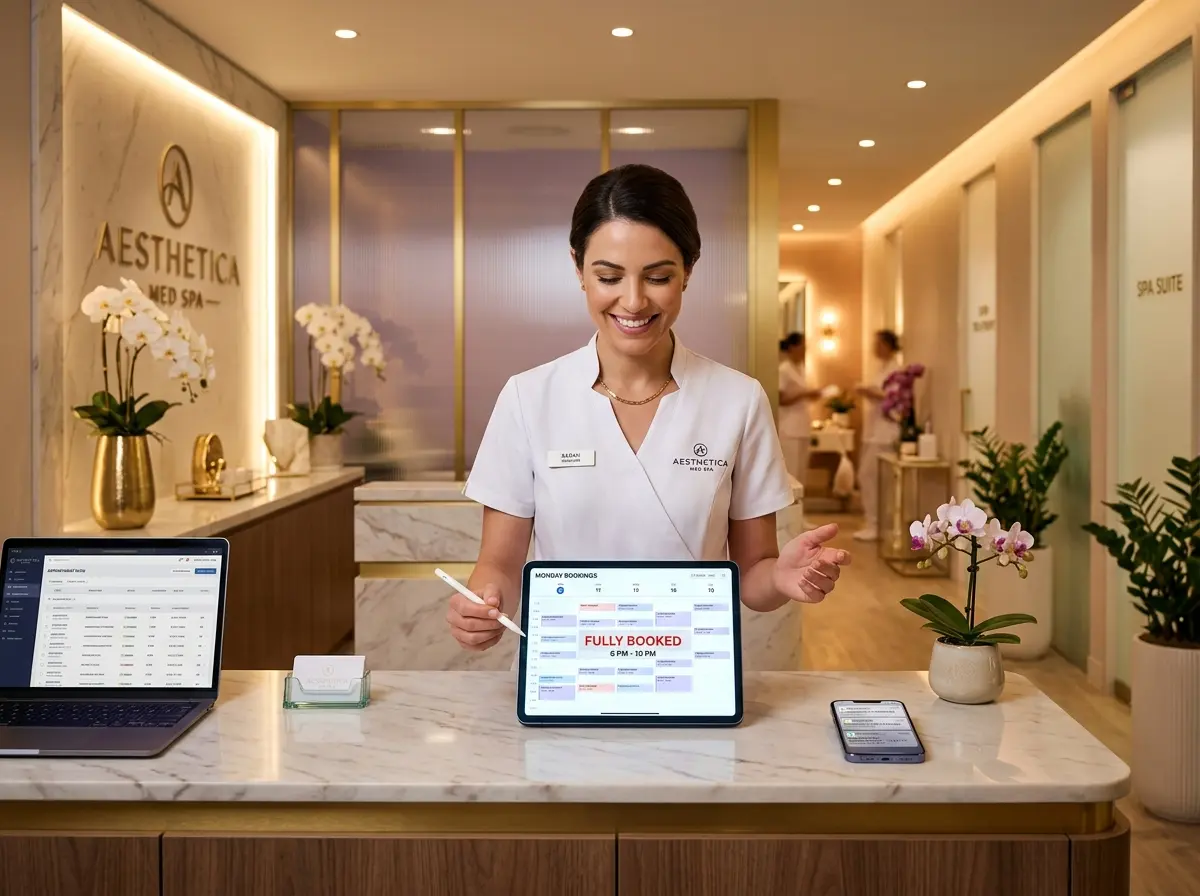
Stella is an AI robot employee and phone receptionist built to help businesses like med spas run more smoothly — greeting clients at her in-store kiosk, answering calls 24/7, collecting intake information, and keeping your CRM populated with the data you actually need. She's available for just $99/month with no upfront hardware costs, so the barrier to getting started is refreshingly low. If clean CRM data and consistent client communication have been the weak links in your retention strategy, Stella is worth a serious look.
Conclusion: Stop Hoping and Start Scoring
Building a client retention score into your med spa's CRM dashboard is not a complicated technical project — it's a decision to stop guessing and start measuring. Once you define your retention baseline, select your weighted metrics, and build a tiered intervention system, you'll have something most med spas don't: a real-time, objective view of client health across your entire book of business.
Here are your immediate next steps:
- Audit your current CRM to confirm which data fields are being consistently populated. If key fields are empty or inconsistent, fix the intake process first.
- Define visit frequency benchmarks for your top five services. These become the backbone of your retention formula.
- Build or configure your scoring formula using the metric weights outlined above, and assign a score to every active client in your database.
- Set up automated workflows so that score drops trigger specific outreach actions without manual monitoring.
- Review the dashboard weekly and treat retention score trends as a leading indicator — not a lagging one.
Your clients didn't stop caring about looking and feeling their best. They just stopped being reminded that you're the one who helps them do it. A retention score gives you the visibility to change that — one timely, personalized touchpoint at a time.